Introduction
A cluttered car can make everyday driving feel more stressful than it should. Loose water bottles, charging cables, receipts, snacks, sunglasses, kids’ items, and gym gear quickly turn a neat interior into a frustrating mess. The good news is that the right car organizer can make a big difference without requiring a major budget or a full interior makeover.
When people search for the best car organizers, they are usually looking for a simple way to keep important items within reach, reduce clutter, and make the cabin easier to clean and use. The challenge is that not every organizer works well for every vehicle or lifestyle. A compact sedan, a family SUV, a rideshare vehicle, and a work truck all need different kinds of storage solutions.
This guide explains the main types of car organizers, what features matter most, and how to choose practical options based on how you actually use your vehicle. Whether you want to tidy the center console, prevent backseat chaos, or create better storage in the trunk, the right organizer can help make your car feel more functional and more comfortable.
Why car organizers matter
Car organizers are useful because they help turn unused or awkward spaces into practical storage. More importantly, they help keep essential items from sliding around while driving. That means fewer distractions, less clutter, and a more controlled environment inside the vehicle.
A well-chosen organizer can improve everyday convenience in several ways:
- It keeps frequently used items easy to find. This is especially helpful for phones, tissues, chargers, parking cards, and drinks.
- It reduces loose clutter. Small items are less likely to end up under seats or scattered across the cabin.
- It makes cleaning easier. When items have a dedicated place, wiping down the interior is simpler.
- It helps different passengers stay organized. Families, commuters, and road-trippers often need separate spaces for different items.
- It can make the vehicle feel more spacious. Even a small organizer can create a more orderly feel inside the car.
For many drivers, a car organizer is less about adding storage for its own sake and more about improving how the space works day to day.
Main types of car organizers
The best car organizer depends on where you need storage most. Different categories solve different problems, so it helps to think about your usual clutter points before buying anything.
Seat-back organizers
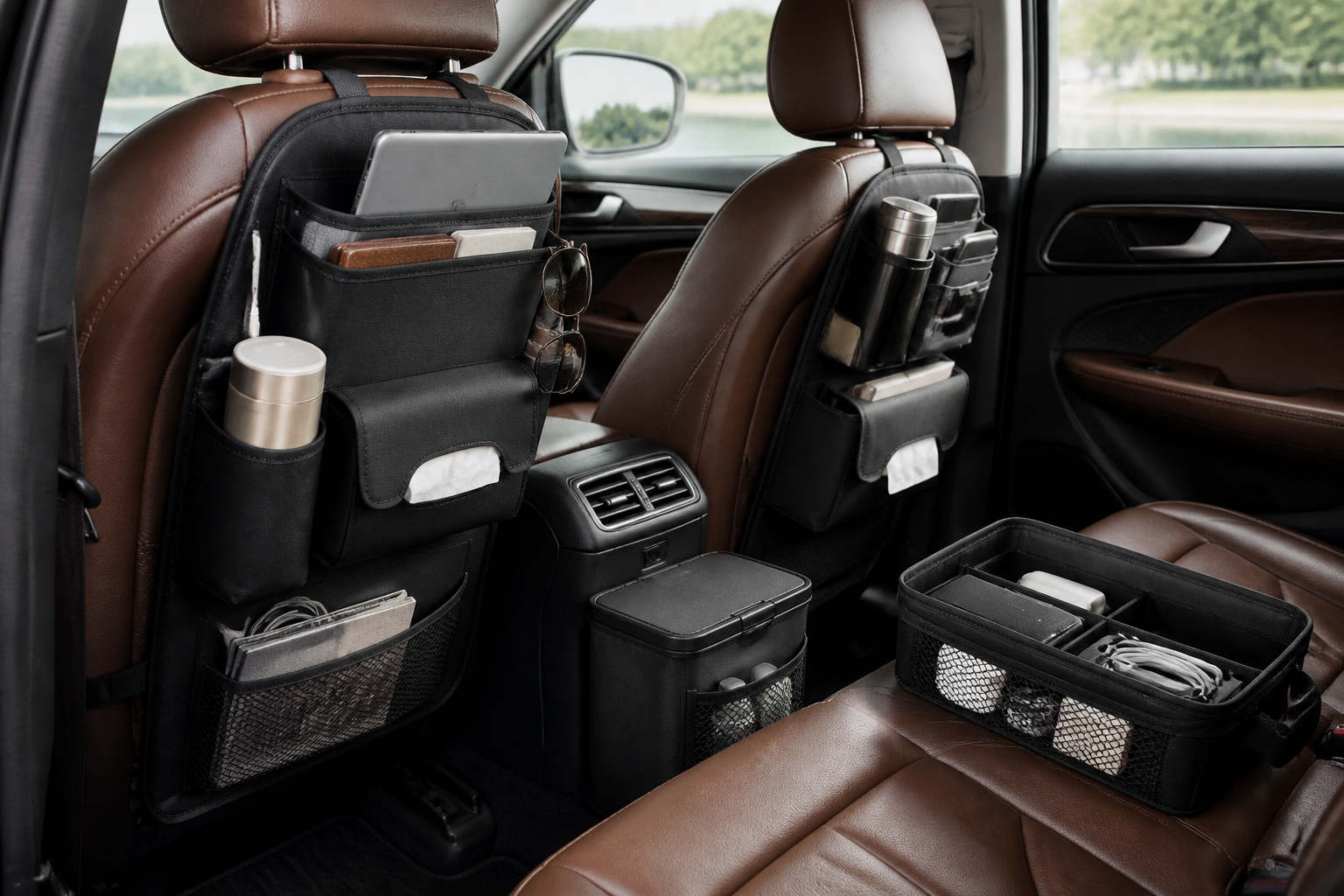
Seat-back organizers hang from the back of the front seats and are popular with families, commuters, and rideshare drivers. They often include pockets for tablets, books, drinks, snacks, tissues, and small travel items.
These are especially useful if you carry passengers frequently or need a way to keep rear-seat items off the floor. Some versions are slim and simple, while others have many compartments for long trips.
Best for: families, rear-seat passengers, road trips, and keeping kids’ items in one place.
Trunk organizers
Trunk organizers help prevent groceries, emergency supplies, tools, and sports gear from rolling around in the cargo area. Many use divided compartments to separate items and keep bags upright.
They are often one of the most practical upgrades for drivers who use the trunk for errands or work. Foldable models are especially convenient because they can be collapsed when not needed.
Best for: grocery runs, emergency kits, cleaning supplies, and everyday cargo management.
Center console and seat-gap organizers
These organizers solve a common problem: small items falling into hard-to-reach gaps. A console organizer may create better internal division inside a center console, while a seat-gap filler organizer can stop phones, cards, and change from disappearing beside the seats.
If you regularly lose items between the seat and console, this category may be one of the simplest and most satisfying solutions.
Best for: phones, cards, keys, coins, and frequent drivers who want quick access.
Visor organizers
Visor organizers attach to the sun visor and usually hold paperwork, parking passes, pens, sunglasses, or small flat items. They work best for drivers who want lightweight storage for documents and tools that must be kept close at hand.
Because visor space is limited, these organizers should be used for slim, lightweight items rather than bulky gear.
Best for: documents, parking items, registration papers, and compact daily essentials.
Door-pocket and seat-side organizers
Some organizers are designed to improve the use of door pockets or seat-side spaces. These can be useful when your vehicle has deep but awkward storage areas that allow items to slide around or tip over.
They are often overlooked, but they can help bring order to spots that would otherwise be wasted.
Best for: water bottles, umbrellas, tissues, gloves, and compact tools.
What to look for when choosing a car organizer
There is no single “best” car organizer for everyone. The right choice depends on how you drive, what you carry, and where your clutter tends to collect. The following features are worth comparing before you buy.
Fit and size
Measure the area where the organizer will go. This is especially important for trunk organizers, console inserts, and seat-gap products. A model that looks useful online may take up too much room or sit awkwardly in your vehicle.
Pay attention to dimensions, depth, and mounting style. A good organizer should fit securely without interfering with seat movement, buckles, armrests, or access to controls.
Storage layout
The most useful organizer is not always the one with the most compartments. Think about the kinds of items you actually carry. For example, if you mainly want a place for cables and small accessories, a simple pocket layout may be more practical than a large multi-pocket design.
Useful layouts often include:
- Open compartments for larger items
- Mesh or elastic pockets for flexible storage
- Dividers for separating groceries or gear
- Zippered sections for items you want to keep contained
- Dedicated slots for phones, tablets, sunglasses, or paperwork
Ease of installation
Many car organizers are designed to install quickly, but some require more adjustment than others. Check whether the organizer uses straps, hooks, buckles, adhesive, or rigid inserts. Simpler installation usually means easier removal and cleaning later.
If you switch vehicles often or want a temporary solution, look for organizers that are easy to move without leaving marks or residue.
Material and durability
The best material depends on how the organizer will be used. Fabric organizers are often lightweight and flexible. Rigid or semi-rigid organizers may hold their shape better, especially in the trunk. Wipeable surfaces can be useful if you expect spills or dirt.
Durability matters most if you carry heavy items, use the organizer daily, or store it in a space with frequent movement. Stitching, seams, zippers, handles, and attachment points are worth checking closely.
Accessibility
A good organizer should make your items easier to reach, not harder. If you have to remove several things just to get to one item, the design may be too complicated for daily use.
For fast access, look for features like:
- Wide openings
- Clearly separated pockets
- Simple grab handles
- Well-placed lid or flap closures
- Easy visibility of stored items
Stability while driving
Storage should stay put when you brake, turn, or accelerate. This matters most for trunk organizers and seat-gap fillers. If the item shifts constantly, it can create clutter rather than reduce it.
Non-slip bases, strong straps, and secure fastening methods can help keep everything in place.
Cleaning and maintenance
Because car interiors collect dust, crumbs, and spills, organizer maintenance matters. Choose materials that are easy to wipe clean or remove for washing when appropriate.
If you carry snacks, sports gear, or children’s items, a surface that handles frequent cleaning may be more practical than a decorative design with many delicate details.
How to choose the right organizer for your needs
The most practical way to shop is to match the organizer to the problem you want to solve. Here are a few common buyer types and what tends to work well for each.
For daily commuters
Commuters often need a place for phone accessories, sunglasses, chargers, work badges, parking passes, and drinks. A center console organizer, visor organizer, or seat-gap filler may be enough to create a much neater cabin.
If your commute includes coffee runs or multiple stops, choose a design that gives you easy access without requiring a full search through the car.
For families
Families usually benefit from organizers that create structure in the back seat and trunk. Seat-back organizers are useful for tablets, snacks, wipes, and travel toys. Trunk organizers can hold grocery bags, sports equipment, and emergency supplies.
When buying for family use, look for easy-to-clean surfaces and pockets that make sense for everyday needs rather than just visual organization.
For road-trippers
Long trips require a mix of storage types. A seat-back organizer can help rear passengers stay comfortable, while a trunk organizer can hold supplies and extras. Consider organizers with strong compartments, easy access, and enough flexibility to handle changing loads.
Road-trip storage should support convenience, not just appearance. If you can reach snacks, chargers, and documents without unpacking the entire vehicle, the organizer is doing its job well.
For work vehicles and service drivers
Drivers who transport tools, paperwork, or supplies often need sturdier storage than the average commuter. Trunk organizers, cargo bins, and seat-side storage solutions can help separate tools from personal items.
In this case, practical details matter more than style. Look for a layout that keeps equipment sorted and easy to access during a busy day.
For rideshare or taxi-style use
Drivers who carry passengers often benefit from clean seat-back organization and easy access to small essentials. The goal is to create a neat, professional-feeling cabin with clearly separated storage.
Simple, low-profile organizers usually work better than bulky options that might interfere with passenger comfort.
Common buying mistakes to avoid
Car organizers can be helpful, but only if you choose them wisely. A few common mistakes can lead to wasted money or an organizer that does not actually improve the car interior.
- Buying based only on compartment count. More pockets do not always mean better organization.
- Ignoring fit. A product that is too large or poorly shaped can be inconvenient in a real vehicle.
- Choosing style over usability. An attractive organizer is less helpful if it is hard to clean or access.
- Overloading small organizers. Not every organizer is meant to carry heavy items or lots of bulk.
- Forgetting maintenance. Dirt, crumbs, and spilled liquids can build up quickly if the organizer is hard to clean.
- Using the wrong organizer for the job. A visor organizer will not solve trunk clutter, and a trunk organizer will not help with loose items in the center console.
Practical tips for keeping your car organized
Even the best car organizer works better when used with a simple system. The goal is not just to store items, but to prevent new clutter from building up again.
- Assign a place for common items. Keep the same items in the same storage zone whenever possible.
- Declutter regularly. Remove receipts, wrappers, and unused items before they accumulate.
- Limit duplicate supplies. Extra chargers, pens, or snacks can create unnecessary clutter.
- Use organizers for categories, not everything. A few clear categories are easier to manage than too many tiny compartments.
- Store seasonal items separately. Keep winter gear, emergency items, or road-trip supplies in dedicated sections when needed.
- Recheck the setup after a week or two. If some pockets are always empty and others are overflowing, adjust the layout.
A thoughtful setup often works better than trying to fill every compartment. The most effective system is usually the one that matches your habits.
Frequently asked questions
What is the best type of car organizer for most drivers?
There is no single best option for everyone, but many drivers find that a trunk organizer or center console organizer provides the most everyday value. The right choice depends on whether your main problem is cargo clutter, small-item storage, or backseat organization.
Are seat-back organizers worth it?
They can be very useful if you travel with passengers, children, or road-trip supplies. They are especially helpful when you want to keep the back seat tidy and make items easier to reach from the rear.
Do car organizers help with small cars?
Yes. In smaller vehicles, good organization can make the interior feel less crowded. Compact products such as seat-gap fillers, visor organizers, and slim console inserts are often a strong fit for limited space.
Should I choose a hard-shell or soft organizer?
Hard-shell or semi-rigid organizers often hold their shape better, especially in trunk use. Soft organizers can be more flexible and easier to fold away. The better choice depends on whether you want structure or portability.
How do I keep a trunk organizer from sliding around?
Look for a model with a non-slip base, anchor straps, or a design that fits snugly into the trunk. A secure fit is important if you want to keep items stable during daily driving.
Can one organizer solve all interior clutter?
Usually not. Many vehicles benefit from a combination of organizers. For example, a trunk organizer may handle cargo while a small seat-gap organizer manages loose everyday items. Choosing the right mix often works better than relying on one product alone.
Conclusion
The best car organizers are the ones that solve a real storage problem in a way that fits your vehicle and your routine. Whether you need to control trunk clutter, keep backseat items in order, or stop small items from sliding into hard-to-reach places, there is likely an organizer designed for that purpose.
When comparing options, focus on fit, storage layout, ease of cleaning, and how securely the organizer stays in place. Think about the items you use most often and the spots in your car that tend to collect mess. That approach will help you choose a practical solution that makes your interior cleaner, easier to use, and more comfortable every day.
For shoppers who want a tidier cabin without unnecessary complexity, a well-chosen car organizer is one of the simplest upgrades to consider.