Introduction
Food storage containers seem simple until you start comparing them. Some are better for leftovers, others are designed for pantry staples, and a few are made to handle freezer storage or meal prep. The best choice depends on how you plan to use them, how often you will open and close them, and what foods you want to store.
If you are shopping for the best food storage containers, the goal is not to find a single perfect product for every kitchen. Instead, it is to choose containers that match your routine, storage space, and the types of food you keep on hand. A thoughtful purchase can help reduce spills, keep ingredients organized, and make everyday cooking more convenient.
This guide explains what to look for before buying, which features matter most, and how to avoid common mistakes. Whether you need containers for dry ingredients, meal prep, leftovers, or freezer meals, the right set should feel practical from the first use.
Why food storage container choice matters
Food storage containers affect much more than kitchen organization. They can influence how easy it is to portion meals, how neatly you can store leftovers, and how well ingredients stay separated and accessible. A good container should fit your storage habits instead of forcing you to adapt your routine around it.
For example, a set that stacks neatly may be ideal for a crowded cabinet. A leak-resistant design may matter more if you transport lunches or soups. Glass may work well for reheating, while lightweight plastic may be easier for daily grab-and-go use. Thinking about the main purpose before shopping helps you narrow the options quickly.
Material: glass, plastic, silicone, and stainless steel
Material is usually the first feature to consider because it influences durability, weight, visibility, and food-use flexibility. Each material has trade-offs, and the right one depends on your priorities.
Glass containers
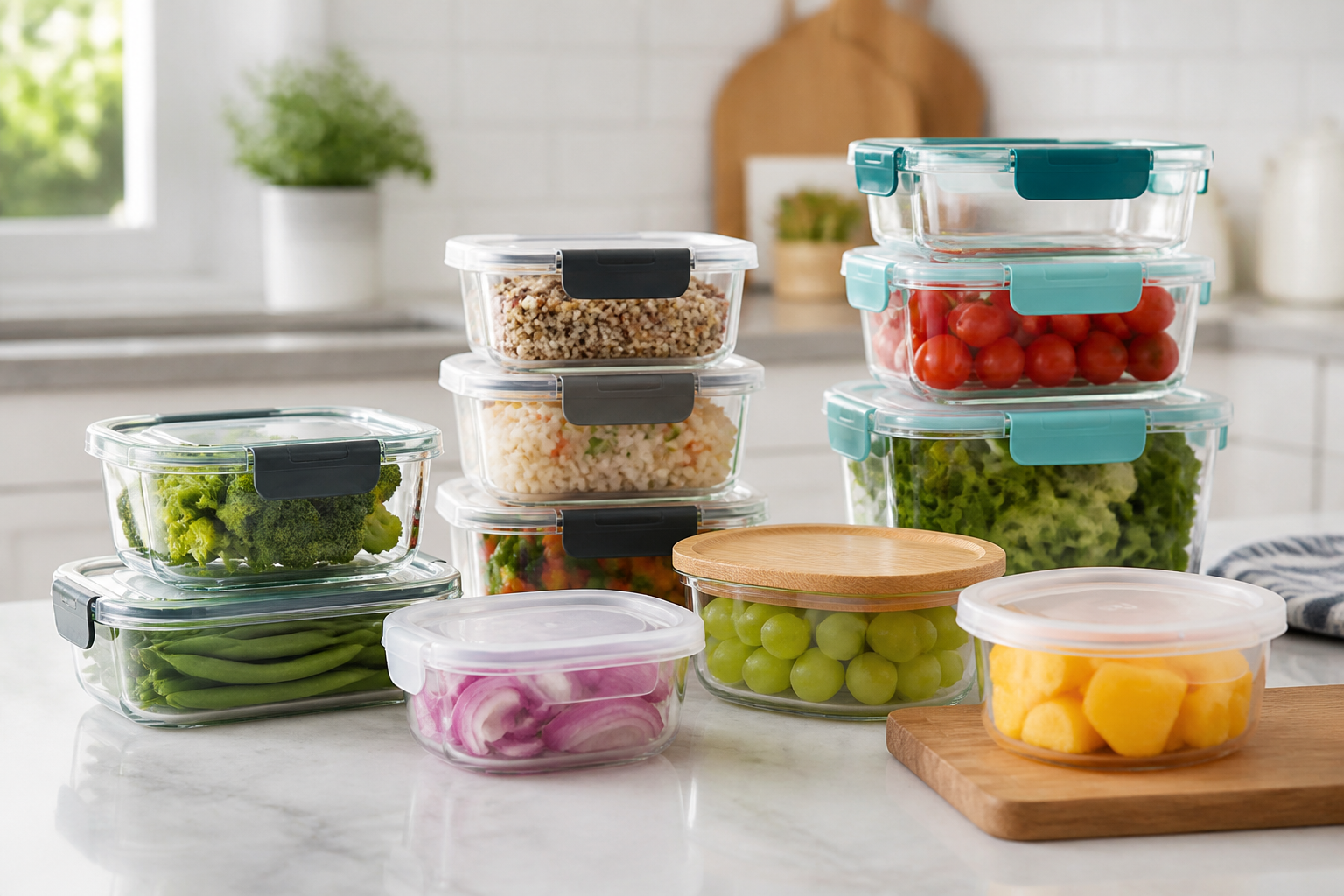
Glass containers are often appreciated for their sturdy feel and clear visibility. They allow you to see the contents at a glance, which can make leftovers and meal prep easier to manage. Glass is also a common choice for people who want containers that can move from storage to table without looking out of place.
However, glass is heavier than plastic and can be more fragile if dropped. It may also take up more space in a bag if you plan to carry meals to work or school. If you prefer durability in a lightweight form, glass may not be the most convenient option for everyday transport.
Plastic containers
Plastic food containers are widely used because they are lightweight, practical, and often budget-friendly. They can be a good fit for packed lunches, snacks, and general refrigerator storage. Many plastic sets also nest together well, which can help save cabinet space.
When comparing plastic containers, pay attention to build quality, lid fit, and whether the set is designed for repeated use. Not all plastic containers perform the same way over time, and the lid is often the part that determines long-term convenience. A flimsy lid or a container that warps easily can become frustrating quickly.
Silicone containers
Silicone containers can be useful for people who want flexible storage options or products that compress more easily when empty. Some designs fold down for space-saving storage, which can be helpful in small kitchens, travel kits, or lunch bags.
Before buying, check how the container stands upright, how well the lid seals, and whether the shape works for the foods you typically store. Flexible materials can be convenient, but they may not suit every purpose equally well.
Stainless steel containers
Stainless steel containers are often chosen for dry foods or portable meals because they are lightweight relative to glass and usually durable. They can be a practical option for packed lunches and storage where visibility is less important than toughness.
One limitation is that you cannot see inside without opening the container. That means labels or memory-based organization may become more important. If visual access matters to you, stainless steel may be less convenient for pantry use.
Lids and sealing performance
The lid matters as much as the container body, and sometimes more. A well-fitting lid helps reduce spills, keep foods contained, and improve confidence when storing liquids or carrying meals. When comparing options, examine how the lid closes and how consistently it appears to seal.
Snap lids, locking lids, and screw-top lids
Snap lids are common and can be quick to use. Locking lids may provide a more secure closure, especially for food that may shift during transport. Screw-top lids are less common in standard kitchen sets but can be useful for certain items that need a tighter closure style.
The best lid style depends on how often you will open the container. If you plan to access the contents several times a day, a simple, easy-to-remove lid may be more convenient. If you plan to carry soups or sauces, a more secure closure is usually worth considering.
Leak resistance versus airtight storage
Leak-resistant and airtight are not always the same thing. A container may be suitable for reducing spills but not fully airtight, while another may be better suited to keeping air out of dry goods. Understanding the difference helps you avoid buying the wrong type for the job.
For liquids, look for containers described as leak-resistant and designed for transport. For pantry staples like rice, flour, coffee, or cereal, airtight performance is usually more useful because it helps maintain freshness and reduce exposure to air.
Size, shape, and capacity
Container size should reflect what you actually store. Buying a set with too many tiny containers or too many oversized ones can lead to clutter instead of organization. The most practical sets usually include a useful mix of sizes.
Choosing the right capacity
Small containers are useful for sauces, dressings, snacks, chopped ingredients, and side portions. Medium containers often work well for leftovers and lunch portions. Larger containers may be better for family meals, bulk ingredients, or pantry items.
It helps to think in terms of your own habits. If you mainly store sauces and leftovers, a set with many large containers may not be efficient. If you prep meals for several days at once, very small containers may not be enough.
Round, square, and rectangular shapes
Shape matters because it affects storage efficiency and ease of use. Rectangular and square containers often stack more neatly and can use cabinet or refrigerator space more efficiently. Round containers can be helpful for soups, salads, and foods that are easier to portion into circular shapes.
If you are trying to maximize shelf space, square or rectangular designs are usually easier to arrange. If you want easy scooping or serving, round containers may feel more natural for some foods.
Stackability and storage efficiency
Good food storage containers should help organize your kitchen, not create more clutter. Stackable designs can make a big difference in a small pantry, refrigerator, or drawer. Look for containers that nest together when empty and stack securely when full.
Also consider whether the lids and bases can be stored together without becoming a jumble. Some sets are designed so each lid matches one container size, which can reduce confusion. Clear labeling or a consistent shape system can make daily use much easier.
If space is limited, avoid buying containers in too many unusual shapes. A smaller group of compatible sizes is often more practical than a large mixed set that does not store efficiently.
Ease of cleaning and maintenance
Cleaning convenience can determine whether a container set becomes a kitchen staple or ends up forgotten in the back of a cabinet. Look for designs with smooth surfaces, minimal corners, and simple lid structures that are easy to wash thoroughly.
Dishwasher-safe options
Many shoppers prefer dishwasher-safe containers because they reduce daily cleanup time. If that matters to you, check the product details carefully and note whether both the container and the lid are dishwasher-safe. In some cases, only the body or only certain parts can handle machine washing.
Even when something is dishwasher-safe, hand washing may still help extend the life of certain lids or seals. If you expect frequent use, choosing a design that is simple to clean by hand can also be worthwhile.
Stains, odors, and residue
Some foods, especially tomato-based sauces, curries, and strongly seasoned dishes, can leave stains or odors in certain materials. This does not make a container bad, but it is worth considering if you regularly store flavorful or colorful foods.
If appearance matters to you over time, glass may be easier to keep looking clean. For plastic containers, a smooth inner surface can sometimes be easier to maintain than textured or deeply grooved interiors.
Microwave, freezer, and oven compatibility
Not every food container is designed for every temperature range. Before buying, check where and how you plan to use the containers most often. A set that is ideal for pantry storage may not be suitable for reheating meals or freezing prepared dishes.
Microwave use
If you want to reheat leftovers in the same container, confirm that it is microwave-safe. Also check whether the lid is microwave-safe or whether it needs to be removed first. Some lids are designed to rest loosely on top during reheating rather than seal tightly.
For anyone who regularly eats at work or prepares meals in advance, microwave compatibility can be a major convenience feature.
Freezer use
Freezer-safe containers should be able to handle lower temperatures without cracking, warping, or losing their seal. This is important if you store soups, sauces, meal portions, or seasonal ingredients for later use. Containers used in the freezer should also leave some room for expansion where appropriate, depending on the food.
If freezer storage is a priority, choose containers with sturdy lids and a shape that stacks well when frozen. A set that slides neatly into freezer drawers can save a lot of time.
Oven use
Some glass containers may be oven-safe, but this should never be assumed. If you want a container that goes from storage to oven, confirm the temperature limits and any restrictions on lid use. Oven compatibility is valuable, but it should be verified carefully before purchase.
Visibility, labeling, and organization
Clear containers can make it easier to see what you have before opening anything. This is especially helpful in busy kitchens, shared households, or pantries with many ingredients. If quick identification matters to you, transparency may be one of the most useful features to prioritize.
Opaque containers can still work well, especially if you prefer a uniform look or use labels consistently. In that case, consider whether the container surface accepts labels easily and whether the shape leaves room for handwriting or printed tags.
Good organization is often a matter of consistency. A matching set in a few well-chosen sizes can be easier to manage than a drawer full of random containers from different brands and eras.
What type of user each container style may suit
Different shoppers have different priorities, so the best food storage containers are not the same for everyone.
- Meal prep users: May prefer stackable, microwave-safe containers with secure lids and consistent portion sizes.
- Families: May benefit from a mix of medium and large containers that can handle leftovers, snacks, and batch-cooked meals.
- Small-space households: Often do well with nestable designs and matching lids that store efficiently.
- Lunch packers: May want lightweight, leak-resistant containers that are easy to carry.
- Pantry organizers: Often need airtight, clear containers with label-friendly surfaces and efficient shapes.
- Freezer planners: May prioritize durable materials, strong seals, and freezer-safe construction.
Common buying mistakes to avoid
One of the most common mistakes is buying a large set based on quantity rather than usefulness. Many sets look attractive because they include many pieces, but if the sizes do not match your actual needs, they may end up unused.
Another mistake is ignoring the lid design. A container with a strong base but a poor lid can be inconvenient, messy, or short-lived. It is often wiser to pay attention to closure quality than to focus only on appearance.
Shoppers also sometimes overlook storage space. A tall stack of mismatched containers can become harder to manage than a smaller set that fits neatly into a drawer or cabinet. Measure available space if you are organizing a compact kitchen.
Finally, do not assume one container type will solve every need. Many kitchens work best with a small combination of container styles rather than one universal set.
Practical tips before you buy
If possible, take a quick inventory of how you cook and store food. List the items you use most often, such as leftovers, chopped produce, lunch portions, sauces, or dry pantry goods. That simple step can make size and material choices much easier.
It also helps to think about whether you want a matching set or a mix-and-match system. Matching sets look tidy and are easier to organize, while mixed containers can be more flexible for specific uses.
When comparing product listings, look closely at the details for lid fit, temperature range, and care instructions. The most useful information is often found in the fine print, not the product photos.
Finally, remember that a practical food storage system is built over time. You do not need the biggest set or the most specialized option. You need containers that match your routine, fit your space, and make food storage simpler rather than more complicated.
Frequently Asked Questions
What is the best material for food storage containers?
The best material depends on how you plan to use the container. Glass is often valued for visibility and sturdiness, plastic for light weight and convenience, silicone for flexibility, and stainless steel for durability and portability. The right choice depends on whether you prioritize reheating, transport, pantry organization, or freezer use.
Are airtight containers better than leak-resistant containers?
Not necessarily, because they serve slightly different needs. Airtight containers are especially useful for dry goods and freshness retention, while leak-resistant containers are more important for liquids or meals that may move around during transport. Some products aim to do both, but you should still check the design carefully.
Should I buy a set or individual containers?
A set can be a good value if the sizes fit your routine and the pieces stack well. Individual containers can be better if you already know exactly what sizes or materials you need. Many people find that a small, targeted set plus a few individual pieces is the most practical approach.
Can one food storage container set handle all kitchen needs?
Sometimes, but not always. A single set may work reasonably well for leftovers, lunches, and some pantry items, but freezer storage, dry goods, and liquid transport often benefit from different design features. It is normal to use more than one style of container in a well-organized kitchen.
What should I look for if I have limited cabinet space?
Prioritize stackability, nesting, and a limited number of compatible sizes. A compact set with efficient storage design is usually better than many unique shapes. Clear or labeled containers can also make it easier to manage a smaller collection.
Conclusion
Choosing the best food storage containers is mostly about matching features to real-life use. Material, lid quality, size, shape, stackability, cleaning ease, and temperature compatibility all matter, but not equally for every shopper. A container that is perfect for pantry organization may not be ideal for lunches, and a great freezer container may not be the best choice for quick reheating.
Before buying, focus on your daily habits, the kinds of food you store most often, and the space you have available. If you choose a set with the right mix of practical features, your containers can make cooking, storing, and organizing food noticeably easier. For many households, that is the real value of a well-chosen container set: less clutter, fewer spills, and a smoother kitchen routine.