Introduction
If you are new to cooking at home, it is easy to feel like you need a fully stocked kitchen before you can make anything worthwhile. In reality, beginner home cooks usually do better with a small set of versatile, easy-to-use kitchen accessories than with a drawer full of gadgets. The best kitchen accessories for beginner home cooks are the ones that help with everyday tasks, reduce frustration, and support simple meals you can repeat confidently.
This guide focuses on practical kitchen accessories that are useful for real beginners. It explains what each item does, why it matters, what features to look for, and which mistakes to avoid when buying. The goal is not to fill your kitchen with extras. The goal is to help you choose a sensible starter set that supports cooking basics like chopping vegetables, measuring ingredients, stirring sauces, draining pasta, and storing leftovers.
Whether you are setting up your first apartment, learning to cook after years of takeout, or refreshing a kitchen that has very few tools, this buying guide will help you make better choices.
What beginner home cooks actually need
One of the most common mistakes new cooks make is buying too many specialized tools too quickly. A garlic press, avocado slicer, pizza scissors, egg separator, and a dozen other gadgets may seem helpful, but many beginners do not need them. A better approach is to start with accessories that are useful across many recipes.
For most beginners, the most valuable kitchen accessories are the ones that support these tasks:
- Measuring ingredients accurately
- Chopping and prepping food safely
- Mixing and stirring without damaging cookware
- Handling hot items with confidence
- Keeping the kitchen organized and clean
- Storing food properly after cooking
If an accessory only solves one narrow problem, it may be less useful than a simpler tool that can do several things. That is especially true when you are still building confidence in the kitchen and learning what you cook most often.
Essential kitchen accessories for beginner home cooks
1. Measuring cups and measuring spoons
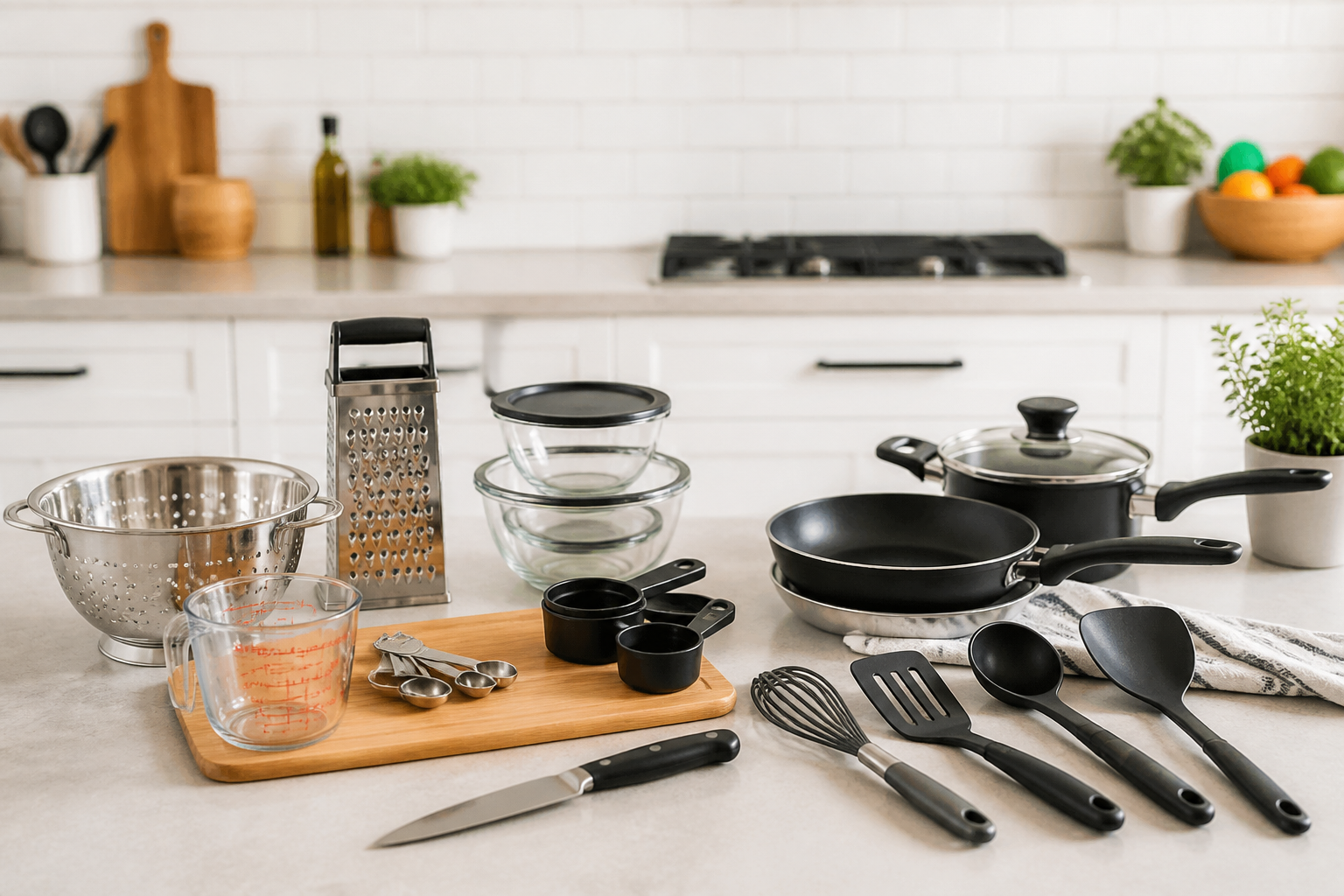
Measuring cups and spoons are among the most important starter tools for beginners because many recipes rely on accurate amounts. Even when you eventually cook by feel, measurements are helpful while you are learning. They are especially useful for baking, sauces, dressings, and seasoning.
Look for a set that includes both dry measuring cups and measuring spoons. Nested sets save space and are usually easier to store. Some beginners also prefer clearly marked handles and cups that feel sturdy enough not to bend during use.
Why they matter:
- Help you follow recipes more reliably
- Reduce waste from guessing amounts
- Make it easier to repeat successful meals
2. A good chef’s knife and a cutting board
Although a knife is not always thought of as an accessory, it is one of the most important tools for beginner home cooks. A sharp, comfortable chef’s knife can make chopping vegetables, herbs, and proteins easier and safer than struggling with a dull blade. Pair it with a stable cutting board and you have the foundation for most meal preparation.
For beginners, a mid-sized chef’s knife is often more manageable than collecting several specialty knives. Choose a knife that feels balanced in your hand and is easy to hold securely. A cutting board with enough surface area to work comfortably is also important.
When choosing a cutting board, consider these points:
- It should stay in place while you cut
- It should offer enough room for basic prep work
- It should be easy to clean after use
Some home cooks keep more than one board: one for produce and another for raw meat, if they cook those foods separately. Beginners may want to start with one or two simple, easy-to-clean boards.
3. Mixing bowls
Mixing bowls are extremely useful for tossing salads, combining ingredients, marinating foods, whisking dressings, and holding prepped items before cooking. A small set of nesting bowls gives you flexibility without taking up much storage space.
When shopping, think about material and shape. Lightweight bowls are easier to handle, while heavier bowls may feel more stable. A set with multiple sizes is ideal because beginners often need a small bowl for sauce, a medium bowl for mixing, and a large bowl for batter or salad.
Helpful features include:
- Non-slip bases or stable bottoms
- Stackable storage
- Easy-to-clean surfaces
4. Spatulas, wooden spoons, and turners
A beginner kitchen benefits from a few basic stirring and flipping tools. Silicone spatulas, wooden spoons, and a sturdy turner or slotted spatula can cover many everyday cooking tasks. These tools help you stir soups, scramble eggs, mix batters, and flip foods in a pan.
Silicone tools are often popular because they are flexible, easy to clean, and gentle on cookware. Wooden spoons are simple, comfortable, and useful for stirring thicker mixtures. A turner helps when you need to flip pancakes, burgers, or sautéed vegetables.
For beginners, a small set is usually enough. You do not need every style at once. The key is to choose tools that feel comfortable and are appropriate for your most common pans and pots.
5. Tongs
Tongs are versatile and easy for beginner cooks to use once they get used to them. They help you turn food in a pan, move items on a tray, toss salads, and handle hot ingredients without relying on a fork or spoon. A simple pair of kitchen tongs can replace several other tools during basic cooking.
Look for tongs that open and close smoothly and have a comfortable grip. A locking mechanism can help with storage. Some beginners prefer silicone-tipped tongs because they are gentler on nonstick surfaces, while others like all-metal versions for sturdiness.
6. A colander or strainer
For draining pasta, rinsing vegetables, washing fruit, or straining canned beans, a colander is a basic kitchen accessory worth owning. It is one of those items that may seem unnecessary until you need it repeatedly.
Consider the size of your sink and your common cooking habits. A medium-size colander is often enough for a beginner, but some kitchens benefit from a smaller strainer as well. If storage space is limited, choose a model that nests or stacks well.
7. Can opener
A reliable can opener is a practical purchase for beginner home cooks who use canned beans, tomatoes, tuna, or vegetables. It is a small item, but a poorly designed opener can become frustrating very quickly. A smooth, easy-turn model is usually more beginner-friendly than a flimsy one.
If you buy one, look for a handle that is easy to grip and a mechanism that feels stable. Some people prefer manual openers for simplicity, while others choose electric models if they want a more effortless option. For most beginners, a straightforward manual opener is enough.
8. Peeler and kitchen shears
A vegetable peeler helps with carrots, potatoes, cucumbers, and other produce that needs quick trimming or skin removal. Kitchen shears are useful for cutting herbs, trimming packaging, portioning some foods, and handling everyday prep tasks. Together, they save time and reduce the need to use a knife for everything.
Choose a peeler that feels secure in your hand and a pair of shears that open and close smoothly. Kitchen shears should be easy to clean, especially if you use them often for food prep.
9. Oven mitts or heat-resistant pot holders
Handling hot trays, pans, and baking dishes is part of home cooking, even for beginners. Oven mitts or heat-resistant pot holders help protect your hands when you remove food from the oven or move hot cookware. This is a category where comfort and coverage matter more than style.
When evaluating these accessories, pay attention to fit, grip, and length. Some mitts offer better forearm coverage than others, which can be helpful when reaching into the oven. Pot holders can work well for smaller tasks, but mitts often feel easier for new cooks handling heavier dishes.
10. Food storage containers
Food storage containers help beginners save leftovers, prep ingredients ahead of time, and reduce food waste. If you are learning to cook, you may find it useful to store extra portions for future meals. Clear, stackable containers make it easier to see what you have in the fridge.
Look for containers with secure lids and sizes that fit your routine. A mixed set is often more useful than only large or only small containers. If you plan to reheat meals, check that the containers are suitable for your intended use. The best choice is the one that makes leftovers easier to manage, not more complicated.
Helpful accessories that make cooking easier
Once you have the basic essentials, a few additional accessories can make cooking more convenient without creating clutter. These are not always required on day one, but many beginner cooks appreciate them after a little experience.
Kitchen timer
A kitchen timer helps beginners keep track of cooking time, especially when learning to roast vegetables, simmer sauces, or bake simple recipes. It can prevent overcooking and allow you to focus on multiple steps at once. Many people use their phone, but a separate timer can be easier to glance at while cooking.
Whisk
A whisk is useful for beating eggs, combining dry ingredients, and mixing dressings or sauces. If you plan to cook simple breakfast dishes, sauces, or baked goods, a whisk is a small but practical addition to your toolkit.
Microplane or fine grater
A fine grater can help with citrus zest, garlic, ginger, hard cheese, and nutmeg. Beginners do not necessarily need one immediately, but it becomes very helpful once you start making recipes that depend on strong flavors from small amounts of ingredients.
Measuring jug or liquid measuring cup
For broth, milk, water, and oil, a liquid measuring cup can be more practical than dry cups. A clear jug with visible markings is especially useful when you are following recipes closely.
How to choose the right kitchen accessories
Focus on versatility
The most useful beginner tools work across many recipes. A mixing bowl, knife, spatula, and measuring set can support dozens of meals. Try to prioritize items you will reach for often rather than novelty gadgets.
Choose comfort and ease of use
Beginner cooks benefit from accessories that are comfortable to hold and simple to clean. If a tool feels awkward or complicated, you may avoid using it. Grip, weight, and storage all matter.
Think about your cooking habits
Your ideal starter set depends on what you plan to make. If you are cooking more pasta and vegetables, a colander and good knife may be top priorities. If you bake often, measuring tools and mixing bowls become even more important. If you make one-pan meals, tongs and a turner may matter more.
Consider kitchen space
Small kitchens benefit from stackable, nesting, and multiuse accessories. If cabinet and drawer space is limited, avoid buying too many single-purpose tools. Compact storage is often just as important as the tool itself.
Pay attention to maintenance
Beginner-friendly accessories should be easy to wash, dry, and store. If something requires special care, think about whether you are realistically willing to maintain it. Simple tools often last longer in everyday kitchens because they are actually used and cared for.
Common buying mistakes beginners make
New home cooks often make the same purchasing mistakes when building a kitchen. Avoiding these can save money and reduce frustration.
- Buying too many gadgets before learning the basics
- Choosing tools only because they look stylish
- Ignoring how much storage space is available
- Buying poor-quality knives or flimsy utensils
- Purchasing sets with items you will not use
- Forgetting that comfort and grip matter in daily use
It is usually smarter to build your collection gradually. Start with the accessories that support your actual cooking habits, then add more only when you know what is missing.
Starter kitchen accessory set: a simple priority order
If you want a practical place to begin, here is a sensible order for many beginner home cooks:
- Measuring cups and spoons
- Chef’s knife and cutting board
- Mixing bowls
- Spatula, wooden spoon, and turner
- Tongs
- Colander
- Can opener
- Peeler and kitchen shears
- Oven mitts
- Food storage containers
This order is not strict, but it offers a useful framework. The first few items tend to be the most foundational. The rest can be added as your comfort and cooking routine grow.
Frequently asked questions
What are the most important kitchen accessories for a beginner?
The most important accessories are usually measuring cups and spoons, a sharp chef’s knife, a stable cutting board, mixing bowls, stirring tools, tongs, a colander, and oven mitts. These items support many basic recipes and help beginners cook more confidently.
Should a beginner buy a full kitchen starter set?
A starter set can be convenient, but it is not always the best value if it includes tools you will not use. Many beginners do better by choosing individual items based on their cooking habits and storage space.
Is it worth buying expensive kitchen accessories as a beginner?
Not always. For beginners, durability and ease of use are often more important than premium features. A few well-chosen, reasonably priced essentials can be more useful than a costly collection of specialty tools.
How many utensils does a beginner really need?
You usually need fewer than you think. A small number of reliable tools is enough for most everyday cooking. As you gain experience, you will learn which items deserve a place in your kitchen and which ones you never reach for.
What should I buy first if I am setting up my first kitchen?
Start with measuring tools, a chef’s knife, a cutting board, mixing bowls, a spatula or wooden spoon, and oven mitts. From there, add items that match the meals you cook most often.
Conclusion
Choosing the best kitchen accessories for beginner home cooks is not about buying everything at once. It is about building a simple, dependable toolkit that makes cooking easier, safer, and less stressful. The most useful accessories are usually the ones that support everyday tasks: measuring, chopping, mixing, draining, flipping, handling heat, and storing food.
If you start with versatile, easy-to-use essentials and avoid unnecessary gadgets, you will create a kitchen that works with you instead of against you. That makes it easier to practice, follow recipes, and build confidence over time. For most beginners, the smartest shopping strategy is to buy fewer tools, choose them carefully, and let real cooking experience guide the rest.