Introduction
A good phone stand can make everyday tasks easier in small but noticeable ways. It can keep your screen at a comfortable viewing angle on a desk, hold your device steady beside the bed, or fold away neatly in a travel bag. Because phone stands come in many styles, the best choice depends less on trend and more on where and how you plan to use it.
If you are searching for the best phone stands for desk, bedside and travel use, the most useful approach is to compare stability, adjustability, portability, and compatibility with your phone or case. A stand that works well for video calls on a desk may be too bulky for travel. A lightweight folding model may be convenient on the go but less ideal for heavy use next to your monitor. This guide walks through the main options and the features that matter most so you can choose a stand that suits your routine.
The right stand is not only about holding a phone upright. It can improve comfort during long reading sessions, reduce the need to prop a device against random objects, and help keep a workspace or nightstand more organized. Whether you want a simple cradle or a multi-angle adjustable stand, understanding the differences will make shopping much easier.
What Makes a Phone Stand Worth Buying?
Phone stands vary widely in design, but the best ones usually share a few practical qualities. They are stable enough to support your device without tipping, sized appropriately for your phone and case, and easy to use in the places you need them most.
Stability Matters Most
A stand may look attractive, but if it slides across a desk or wobbles when you tap the screen, it can quickly become frustrating. Stability depends on the base shape, material, weight, and grip surfaces. A wider base often helps, as do rubber pads or textured feet that keep the stand in place on smooth surfaces.
For bedside use, stability is especially important because the phone may be placed on soft or uneven furniture. For desk use, a steady stand is useful during video calls, reading, and keeping notifications visible. For travel, stability should still be considered, but it needs to be balanced with size and weight.
Compatibility With Your Device
Before buying, make sure the stand fits your phone size, especially if you use a thick case, a battery case, or accessories attached to the back. Some stands only fit smaller phones or require a certain device thickness. Others include a broad cradle or adjustable arms that can support more shapes and sizes.
If you charge your phone while it sits on the stand, check that the design leaves enough room for the charging cable. A stand may seem suitable at first, but if the cable bends too sharply or cannot be connected at all, it will not be as practical in daily use.
Adjustability and Viewing Angle
Many shoppers want a stand that supports both portrait and landscape viewing. This is especially useful for video calls, streaming, recipe viewing, and reading. Adjustable angle designs allow you to tilt the screen to match eye level, which can improve comfort during desk work or long watching sessions.
That said, not every use case requires a highly adjustable stand. A simple fixed-angle model can work well for bedside charging or basic notification viewing. More adjustment adds flexibility, but it may also add complexity or reduce portability.
Best Phone Stand Types for Different Uses
The best phone stand for you depends on the environment where it will be used. Some models are built for all-day desk use, while others focus on compact storage and lightweight travel convenience. Here are the main types to compare.
Desk Phone Stands
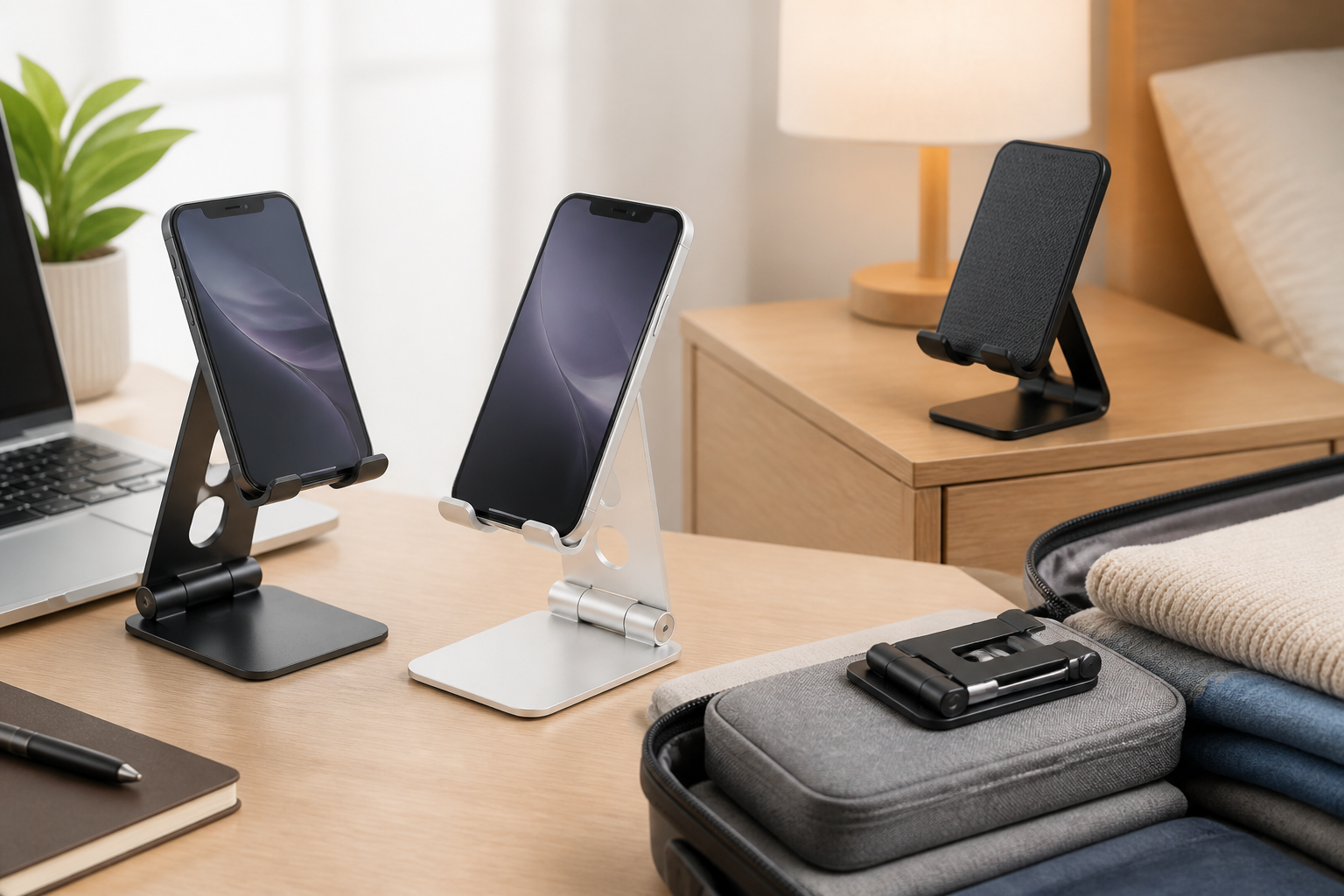
Desk stands are generally designed for frequent use and greater stability. They often have a heavier base, a more upright viewing position, and a design that works well beside a laptop, monitor, or keyboard. These are a strong choice for remote workers, students, and anyone who checks their phone throughout the day while keeping hands free.
Good desk stands often include adjustable height or angle. This is helpful if you want the phone positioned near eye level for calls or if you prefer a lower angle for quick glances. Some also have cable management cutouts or a channel for charging cords, which can help keep the workspace tidy.
If your desk is crowded, consider a compact stand footprint. If you use your phone as a secondary screen for messages or timers, a stable metal or weighted stand may be worth the extra space.
Bedside Phone Stands
Bedside stands are often chosen for nighttime charging, alarms, reading, and casual media use. The ideal bedside stand usually offers a balance of easy access and low visual clutter. It should keep the phone visible without taking over the nightstand.
For this use, a stand with a gentle viewing angle is often practical. Some people prefer a stand that allows easy one-handed pickup in the morning. If you charge overnight, make sure the stand does not block the cable and that the phone sits securely even if you lightly bump the table.
Bedside stands can be simple and elegant or more feature-rich with adjustable height. The best choice depends on whether you mostly want a place for the phone to rest or a more active viewing setup for reading and video.
Travel Phone Stands
Travel stands are made to be portable, compact, and easy to pack. They are often foldable or collapsible, which makes them suitable for a carry-on, backpack, or even a small organizer pouch. Many travelers use them in hotels, airports, trains, or airplanes when they want a stable viewing position without carrying a full-size accessory.
When choosing a travel stand, weight and fold size matter. A stand that folds flat or tucks into a slim shape is more convenient than one that offers more features but adds bulk. At the same time, it should still be strong enough to support your device reliably.
Travel-friendly stands can be useful for streaming, hands-free calls, following maps, or keeping the phone upright while charging in unfamiliar places. If you travel often, a stand with a strong folding mechanism and durable materials is usually a better choice than a delicate lightweight design.
Key Features to Compare Before You Buy
Shopping for a phone stand becomes easier when you focus on a few practical features rather than appearance alone. These factors usually matter most over time.
Material and Build Quality
Phone stands are commonly made from plastic, aluminum, wood, silicone, or mixed materials. Plastic stands can be affordable and lightweight, while metal stands may feel sturdier and more stable. Wood can offer a more decorative look, though the design should still be evaluated for balance and fit. Silicone or rubber elements are often helpful for grip where the phone touches the stand.
Build quality matters because a stand may be used repeatedly every day. Hinges, joints, and moving parts should feel secure rather than loose. If a stand folds, check whether the mechanism seems durable enough for regular packing and unpacking.
Portability
For travel use, portability is a major concern. A stand that folds flat or uses a compact angle-adjustment design is easier to carry. If you plan to move the stand between a home office and a bedside table, portability may also be helpful even if you do not travel often.
Still, portability should not come at the expense of stability. A very small stand may be convenient to pack but less reliable for a larger phone or a thicker case. The best portable choice is one that balances size with confidence-inspiring support.
Angle and Height Adjustments
Some stands offer only one fixed position, while others allow multiple tilt settings or height changes. More adjustment can make a stand useful in more situations, such as reading, typing, video watching, or joining a video meeting. Height adjustment can be especially useful at a desk because it helps align the screen more comfortably with your eye line.
If you know you prefer a simple setup, a fixed-angle stand may be enough. If your usage changes throughout the day, choose a model that adjusts easily and holds position firmly once set.
Charging Access
A useful phone stand should not get in the way of charging. Check whether the phone can rest on the stand while plugged in, and whether the cable has room to bend naturally. This matters for desk use, bedside charging, and long travel days alike.
Some stands are designed with an open bottom or a rear cable opening to support charging. Others may hold the phone in a way that blocks the port or places pressure on the connector. That can make a stand less practical than it first appears.
Grip and Surface Protection
To avoid slipping and scratching, look for stands with soft contact points, rubber feet, or padded edges. This can help keep both the stand and the phone in good condition. On glossy desks, nightstands, or hotel tables, anti-slip features can make a noticeable difference.
Surface protection is especially relevant if you frequently reposition the stand. A model with stable feet and gentle contact materials is less likely to leave marks or slide when you tap the screen.
How to Choose the Right Stand for Your Routine
The best phone stands are not necessarily the most feature-rich. They are the ones that match how you actually use your device day to day.
If You Mostly Use Your Phone at a Desk
Choose a stand with a stable base, a comfortable viewing angle, and enough clearance for charging. If you take many calls or follow notifications throughout the workday, a stand that keeps the screen visible without needing constant repositioning is a strong option.
Desk users may benefit from a more solid metal or weighted design. If your desk is already full of accessories, a vertical or compact stand may help save space.
If You Want a Stand for the Bedside Table
Look for a stand that is easy to use in low light, does not require much setup, and fits neatly among a lamp, book, or alarm clock. A stand with simple one-handed phone placement is often more convenient at night and in the morning.
If bedside charging is important, prioritize a model that supports cable access and keeps the phone steady even when the cord is attached.
If You Need One for Travel
Focus on foldability, low weight, and reliable support. If you are often on the move, a stand that packs flat will likely be more useful than a heavier desktop-style model. Consider how quickly the stand opens and whether it can sit on different surfaces, since hotels and transit spaces are not always uniform.
Travel users often appreciate a stand that works in both portrait and landscape orientations. That makes it easier to use for navigation, video, or reading during downtime.
Common Buying Mistakes to Avoid
Many phone stand buyers make the same avoidable mistakes. Knowing them in advance can save time and frustration.
- Choosing style over stability: A decorative stand may look appealing but fail to hold the phone securely.
- Ignoring case thickness: Some stands fit bare phones better than phones with protective cases.
- Overlooking charging access: If the cable does not fit comfortably, daily use becomes inconvenient.
- Buying a travel stand that is too bulky: A stand that is easy to pack is usually more useful on the road.
- Assuming all angles work equally well: A stand may look adjustable but not actually hold the angle you want.
- Not checking surface grip: A stand that slides on smooth furniture can become annoying quickly.
Practical Tips for Getting More Use From a Phone Stand
Once you choose a stand, a few small habits can improve your experience.
- Place it on a stable surface: Even a well-designed stand works better on a flat, solid table or desk.
- Test the fit with your case on: Use the stand the way you normally carry your phone.
- Check the angle for your main activity: A reading angle may differ from a video call angle.
- Keep a charging cable nearby if needed: This makes desk and bedside use more convenient.
- Store folding stands carefully: Avoid forcing hinges or joints when packing them.
If you plan to use one stand in multiple places, consider whether it is easy to move from desk to nightstand to suitcase without needing adjustment every time. Versatility is often one of the most valuable features a stand can offer.
Who Might Benefit Most From a Phone Stand?
Phone stands are useful for many different people, but some users may especially appreciate them.
Remote workers may want a stand for video meetings, messages, and multitasking. Students may use one to keep lessons, timers, or notes visible. Readers and streamers may prefer a bedside stand for relaxed hands-free viewing. Frequent travelers may like a compact stand that turns unfamiliar spaces into more comfortable viewing setups.
Even if you do not use your phone constantly, a stand can still be useful for charging and keeping your device organized. It is one of those accessories that can quietly improve a routine without requiring much attention.
Frequently Asked Questions
What is the best phone stand for everyday use?
The best everyday stand is usually one that balances stability, easy viewing, and charging access. For many people, that means a simple adjustable stand with a secure base and enough room for a case and cable.
Are foldable phone stands good for travel?
Yes, foldable stands are often a strong choice for travel because they store easily and add little weight. Just make sure the folded size and build quality fit your packing style.
Can one phone stand work for desk, bedside, and travel use?
It can, but the stand will usually be a compromise. A mid-size folding stand with moderate adjustability is often the most versatile option, though a dedicated desk stand may feel better at home and a smaller stand may pack more easily for trips.
Do I need an adjustable stand?
Not always. If you only want a fixed place for your phone to sit and charge, a simple non-adjustable stand may be enough. If you switch between reading, watching, and video calling, adjustment is more useful.
What should I check before buying a phone stand online?
Review the stand size, compatibility with your phone and case, angle options, charging clearance, material, and portability. Those details matter more than appearance alone.
Conclusion
Finding the best phone stands for desk, bedside and travel use comes down to matching the design to the setting. A stable desk stand is ideal for work and daily organization. A bedside stand should be easy to use, compact, and charging-friendly. A travel stand should fold neatly and remain dependable wherever you set it down.
By focusing on stability, compatibility, adjustability, material, and portability, you can narrow the options quickly and avoid buying a stand that looks good but does not suit your routine. Whether you want a minimal cradle or a flexible folding model, the best choice is the one that makes your phone easier to use in the places you spend the most time.