Introduction
Students often think productivity is only about motivation, but in daily life it is also shaped by the tools around them. A well-chosen accessory can make studying more organized, reduce small distractions, and help a student move through assignments with less friction. The best productivity accessories for students are not flashy gadgets or trendy desk decorations. They are practical items that support focus, make materials easier to access, and create a study setup that feels easier to use every day.
This guide focuses on useful accessories students can actually benefit from, whether they study at home, in a dorm, in the library, or while commuting between classes. The goal is not to buy the most items, but to choose the right ones based on study habits, available space, and the kind of work a student does most often.
Because students have different needs, the best accessories for one person may not be useful for another. A student who takes handwritten notes may need a very different setup from someone who works mostly on a laptop. A commuter may prioritize portability, while a student with a fixed desk may care more about comfort and organization. Thinking this way helps avoid unnecessary purchases and makes each item more intentional.
What Makes a Productivity Accessory Worth Buying?
Before looking at categories, it helps to define what makes an accessory genuinely useful. The strongest options usually solve a specific problem. They reduce clutter, make it easier to start studying, or limit the time spent searching for materials. Good productivity accessories should also fit naturally into a student’s routine rather than creating extra work.
Practical value matters more than novelty
A useful accessory should support a real need. For example, a simple desk organizer may be more effective than a decorative item that looks impressive but does not improve workflow. Students often benefit most from products that help with daily repetition: storing supplies, managing cables, improving posture, or keeping notes visible.
Portability is important for many students
Many students do not study in one place. They move between classrooms, libraries, cafés, and home. In that case, lightweight and easy-to-pack accessories are often more valuable than large or fixed setups. If an item is difficult to carry or set up, it may end up unused.
Durability and simplicity help long-term use
Accessories used every day should be able to handle repeated packing, unpacking, and transport. Simple designs are often easier to maintain and less likely to become frustrating over time. This is especially relevant for students who want tools that can last through a term or even an entire school year.
Desk Accessories That Can Improve Study Focus
A student’s desk can either support concentration or create low-level stress. When important items are scattered, it becomes harder to begin work and stay on task. Desk accessories are among the most effective productivity tools because they shape the work environment directly.
Desk organizers
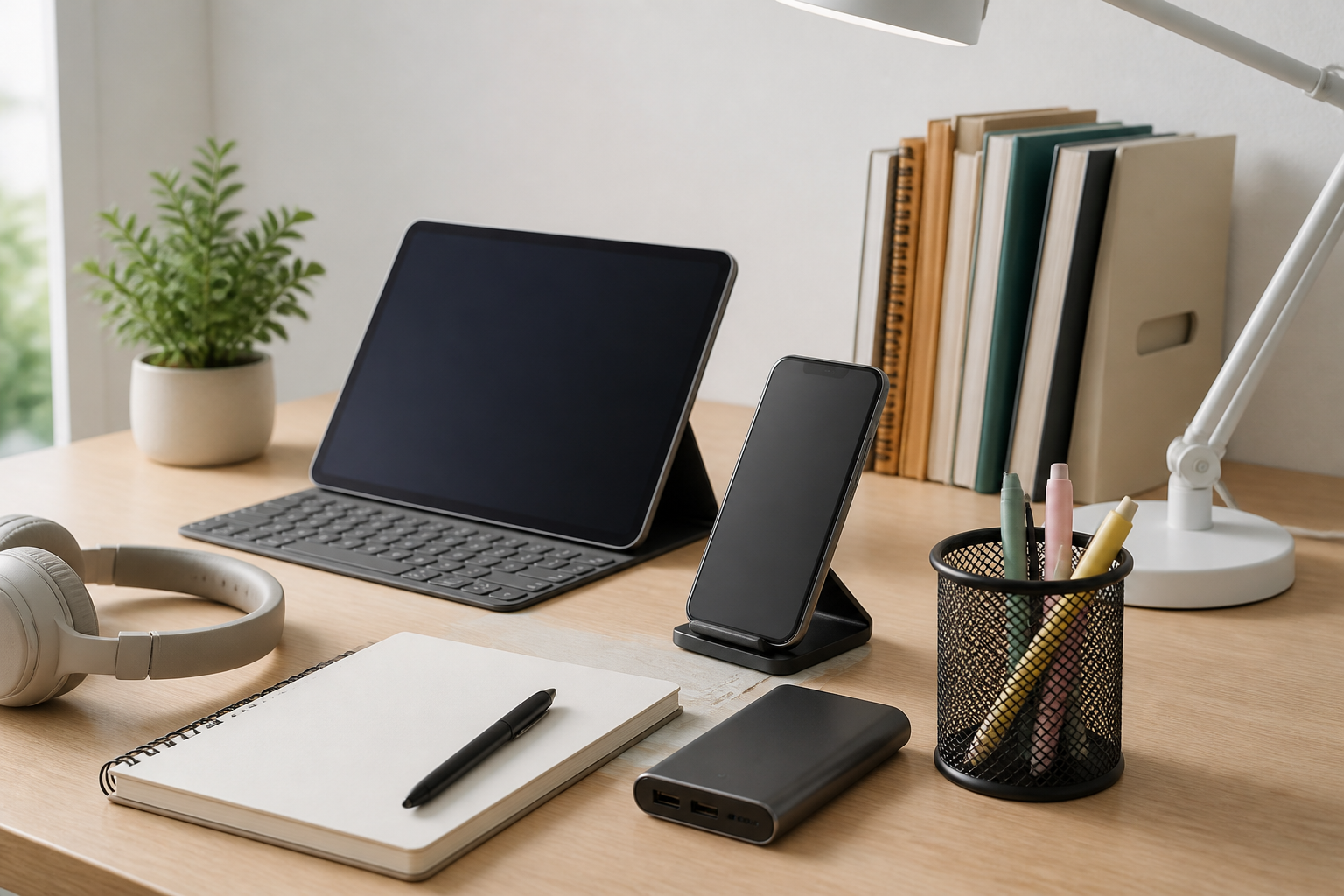
Desk organizers help keep supplies in one place, which can save time and reduce visual clutter. They are useful for pens, sticky notes, paper clips, chargers, and other small items that tend to disappear into drawers or backpacks. Students who keep their desks clear often find it easier to transition into study mode.
When choosing a desk organizer, look for a layout that matches the items you actually use. A compact organizer can work well for a minimal setup, while larger options may suit students with many study supplies. If your desk is small, a vertical organizer may be more practical than one that takes up a wide footprint.
File trays and document sorters
Paper assignments, lecture handouts, and printed reading packets can quickly pile up. File trays or sorters can help separate current work from completed work and keep important papers easy to find. This is especially useful for students taking multiple classes with different deadlines.
A simple system with labels such as “to do,” “in progress,” and “done” can be more effective than a complex setup. The key is to use a system that is easy to maintain when you are busy.
Desk pads and writing surfaces
A desk pad can create a more comfortable writing or typing area and protect the desk surface from scratches, ink marks, or wear. It can also help define a study zone, which may make it psychologically easier to begin focused work. Some students appreciate the smoother surface for handwritten notes or for placing a laptop and notebook side by side.
Monitor stands and laptop risers
If a student studies on a laptop for long periods, a riser or stand can help raise the screen to a more comfortable viewing level. This can improve desk organization by freeing space underneath for a keyboard, notebook, or external drive. It also encourages a more upright setup, which many students find easier to use for long study sessions.
When shopping for a riser, make sure it fits your laptop size and supports stable placement. If portability matters, foldable designs or lightweight stands may be easier to carry between study locations.
Tech Accessories for Faster, Easier Studying
Many students already rely on digital tools for class notes, research, and assignments. The right accessories can make those tools more efficient without requiring a major upgrade to a laptop or tablet.
Wireless mice and keyboards
A wireless mouse can make everyday navigation faster and more comfortable than using a trackpad alone. A separate keyboard may also be helpful for students who use a laptop at a desk for long periods. Together, these tools can create a more flexible study setup and reduce strain from awkward typing positions.
Students who move between locations should consider battery life, size, and portability. A compact keyboard or travel mouse may be more useful than a larger desktop-style accessory if the setup needs to fit inside a backpack.
Tablet stands and stylus holders
For students who use tablets for reading, annotating, or note-taking, a stand can make the device easier to view at a desk. A stylus holder can help keep writing tools from getting lost in a bag. These small accessories are often overlooked, but they can reduce friction during fast-paced classes or study blocks.
Cable management accessories
Charging cables, headphones, and adapters can clutter a desk or bag quickly. Simple cable organizers, ties, and clips can prevent tangles and make it easier to find what you need. This is especially helpful for students who carry multiple devices or use the same charger in different places.
Good cable management is less about perfection and more about convenience. If a student can pack and unpack faster, they are more likely to keep their study setup consistent.
Portable chargers and charging hubs
Long class days and study sessions can drain device batteries. A portable charger can be a useful accessory for students who are often away from outlets. For a fixed desk setup, a charging hub or multi-port charger may be more practical because it helps keep devices powered in one place.
When choosing charging accessories, think about the number of devices you regularly use and where you typically study. A student who spends all day on campus may value portability more than someone who studies mostly in one room.
Accessories That Support Better Note-Taking and Organization
Good notes are often at the center of student productivity. Accessories that improve note-taking can help students capture information more clearly and stay organized across courses.
Notebook systems and planners
Some students work best with a traditional paper notebook, while others prefer a planner or a structured notebook system. These tools can support time management by helping students track assignments, exams, reading goals, and weekly priorities in one place.
The best planner is the one a student will actually use consistently. Some people prefer daily pages, while others need only a weekly overview. A simple format often works better than an elaborate one if the student is busy or easily overwhelmed.
Sticky notes and page markers
Sticky notes and page markers are small but highly practical. They can be used to flag important textbook sections, mark deadlines, separate topics, or leave reminders in visible places. For students who review material often, these accessories can make revision more efficient.
Index cards and study tabs
Index cards remain useful for quick review, definitions, formulas, and practice prompts. Study tabs can help label sections in notebooks, binders, or textbooks. These accessories are especially helpful for students who study by revisiting key terms repeatedly rather than by rewriting full notes.
Comfort Accessories That Help Students Study Longer
Productivity is easier when the study environment feels comfortable enough to use for a while. Comfort accessories do not need to be expensive or complicated; they just need to reduce unnecessary discomfort that interrupts concentration.
Ergonomic mouse pads and wrist rests
If a student types or uses a mouse for long sessions, a wrist rest or supportive mouse pad may make the setup feel more comfortable. The idea is not to promise health outcomes, but to improve general usability and reduce the feeling of working at a poorly arranged desk.
Desk lamps
Good lighting can make reading and writing easier, especially in the evening or in rooms with limited natural light. A desk lamp with adjustable brightness may be more useful than a fixed lamp because it can adapt to different tasks. Students who share a room or study late at night may especially appreciate focused lighting that does not disturb others.
Noise-reducing accessories
Some students benefit from simple noise-management tools such as headphones or earplugs, depending on where they study. These accessories are not about complete silence for everyone, but about making it easier to concentrate in lively spaces such as dorms, libraries, or shared apartments. The right choice depends on personal preference and the study environment.
Accessories for Students Who Study on the Go
Commuter students and students with busy schedules often need accessories that travel well. In these cases, convenience and packing efficiency matter just as much as desk performance.
Backpack organizers
Backpack organizers, pouches, and small zip cases can keep chargers, pens, cables, and notebooks separated. This can make it faster to switch between classes or study locations. If a student spends time searching through a backpack each day, a few simple organizers may save more time than a new bag.
Compact laptop sleeves and tablet cases
Protective sleeves and cases can help keep devices safer during transport while also creating a more orderly packing system. Students should look for a fit that is snug but not tight, and for materials that suit the amount of travel involved.
Collapsible accessories
Foldable laptop stands, compact keyboards, and lightweight document holders are useful for students who need a flexible setup. Collapsible items are often easier to justify because they can be used in more than one place without adding too much bulk.
How to Choose the Right Productivity Accessories
Choosing the right accessory starts with identifying the student’s main pain points. If the problem is clutter, organization tools may be the best investment. If the problem is fatigue during long study sessions, comfort-focused items may help more. If the issue is moving materials between classes, portability should be the priority.
Start with one problem at a time
It is easy to buy several accessories at once, but that can create more clutter instead of less. A better approach is to ask: what is slowing me down most? Once the main issue is clear, the right item becomes easier to identify.
Match the accessory to the study space
A dorm desk, a kitchen table, and a library carrel all have different limitations. Students with limited space should choose compact items that store easily. Those with a fixed workspace may benefit from larger, more structured accessories.
Think about maintenance
Some accessories require regular organizing, charging, or adjustment. Others work almost automatically. If a student already struggles to maintain routines, simpler accessories may be better than tools that need constant upkeep.
Avoid buying duplicate solutions
A common mistake is purchasing multiple accessories that solve the same problem in slightly different ways. For example, a student may not need three separate storage tools if one well-designed organizer is enough. Reducing overlap keeps both the desk and the budget under control.
Common Buying Mistakes Students Should Avoid
When shopping for productivity accessories, it helps to avoid a few common mistakes that can make products less useful than expected.
- Buying for appearance instead of function
- Choosing accessories that are too large for the available space
- Ignoring portability when studying in different locations
- Overcomplicating storage systems so they become hard to maintain
- Purchasing too many tools before understanding actual needs
- Forgetting to check compatibility with a laptop, tablet, or desk setup
These mistakes are common because productivity accessories often look appealing in online photos or social media setups. In practice, the most effective items are usually the ones that fit the student’s real habits, not the idealized version of them.
Who May Benefit Most from Different Types of Accessories?
Different students often benefit from different product categories. Thinking in terms of study style can make shopping more efficient.
Students with heavy note-taking loads
These students may benefit from planners, notebooks, sticky notes, index cards, and document sorters. They often need tools that make it easier to capture and review information quickly.
Students who work mostly on laptops
Those who spend much of the day on a computer may value laptop stands, wireless mice, keyboards, cable organizers, and charging accessories. These items can make digital work more convenient and reduce desk clutter.
Commuter students
Students who travel between home, campus, and study spots may prioritize lightweight organizers, device sleeves, portable chargers, and compact accessories that are easy to pack.
Students in shared spaces
Students studying in dorms or shared rooms may appreciate lamps, noise-reducing accessories, and small organizers that help keep personal items contained in a limited area.
Practical Tips for Building a Better Student Study Setup
A few practical habits can make any productivity accessory more effective. The best setup is one that feels easy to return to each day.
- Keep frequently used items within arm’s reach
- Use labels if you have more than one class folder or paper tray
- Store charging accessories in a fixed place so they are easy to grab
- Use one notebook or planner system consistently instead of switching often
- Review your setup every few weeks and remove items you do not use
Small improvements can add up. A clear desk, a visible planner, and a simple charging routine may do more for day-to-day productivity than expensive upgrades.
Frequently Asked Questions
What are the most useful productivity accessories for students?
Some of the most useful options include desk organizers, planners, laptop stands, wireless mice, cable organizers, and desk lamps. The best choice depends on whether the student needs help with organization, comfort, portability, or note-taking.
Do students need expensive accessories to be productive?
No. Many productivity improvements come from simple, affordable items and better organization. The best accessory is often the one that solves a specific problem without adding complexity.
Should students buy accessories before starting school?
It can help to begin with a few basics, but it is often smarter to wait until the student understands their actual routine. After a week or two of classes, it becomes clearer which accessories are genuinely needed.
What should students prioritize first?
A good starting point is organization. If a student’s materials are easy to find, it becomes easier to focus on study time. After that, comfort and portability are often the next most helpful areas to improve.
How can students avoid buying too many accessories?
The simplest approach is to identify one main problem and buy one accessory that addresses it. If the item is used regularly and clearly helps, then it may be worth adding another later. This approach reduces wasted spending and clutter.
Conclusion
The best productivity accessories for students are the ones that make studying easier to start, easier to maintain, and easier to repeat. That could mean a desk organizer that clears clutter, a laptop stand that improves a desk setup, a planner that keeps deadlines visible, or a simple cable solution that reduces daily frustration.
Instead of chasing the biggest or most popular product, students usually get better results by choosing accessories that match their study style and space. A focused, practical setup can support better habits over time, making schoolwork feel a little more manageable and a little less chaotic. If you are building a student study space from scratch or improving an existing one, start with the accessory that solves the biggest everyday problem first.