Preparing vegetables is one of the most frequent tasks in home cooking, and the right tools can make it faster, cleaner, and far less frustrating. Whether you cook simple weeknight meals, batch-prep ingredients for the week, or make salads, soups, stir-fries, and roasted vegetables often, having a reliable set of vegetable preparation tools can save time and improve consistency.
This guide focuses on the best vegetable preparation tools for everyday cooking and explains what each tool does, which features matter most, and how to choose tools that fit your kitchen and your cooking style. Rather than looking at one single gadget, it covers the practical categories that most people actually use: knives, peelers, cutting boards, graters, mandolines, choppers, and a few helpful extras. The goal is to help you build a vegetable prep setup that is useful, easy to maintain, and suited to real daily cooking.
What Makes a Vegetable Preparation Tool Worth Buying?
Not every kitchen tool earns a permanent place on the counter or in a drawer. The best vegetable preparation tools are the ones that match how you cook, feel comfortable in hand, and hold up to repeated use. A useful tool should reduce prep time without adding unnecessary complexity.
When comparing tools, focus on a few practical factors:
- Ease of use: The tool should feel intuitive and comfortable, especially if you use it several times a week.
- Cleaning: Vegetable prep creates a lot of small scraps, juice, and starches, so tools that are easy to rinse or dishwasher-safe can be more convenient.
- Storage: A tool that fits in a drawer or hangs neatly is often more realistic than one that requires special space.
- Durability: Everyday prep tools should stand up to regular chopping, slicing, peeling, and grating without quickly losing performance.
- Versatility: A good tool should handle more than one common task whenever possible.
It also helps to think about the types of vegetables you prepare most often. Soft vegetables, dense root vegetables, leafy greens, and delicate herbs each benefit from different tools and techniques. A single “best” tool does not exist for every kitchen, but a smart combination of a few well-chosen tools can cover most needs.
The Essential Vegetable Prep Tools for Most Kitchens
If you are building a practical set from scratch, start with the tools that support the widest range of vegetable prep tasks. These are the items most home cooks rely on daily or weekly.
Chef’s Knife
A chef’s knife is often the most important vegetable prep tool in the kitchen. It handles chopping onions, slicing peppers, mincing garlic, dicing carrots, and cutting larger produce into manageable pieces. For many cooks, one good knife can replace several smaller tools for routine prep.
Look for a knife that feels balanced and comfortable. Blade length, handle shape, and weight all affect how easy it is to use. A knife that is too large may feel awkward for small tasks, while one that is too short may slow down prep on larger vegetables.
Best for: general chopping, slicing, dicing, and mincing.
Who it suits: almost every home cook, especially those who prepare vegetables frequently.
Paring Knife
A paring knife is useful for smaller, more precise work. It is ideal for trimming green beans, removing blemishes, coring strawberries, peeling small produce by hand, or cutting garnishes. While it is not a replacement for a chef’s knife, it can make detailed tasks easier and safer than using a large blade.
Best for: trimming, peeling small items, and detailed cuts.
Who it suits: cooks who prepare a variety of small vegetables and need control for close work.
Vegetable Peeler
A reliable vegetable peeler is a simple tool that many people use more often than they expect. It helps remove thin skins from potatoes, carrots, cucumbers, squash, and other vegetables without wasting much flesh. A good peeler should glide smoothly and feel secure in the hand.
There are two common styles: swivel peelers and Y-shaped peelers. Swivel peelers are familiar and compact, while Y-peelers often provide a comfortable grip and efficient motion for larger batches. The right choice depends on your hand comfort and how you prefer to peel.
Best for: potatoes, carrots, cucumbers, squash, and similar vegetables.
Who it suits: anyone who peels produce regularly, especially for soups, stews, and roasted dishes.
Cutting Board
A cutting board is not always described as a prep tool first, but it is one of the most important parts of an efficient vegetable prep setup. A stable, appropriately sized board supports safe and clean slicing. The wrong board can make even a sharp knife feel awkward.
Many people like to keep more than one board on hand. One can be used for raw vegetables, another for more aromatic ingredients like onions and garlic, and a larger board can help when prepping multiple items at once. Look for a board that offers enough space for the largest vegetables you usually cut.
Best for: all cutting, chopping, and slicing tasks.
Who it suits: every kitchen, especially households that cook in batches or prepare multiple ingredients at once.
Tools That Save Time on Repetitive Prep
Some vegetables are easy to cut by hand, but repetitive tasks can become time-consuming. The following tools are especially helpful if you often cook in volume or want more uniform results.
Box Grater
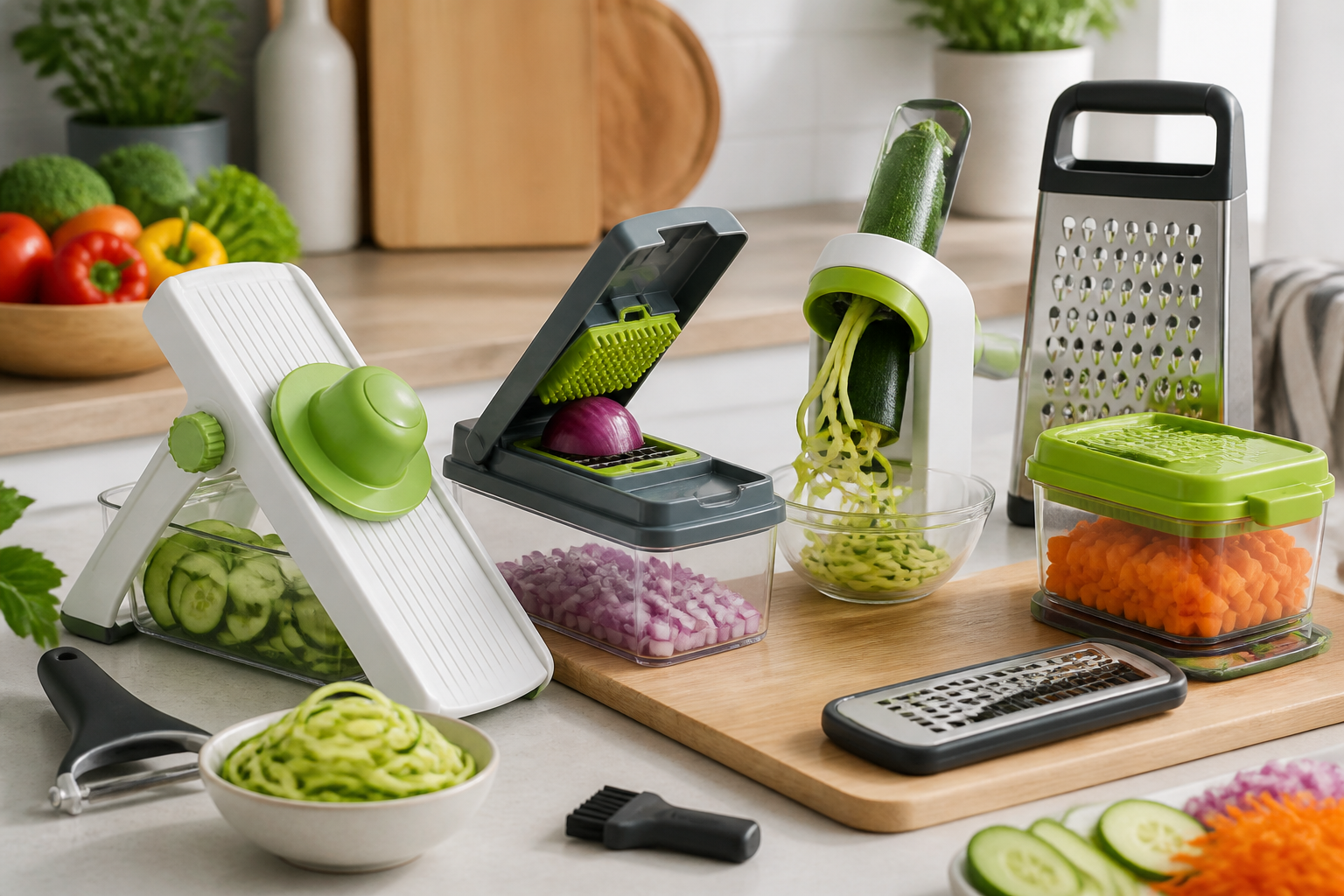
A box grater is useful for shredding carrots, grating zucchini, slicing cheese, or creating coarse shreds from vegetables for slaws and salads. The different sides allow you to choose texture, which makes it a flexible tool for a range of recipes.
When choosing a box grater, look for a sturdy base, a comfortable handle, and sharp grating surfaces. A stable grater is easier to use and can reduce slipping while you work. A catch container can also be helpful if you want to keep the workspace tidier.
Best for: shredding, coarse grating, and quick prep for salads, fritters, and bakes.
Who it suits: cooks who make coleslaw, vegetable patties, baked casseroles, or grated toppings often.
Microplane or Fine Grater
A fine grater is a good choice when you want very small shreds or delicate texture. It can help with hard vegetables in small amounts, such as finely grating ginger-like aromatics or adding a light topping of citrus zest when recipes call for it. For vegetable-only prep, it is especially useful when you want a refined texture rather than a coarse shred.
This type of tool works best when handled carefully and cleaned soon after use, since tiny food particles can cling to the surface. It is usually a supporting tool rather than an all-purpose one, but many cooks appreciate having it nearby.
Best for: fine grating and small finishing tasks.
Who it suits: cooks who like precise texture and use small grated amounts regularly.
Mandoline Slicer
A mandoline slicer is designed to create evenly thin slices quickly. It is helpful for potatoes, cucumbers, onions, zucchini, radishes, and other vegetables where uniform thickness matters. If you make salads, gratins, chips, or pickled vegetables, this tool can save a lot of time.
Because mandolines are designed for speed and uniformity, they are best used carefully and with the proper food holder. A stable base, adjustable thickness settings, and a compact storage design are all worth considering. Some models are simpler, while others include multiple blade options. Choose only the features you will realistically use.
Best for: thin slicing, uniform cuts, and large batches.
Who it suits: cooks who prep salads, potato dishes, or pickles often and want consistent slices.
Handheld or Manual Chopper
A handheld chopper or manual chopper can be helpful for quick, repetitive cutting tasks. These tools are often used for onions, herbs, soft vegetables, or small batches of salsa-style prep. They can reduce the time spent making uniform cuts when you do not want to bring out a full food processor.
As with any compact tool, the main question is whether it fits your habits. A manual chopper can be useful for quick weekday prep, but it may not be the best choice for very large quantities or hard vegetables unless the design is sturdy and the blades are suitable.
Best for: small batches, quick chopping, and occasional shortcut prep.
Who it suits: cooks who want convenience without using larger appliances.
Helpful Specialty Tools for Specific Vegetable Tasks
After the basics, there are several specialty tools that can be worth adding if you frequently cook certain dishes. These are not essential for every kitchen, but they can be practical for particular needs.
Spiralizer
A spiralizer turns vegetables into noodle-like strands or decorative curls. It is commonly used for zucchini, carrots, cucumbers, and similar vegetables. This tool is especially helpful for salads, vegetable-based noodle dishes, and creative presentation.
For occasional use, a compact handheld spiralizer may be enough. For more frequent use, a countertop model may provide better stability. If you do not plan to use spiralized vegetables often, it may be better to skip this category and focus on more versatile tools.
Best for: vegetable noodles, garnishes, and creative slicing.
Who it suits: cooks who enjoy fresh vegetable-based dishes and visual presentation.
Herb Scissors or Kitchen Shears
Kitchen shears are useful for trimming herbs, cutting greens, opening packaging, and snipping delicate vegetables or stems. While not a cutting tool for every task, they are often surprisingly convenient when a knife feels too bulky for small jobs.
Look for a pair that is comfortable, easy to clean, and sturdy enough for regular use. Some models separate for cleaning, which can be convenient for removing debris after handling fresh produce.
Best for: herbs, leafy greens, and quick trimming.
Who it suits: cooks who make salads, garnish dishes often, or want an easy utility tool.
Salad Spinner
A salad spinner is not a cutting tool, but it is an important vegetable preparation item for many kitchens. Washing and drying leafy greens, herbs, and tender vegetables can make a noticeable difference in texture and storage. Excess water can dilute dressings or affect how ingredients behave in a pan.
If you regularly prepare leafy salads or use washed greens throughout the week, a salad spinner can be a practical buy. Choose one that is easy to spin, simple to disassemble, and not too large for your storage space.
Best for: washing and drying greens, herbs, and tender produce.
Who it suits: salad lovers, meal preppers, and households that use fresh greens often.
How to Choose the Right Vegetable Preparation Tools
The best choice is not always the tool with the most features. It is the one that fits your cooking habits and does the job reliably. Before buying, ask yourself a few practical questions.
How Often Do You Prep Vegetables?
If you cook vegetables several times a week, durability and comfort matter more than novelty. You may benefit from investing in a better knife, a sturdier cutting board, and a dependable peeler before buying specialty gadgets. If you only prep vegetables occasionally, a simple set of essentials may be enough.
What Types of Vegetables Do You Cook Most?
Dense vegetables like potatoes, carrots, squash, and beets benefit from strong blades and stable surfaces. Soft vegetables and herbs may be easier to handle with smaller knives, shears, or manual choppers. If your meals often include salads, a mandoline, grater, or spinner may be more useful than a tool intended for larger cuts.
Do You Prefer Speed or Control?
Some tools are designed to speed up repetitive tasks, while others are meant to improve precision. A chef’s knife offers broad control. A mandoline offers fast, even slicing. A peeler prioritizes efficient skin removal. Knowing whether you want quick prep or highly controlled cuts will help narrow your choices.
How Much Space Do You Have?
Storage is often overlooked. Many useful tools are only practical if you can access them easily. If your kitchen is compact, choose stackable or multiuse tools rather than bulky items you are unlikely to store properly. A few compact, high-use items may serve you better than a drawer full of specialized gadgets.
Common Buying Mistakes to Avoid
When choosing vegetable prep tools, it is easy to focus on convenience features and overlook basics. Avoiding these common mistakes can help you make better long-term decisions.
- Buying too many single-purpose gadgets: Tools that only do one narrow task may end up unused unless you prepare that food often.
- Ignoring comfort: A tool may look efficient, but if it feels awkward in your hand, you may avoid using it.
- Choosing poor stability: Slipping boards, wobbly graters, and unstable slicers can slow prep and make kitchen work more frustrating.
- Overlooking cleaning effort: Tools with many parts or hard-to-reach surfaces can be inconvenient on busy days.
- Prioritizing appearance over function: Attractive tools are nice, but daily use depends more on grip, balance, and durability.
Practical Tips for Everyday Vegetable Prep
Good tools work best when paired with a few simple habits. These tips can make vegetable prep faster and more manageable without requiring a major kitchen overhaul.
- Keep knives sharp: A sharp knife generally cuts more cleanly and feels easier to control than a dull one.
- Use the right tool for the task: Small trimming work is easier with a paring knife, while larger slicing jobs are usually better with a chef’s knife.
- Prep in stages: Washing, peeling, cutting, and storing separately can streamline cooking later in the week.
- Stabilize your work area: A steady board and clear counter space make prep more efficient.
- Clean tools soon after use: Vegetable residue can dry and become harder to remove if left too long.
If you cook often, it can also help to keep your most-used tools in easy reach. A small setup with a knife, peeler, board, and grater accessible near the prep area can make cooking feel much less like a chore.
Who Needs Which Vegetable Preparation Tools?
Different households need different combinations of tools. The best setup depends on how you cook and what kinds of dishes you make most often.
- Busy weeknight cooks: Focus on a sharp chef’s knife, a dependable peeler, and a large cutting board.
- Meal preppers: Add a box grater, a mandoline, and a salad spinner for faster batch preparation.
- Salad and fresh produce fans: A mandoline, kitchen shears, and salad spinner can be especially useful.
- Beginners building a first kitchen: Start with the basics before buying specialty tools.
- Home cooks with limited space: Choose compact, multiuse tools that handle several tasks well.
Frequently Asked Questions
What are the most important vegetable preparation tools for a basic kitchen?
The most useful basics are usually a chef’s knife, a paring knife, a vegetable peeler, and a cutting board. These four tools cover a large share of everyday vegetable prep tasks.
Is a mandoline worth buying for everyday cooking?
A mandoline can be worth buying if you often make thin, uniform slices for salads, gratins, chips, or pickled vegetables. If you only need that kind of slicing occasionally, a good knife may be enough.
Do I need both a box grater and a microplane?
Not always. A box grater is more versatile for larger shredding jobs, while a microplane is better for fine, delicate grating. Some kitchens can manage with just one, but both can be useful if you prep vegetables in different textures.
What should I buy first if I am setting up a new kitchen?
Start with a quality knife, a stable cutting board, and a peeler. After that, add a grater or slicer based on the meals you cook most often.
How can I tell if a prep tool is good quality?
Look for solid construction, comfortable handling, stable use, and designs that are easy to clean and store. For cutting tools, consistent sharpness and a secure grip are especially important.
Conclusion: Build a Vegetable Prep Setup That Matches Your Cooking
The best vegetable preparation tools for everyday cooking are not the flashiest ones. They are the tools you reach for repeatedly because they make routine tasks easier, faster, and more comfortable. For most kitchens, that means starting with the essentials: a good chef’s knife, a paring knife, a peeler, and a solid cutting board. From there, tools like graters, mandolines, choppers, shears, and salad spinners can add convenience depending on your habits.
If you choose carefully, your vegetable prep tools can support a wide range of meals without cluttering your kitchen. Focus on comfort, usefulness, storage, and ease of cleaning, and you will end up with a setup that works well every day rather than only on special occasions. For shoppers looking to improve daily cooking, the smartest vegetable prep tools are the ones that make healthy ingredients and home-cooked meals feel more manageable from the first cut to the final bowl.