A well-equipped kitchen does not need to be full of gadgets. For most home cooks, the most useful setup is a small collection of reliable tools that handle everyday tasks well. The right essentials can make chopping faster, cooking more consistent, cleanup easier, and meal preparation less stressful.
If you are setting up a kitchen for the first time, replacing worn-out items, or simply trying to simplify what you own, it helps to focus on tools that support the basics: prep, cooking, measuring, serving, and storage. This guide covers the essential kitchen tools every home cook should have, along with practical buying considerations and common mistakes to avoid.
Why kitchen essentials matter
The best kitchen tools are not always the most specialized. In many homes, a few dependable items get used every day while more niche tools stay in a drawer. Essential tools matter because they help you cook with less frustration and more consistency.
Good basics can also save space and money. Instead of buying single-use gadgets, you can invest in tools that work across many recipes. A sturdy cutting board, a sharp knife, and a dependable skillet can support everything from eggs and vegetables to pasta sauces and stir-fries.
When choosing essentials, think about how you actually cook. A person who makes quick weeknight meals may need different priorities than someone who bakes often or prepares family-sized dinners. Still, most home cooks benefit from the same core categories.
The core tools every home cook should have
1. A reliable chef’s knife
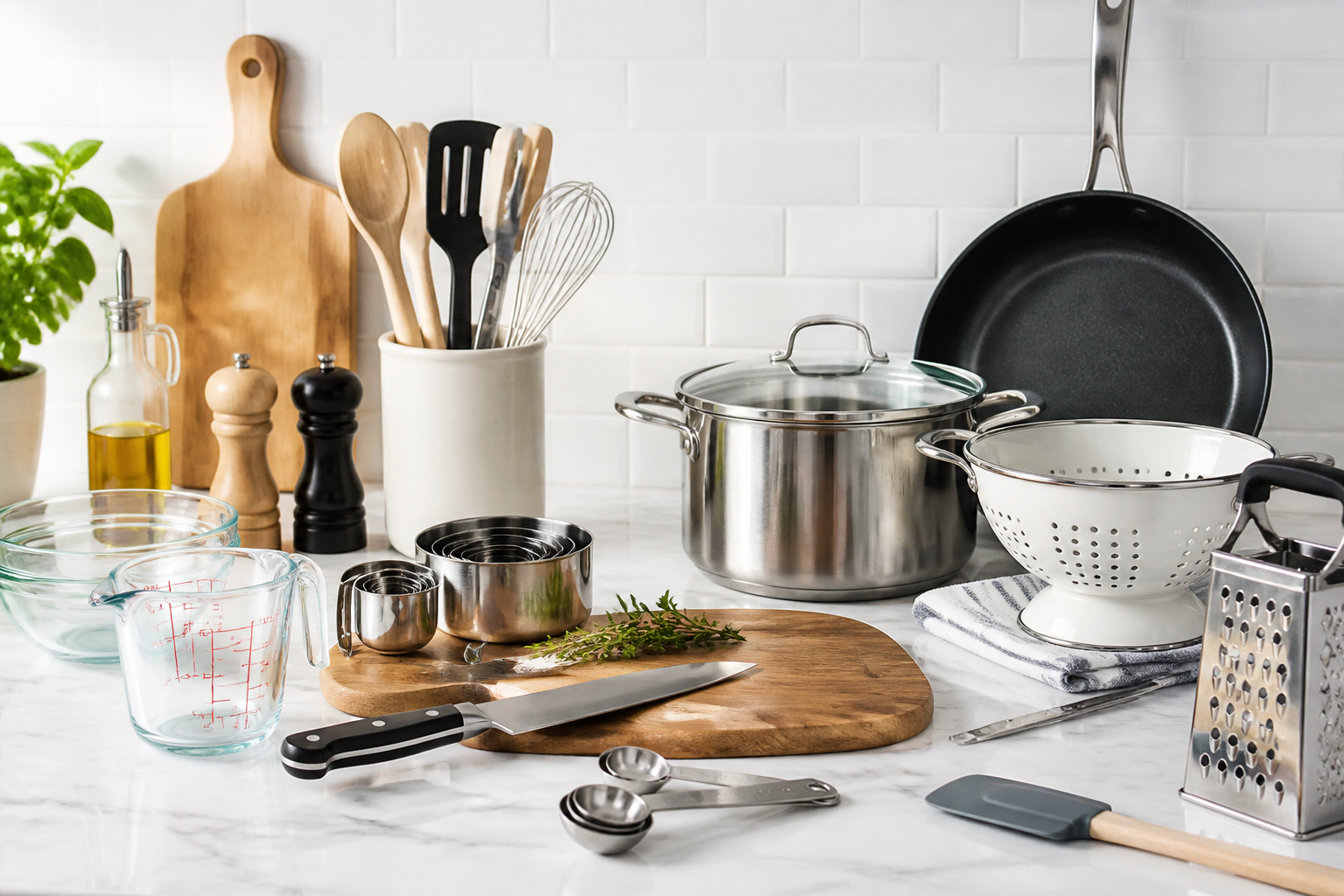
A chef’s knife is one of the most important tools in any kitchen. It handles chopping, slicing, mincing, and dicing tasks that come up in nearly every recipe. For many home cooks, this one knife becomes the most-used item in the kitchen.
When buying a chef’s knife, look for a comfortable handle, balanced weight, and a blade length that feels manageable in your hand. An 8-inch knife is a common all-purpose choice, but some cooks prefer a smaller or larger size depending on hand size and comfort.
What matters most is control. A knife should feel stable and easy to guide, not awkward or overly heavy. Also consider how it will be maintained. A quality knife should be easy to sharpen and comfortable enough that you will actually use it regularly.
This tool may suit nearly all home cooks, especially anyone preparing fresh ingredients often.
2. A sturdy cutting board
A good cutting board protects your countertops and gives you a safer, more stable surface for food prep. Ideally, every kitchen should have at least one large board for general chopping and one smaller board for lighter tasks or quick prep.
Common options include wood, bamboo, and plastic. Wood and bamboo often feel more substantial and may be preferred for general prep, while plastic can be convenient because it is lightweight and easier to clean in many setups. The best choice depends on your routine, cleaning preferences, and whether you want a board for produce, bread, or raw proteins.
Look for a board that is large enough to give you space to work without crowding ingredients. A board with non-slip feet or a stable grip can also make prep safer and more comfortable.
3. A versatile skillet or frying pan
A skillet is one of the most useful cooking vessels in the kitchen. It can be used for eggs, sautéed vegetables, pan sauces, seared proteins, and many stovetop meals. A medium or large skillet often earns a permanent place on the stove because it works for so many cooking styles.
When shopping, consider size, material, weight, and how it will be cleaned. Some cooks prefer nonstick pans for delicate foods and easy cleanup, while others want stainless steel or cast iron for higher-heat cooking and long-term durability. The right choice depends on what you cook most often.
Think about comfort as well. A skillet should have a handle that is easy to grip and a weight that you can manage safely when the pan is full.
4. A medium saucepan
A saucepan is essential for boiling pasta, simmering sauces, cooking grains, reheating soups, and preparing small batches of vegetables or sides. A medium size is often the most flexible because it supports everyday tasks without taking up too much storage space.
Useful features include a well-fitted lid, a comfortable handle, and a shape that heats evenly. If you cook rice, sauces, or oatmeal often, this tool will likely be in regular rotation.
Some households benefit from having two saucepans in different sizes, but one dependable medium saucepan is a strong starting point.
5. A stockpot
A stockpot is helpful for larger jobs such as soups, stews, pasta, boiled vegetables, and homemade broth. Even if you do not cook in large batches often, this tool is valuable when you need to prepare meals for a group or want leftovers for later.
When choosing a stockpot, look for a size that fits your household needs and a construction that feels stable when full. A wide base can help with even heating, and sturdy handles can make lifting and pouring easier.
If storage space is limited, make sure the size truly matches how often you cook large quantities. For some home cooks, a large saucepan may be enough; for others, a stockpot is indispensable.
6. Measuring cups and measuring spoons
Measuring tools are important for baking, but they are also useful for consistent cooking in general. Measuring cups and spoons help with portions for broth, spices, flour, sugar, oil, and many other ingredients.
Look for clear markings that will not wear off quickly and a set that feels easy to stack and store. Stainless steel sets are popular for durability, while some plastic versions are lightweight and inexpensive. The best choice is one that matches how often you cook and how much precision you want.
For home cooks who bake occasionally, a basic set is usually enough. For those who bake regularly, it may be worth choosing a set that includes both standard measuring cups and spoons with clear, easy-to-read labels.
7. Mixing bowls in a few sizes
Mixing bowls support nearly every part of cooking, from tossing salads and marinating ingredients to whisking batters and holding chopped vegetables. A set of nested bowls in multiple sizes is especially useful because it gives you flexibility without clutter.
Choose bowls that are easy to hold, stack neatly, and feel sturdy enough for regular use. Materials vary, including stainless steel, glass, and plastic. Each has strengths: stainless steel is lightweight and durable, glass is often useful for prep and serving, and plastic can be practical for everyday tasks.
If space is limited, prioritize one large bowl and one medium bowl, then add smaller ones as needed.
8. A wooden spoon and a heat-safe spatula
Simple stirring tools are easy to overlook, but they are essential for everyday cooking. A wooden spoon is useful for stirring sauces, soups, and sautéed ingredients, while a heat-safe spatula helps with scrambling eggs, folding mixtures, and scraping pans.
When buying these tools, focus on comfort, durability, and how they feel in your hand. A good spatula should be flexible enough to handle mixing but sturdy enough to move food effectively. A wooden spoon should feel solid without being bulky.
Many kitchens benefit from having more than one of each, especially if you cook multiple dishes at once.
9. Tongs
Tongs are one of the most practical multitasking tools in the kitchen. They can turn food in a pan, toss salads, move roasted vegetables, serve pasta, and handle grilled or baked items with more control than a spoon alone.
Look for tongs that open and close smoothly and feel comfortable to hold. A locking mechanism can help with storage. The right length depends on your needs: shorter tongs may be easier for everyday stovetop cooking, while longer tongs can be useful for grilling or larger pans.
For many home cooks, tongs become one of the most-used tools because they are simple and versatile.
10. A whisk
A whisk is useful for eggs, sauces, salad dressings, batters, and anything that needs quick blending. Even basic cooking becomes easier when you have a whisk that fits comfortably in a bowl or saucepan.
Stainless steel whisks are common because they are durable and easy to clean. Some kitchens also benefit from a smaller whisk for dressings or a larger one for bigger batches.
Choose a whisk that feels balanced and does not bend too easily under regular use.
11. A colander or strainer
Draining pasta, rinsing produce, and washing beans are all easier with a colander or strainer. This is a simple tool, but it supports many routine kitchen tasks.
When buying one, consider bowl depth, drainage speed, handle comfort, and stability. A colander with a wide base or feet may sit more securely in the sink. Some cooks prefer a strainer with fine holes for smaller ingredients, while others need a larger perforated colander for pasta and vegetables.
If you cook a lot of grains, pasta, or fresh produce, this tool should be high on your list.
12. A baking sheet or sheet pan
A sheet pan is a surprisingly useful essential, even for cooks who do not bake often. It can roast vegetables, bake chicken, toast nuts, reheat leftovers, and support many one-pan meals.
Look for a pan that feels heavy enough to resist warping and large enough to suit your oven. Rimmed baking sheets are especially versatile because they help contain juices, oil, and small ingredients.
For people who want simple weeknight cooking, a dependable sheet pan can be one of the easiest ways to reduce cleanup.
Helpful tools that are often worth adding next
Once the basics are covered, a few additional tools can make cooking easier and more organized without creating clutter. These are not always the first items to buy, but they are often valuable additions for home cooks who are ready to expand their setup.
A microplane or fine grater
A fine grater is useful for zesting citrus, grating garlic or ginger, and finishing dishes with cheese or spices. It takes up little space but adds a lot of convenience.
A vegetable peeler
A good peeler can make prep faster and more comfortable, especially for carrots, potatoes, cucumbers, and other firm produce. Look for one that feels easy to grip and moves smoothly without snagging.
A set of food storage containers
Storage containers help with leftovers, meal prep, and keeping dry ingredients organized. If you cook regularly, containers with secure lids can improve both refrigerator and pantry organization.
An instant-read thermometer
For cooks who want more confidence with meat, baked goods, or temperature-sensitive foods, an instant-read thermometer can be a helpful addition. It is not required for every kitchen, but it can reduce guesswork.
How to choose kitchen tools that actually last
When shopping for essentials, it is easy to be drawn to looks or features that sound impressive. A better approach is to focus on everyday usability. The best kitchen tools are the ones you reach for repeatedly because they are comfortable, dependable, and easy to clean.
Think about material and maintenance
Different materials have different strengths. Stainless steel is often durable and low-maintenance. Wood can be comfortable and attractive but may need more care. Nonstick surfaces are convenient for certain tasks but may require gentler handling. Choose materials that fit the way you cook and clean.
Consider size and storage
A tool that is technically useful may still be a poor choice if it is too large for your kitchen. Measure cabinet space, drawer space, and pantry storage before buying bulky items. This is especially important for mixing bowls, stockpots, and sheet pans.
Prioritize comfort
Handles, weight, balance, and grip matter more than many shoppers expect. A tool that feels awkward will likely be used less often. Whenever possible, choose items that feel comfortable in your hands and match the size of your kitchen routine.
Buy for your cooking habits
If you cook simple meals, you may not need a large number of tools. If you bake weekly, measuring tools and mixing bowls deserve more attention. If you make soups and stews, a stockpot and ladle matter more. The best kitchen setup is personal, not one-size-fits-all.
Common buying mistakes to avoid
One common mistake is buying too many specialized gadgets before covering the basics. Another is choosing tools that are attractive but uncomfortable or difficult to clean. Some people also buy oversized cookware that does not fit their stove, sink, or storage space.
Another mistake is overlooking quality in the tools used most often. It may be better to own one excellent knife and one dependable skillet than several mediocre versions of each. Focus on the items that will actually see daily use.
Finally, avoid assuming every kitchen needs the same setup. A minimalist home cook, a frequent baker, and a family meal planner will all have different priorities.
FAQs about essential kitchen tools
What are the absolute must-have kitchen tools for a beginner?
A beginner can start with a chef’s knife, cutting board, skillet, saucepan, measuring cups and spoons, mixing bowl, spatula, whisk, and colander. These items cover a wide range of basic cooking tasks.
Is it better to buy a kitchen tool set or individual pieces?
It depends on the set. Some sets are convenient, but they may include items you do not need. Individual pieces let you choose quality and size more carefully. Many home cooks prefer building a kitchen gradually with separate essentials.
How many knives does a home cook really need?
Many home cooks can manage well with a chef’s knife, a paring knife, and a serrated knife. That small selection covers most everyday cutting tasks without creating clutter.
Do I need expensive tools to cook well at home?
No. Skill, planning, and practice matter more than expensive equipment. Focus first on dependable basics that fit your needs, then upgrade specific items over time if necessary.
What is the best way to avoid clutter when buying kitchen tools?
Choose multiuse tools, avoid duplicate gadgets, and think carefully about storage before buying. It also helps to review what you already own and replace only the tools that are worn out, uncomfortable, or no longer useful.
Conclusion
Essential kitchen tools do not need to be complicated. For most home cooks, a small set of reliable basics is enough to handle everyday meals with confidence. A good knife, a solid cutting board, dependable cookware, measuring tools, mixing bowls, and a few simple utensils can support almost everything you make.
The key is to choose tools that fit your cooking style, your space, and your comfort level. Start with the items you will use most often, then build slowly as your routine evolves. A thoughtful kitchen setup is not about having the most tools; it is about having the right ones.