How to Choose a Good Smartphone Charger
Choosing a good smartphone charger may seem simple, but the right choice can affect charging speed, compatibility, convenience, and long-term usability. A charger that works well with one phone may be too weak, unnecessarily bulky, or not fully compatible with another. On the other hand, a well-matched charger can make everyday charging easier and more dependable without requiring you to think about it every time you plug in.
The best charger is not always the one with the highest power rating. It is the one that fits your phone, your cable, your charging habits, and the places where you charge most often. Some people need a compact charger for travel. Others want a multi-port model for a desk or shared household use. Many buyers simply want a charger that is safe, efficient, and fast enough for their device. This guide explains the most important factors so you can make a confident choice.
Start with Your Phone’s Charging Needs
The first step is to check what your smartphone actually supports. Not all phones charge at the same speed, and not all chargers communicate with phones in the same way. A charger that looks powerful on paper may not speed up your phone if the phone does not support that charging method.
Check the charging port type
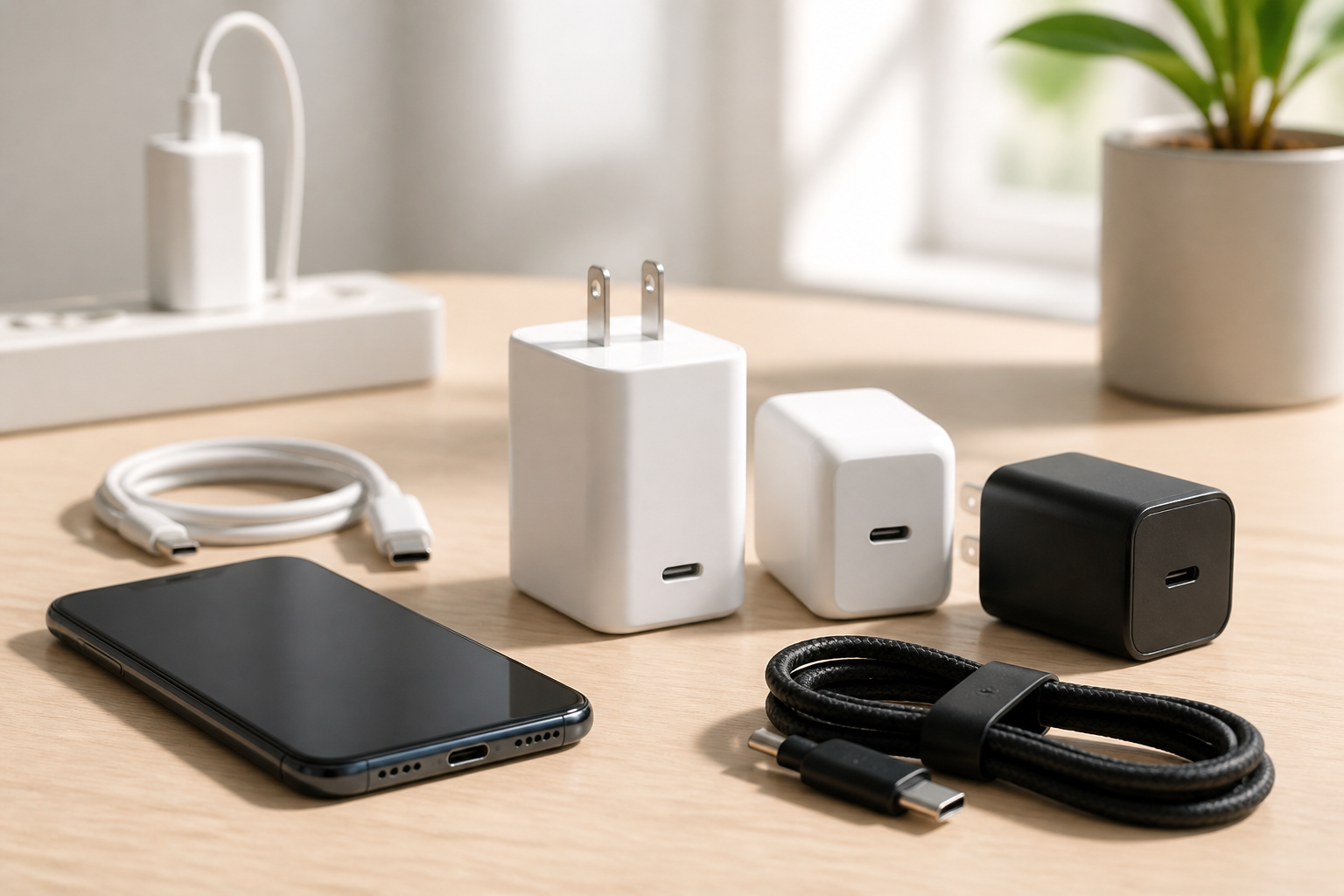
Most modern smartphones use either USB-C or, in some older models, Lightning. The charger itself usually plugs into the wall and connects to a cable, so the cable end must match your phone. If your phone uses USB-C, you will need a USB-C cable. If your phone uses Lightning, you need a Lightning-compatible cable. Choosing the right cable is just as important as choosing the wall adapter.
Look for supported charging standards
Different brands and devices may support different fast-charging standards. Some phones charge best with their manufacturer’s own system, while others use common standards such as USB Power Delivery. The practical point is simple: check your phone’s specifications before buying. If your phone only accepts moderate charging speeds, a very high-output charger will not necessarily make it charge faster.
Buying a charger with the right standard helps you avoid disappointment. It also makes it easier to choose a charger that will remain useful if you upgrade to a newer phone later.
Understand Wattage, Voltage, and Amperage
Charger packaging often highlights wattage, which is one of the most useful numbers to pay attention to. In simple terms, wattage indicates how much power the charger can deliver. Higher wattage can support faster charging, but only if your phone can accept it.
Why wattage matters
If you use a charger with very low wattage, your phone may charge slowly, especially if you are using it while plugged in. A charger with sufficient wattage can improve charging convenience because the battery can recover more quickly. However, more wattage does not automatically mean better results. The phone and the charger must work together.
Why “more power” is not always better
Some buyers assume that the highest-power charger is the best choice for every device. That is not always true. If your phone is designed to draw only a certain amount of power, it will usually limit itself. In other words, buying far more power than you need may increase cost or size without offering a noticeable benefit. A sensible approach is to match the charger to your device and usage pattern.
Choose the Right Charger Type
Smartphone chargers come in several forms, and the right one depends on where and how you charge.
Wall chargers
Wall chargers are the most common choice for everyday use. They plug into a wall outlet and usually provide the fastest and most reliable charging. If you mostly charge at home, a good wall charger is often the best starting point. Look for one that is compact enough for your outlet space but powerful enough for your phone.
Multi-port chargers
Multi-port chargers are useful for families, shared workspaces, and anyone who charges several devices at once. They can reduce clutter and save outlet space. If you choose a multi-port charger, check how power is distributed across ports. Some chargers advertise a high total output, but each port may provide less power when multiple devices are connected. That can be perfectly fine if you understand how you plan to use it.
Wireless chargers
Wireless chargers offer convenience because you simply place your phone on a pad or stand. They are useful on desks, nightstands, and bedside tables, especially when you want easy access without plugging and unplugging a cable repeatedly. However, wireless charging is often slower than wired charging and may require more precise placement. A wireless charger is best when convenience matters more than maximum speed.
Car chargers
Car chargers are helpful for commuters, rideshare drivers, and road-trippers. They are not a replacement for a home charger, but they are useful when you need to top up on the go. Look for a car charger that fits your vehicle’s power outlet and offers the charging speed your phone can use.
Prioritize Safety and Build Quality
A good charger should do more than deliver power. It should do so consistently and with dependable construction. While shoppers often focus on speed, safety and build quality are equally important in day-to-day use.
Check for clear product information
Quality chargers usually provide clear specifications such as input, output, port type, and supported standards. Vague or incomplete labeling can be a warning sign. When product information is easy to understand, it is easier to compare options and avoid buying something that does not suit your device.
Look for protection features
Many chargers include protection against common electrical issues such as overheating, overcurrent, or short-circuit conditions. These features are worth considering because they suggest the charger is designed with everyday use in mind. While no accessory can guarantee perfect performance in every situation, sensible protection features are a positive sign.
Consider the physical design
Build quality also includes the shape, size, and sturdiness of the charger itself. A compact charger may be ideal for travel, but it should still feel stable when plugged in. If the prongs fold, that can make storage easier. If the charger will sit behind furniture or in a crowded outlet, a slimmer design may be more practical. The best physical design depends on your environment.
Make Sure the Cable Matches the Charger
Many charging frustrations come from the cable rather than the wall adapter. A charger and cable must work as a pair. Even a high-quality adapter will not perform well if the cable is poorly made, incompatible, or not rated for the charging speed you want.
Use a cable that supports the same charging level
Some cables can carry higher power more effectively than others. If you want fast charging, choose a cable that is suitable for the charger and the phone. This is especially important for USB-C charging, where cable quality can affect how well the charger performs. If your cable is too limited, the overall charging speed may drop.
Match the connector to your devices
If you use several devices, think carefully about connector types. A household may include USB-C phones, older accessories, tablets, or headphones with different ports. Choosing a charger with the right mix of ports and cables can prevent unnecessary clutter and repeated adapter purchases.
Think About Port Count and Everyday Use
How many devices do you charge at the same time? This simple question can help narrow your choice quickly. A solo user with one phone may prefer a small single-port charger. A parent, frequent traveler, or shared-office user may benefit from multiple ports.
- Single-port chargers are often smaller and simpler.
- Dual-port chargers can serve a phone plus another device.
- Multi-port chargers are better for shared spaces or travel kits.
When comparing port counts, do not look only at the number of ports. Also consider whether the charger can deliver enough power to each connected device. A charger that splits power too thinly may be less convenient than a smaller charger used in combination with another adapter.
Consider Portability and Travel Needs
If you travel often, portability can be more important than raw charging power. A compact charger is easier to pack, and a foldable-plug design can protect the prongs and reduce snagging in a bag. Travelers may also prefer a charger that supports a wide range of input voltages, since that can make it more flexible in different regions. Always check the product’s specifications carefully before using it in another country.
For many people, a travel-friendly charger is one that balances size, weight, and usefulness. A small wall charger with a single USB-C port may be ideal for hotel stays. A lightweight multi-port charger may work better if you carry several devices. The right answer depends on whether you value minimal packing or greater versatility.
Decide Between Fast Charging and Convenience
Some users want the fastest possible charge, while others care more about simplicity. Your answer should reflect your routine.
Fast charging is useful when time matters
If you often need a quick battery top-up before leaving home, a fast charger can be a practical upgrade. It can reduce the time your phone needs on the outlet, which is especially useful for busy schedules. Fast charging is also helpful if you use navigation, video calling, or other battery-intensive apps throughout the day.
Convenience may matter more for overnight charging
If you usually charge overnight, extremely fast charging may be less important. In that case, a dependable, well-built charger with steady output may be the smarter choice. A wireless charger on a bedside table or a simple wall charger on a nightstand may suit your routine better than a high-output travel brick.
Common Mistakes to Avoid
Many charging problems can be avoided by steering clear of a few common buying mistakes.
- Buying without checking compatibility: A charger may be powerful but still unsuitable for your phone or cable.
- Assuming higher wattage always helps: The phone sets the limit for charging speed.
- Ignoring the cable: A weak or incompatible cable can reduce performance.
- Overlooking port sharing: Multi-port chargers may distribute power differently when more than one device is connected.
- Choosing only by price: A very cheap charger may lack the features or build quality you need.
- Forgetting about placement: A bulky charger may block adjacent outlets or not fit well behind furniture.
Who Different Charger Types May Suit
Different users have different needs, so the best charger depends on your situation.
- Students and office workers: A compact wall charger or desk-friendly multi-port model may be useful.
- Frequent travelers: A small charger with folding prongs and solid portability can be a strong choice.
- Families: Multi-port chargers can reduce the number of adapters scattered around the home.
- Heavy phone users: A compatible fast charger can help keep the battery topped up throughout the day.
- Minimalists: A single versatile charger that works across several devices can reduce clutter.
Practical Tips Before You Buy
Before you make a purchase, it helps to slow down and verify the details. A few minutes of checking can prevent an incompatible or inconvenient choice.
- Confirm your phone model and its supported charging method.
- Check the charger’s output rating and compare it with your phone’s needs.
- Make sure the cable type matches your device.
- Consider where you will use the charger most often.
- Decide whether you need one port or several.
- Choose the smallest charger that still meets your practical needs.
- Look for clear product specifications rather than vague marketing language.
If you already own a good cable, it may be worth buying only the adapter. If not, a charger-and-cable bundle can sometimes be more convenient, provided both parts match your phone and charging goals.
Frequently Asked Questions
Is a higher-watt charger always better for a smartphone?
No. A higher-watt charger is only useful if your phone can take advantage of it. Many phones limit the amount of power they draw, so you should choose a charger that matches your phone’s supported charging level.
Can I use any USB-C charger with any USB-C phone?
Often yes, but not always with the same charging speed. Compatibility and speed depend on the phone, charger, and cable. For best results, check that the charger supports the charging standard your phone uses.
Do wireless chargers damage batteries?
Wireless charging is widely used and can be convenient, but it is typically slower and may produce more heat than wired charging in some situations. If you prefer wireless charging, choose a well-made charger and follow the product’s usage instructions.
How important is the cable compared with the charger?
Very important. The cable is part of the charging system, and an incompatible or low-quality cable can limit speed or convenience. If charging performance matters, treat the cable and adapter as a matched pair.
Should I buy a charger with more than one port?
Choose a multi-port charger if you regularly charge more than one device. If you only charge one phone, a single-port model may be simpler and more compact.
Conclusion
Choosing a good smartphone charger is mostly about matching the charger to your phone, your cable, and your daily habits. Focus on compatibility first, then compare wattage, charging standards, port count, portability, and build quality. The best charger is not always the most powerful or the most feature-rich. It is the one that fits your real-world routine and charges your device reliably.
If you take the time to check your phone’s requirements, choose the right cable, and consider how you will use the charger day to day, you can avoid common mistakes and buy with confidence. That way, your charger becomes a simple, dependable tool rather than a source of confusion.