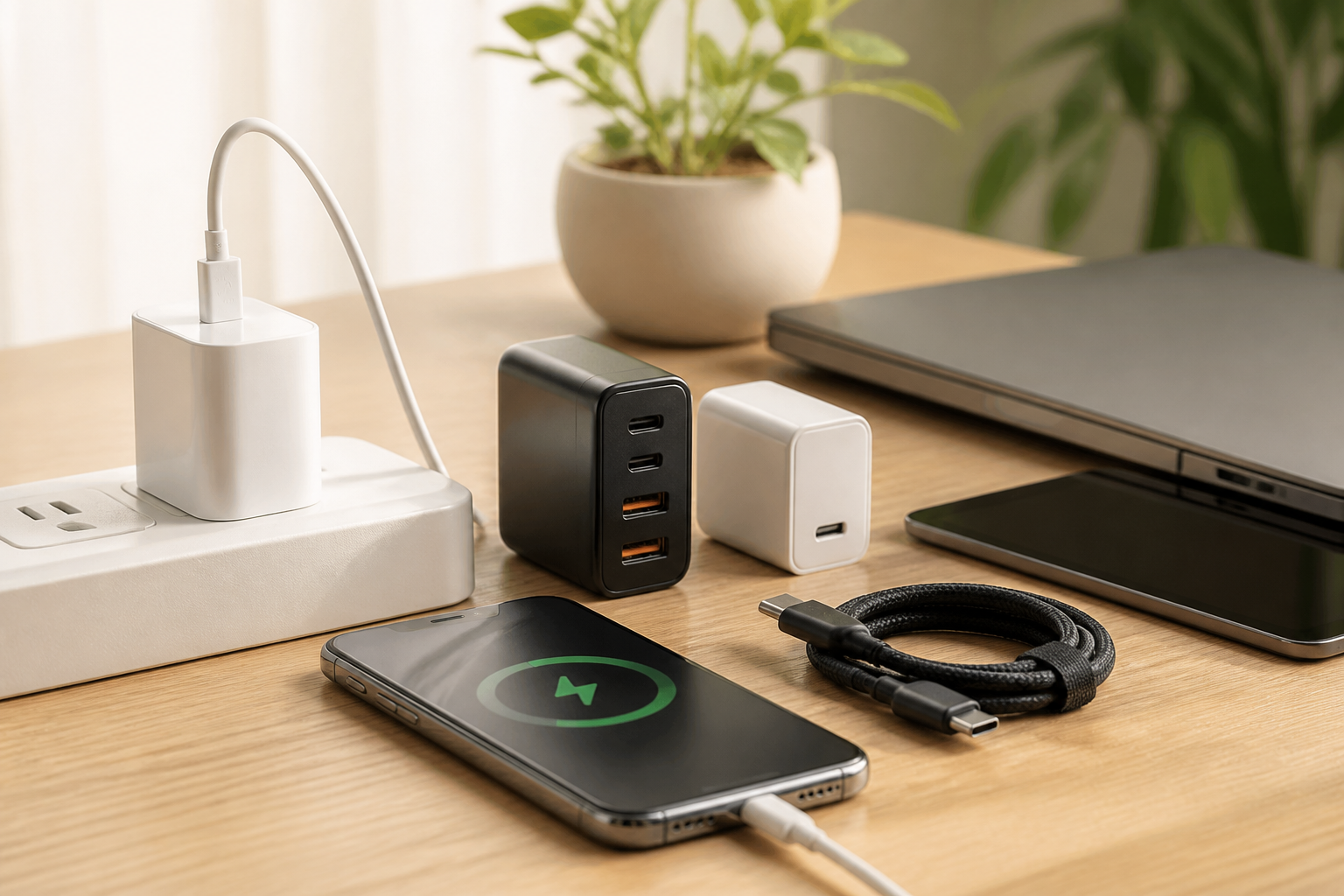
Fast chargers have become a normal part of everyday life. Many people use them to top up a phone before leaving for work, keep a tablet ready for the evening, or recharge wireless earbuds and other small devices during the day. But not every charger that claims to be “fast” is equally dependable. Some are poorly matched to a device, some are inconvenient to carry, and others may not hold up well to regular use.
If you are looking for a reliable fast charger for everyday use, the best choice is usually not the one with the biggest wattage number on the box. It is the charger that fits your devices, delivers power consistently, includes the right safety features, and feels practical in the places you actually use it. This guide explains what to look for, what to avoid, and how to make a smart choice without overpaying for features you do not need.
The goal is simple: help you choose a charger that works smoothly day after day, with less frustration and fewer compatibility surprises.
What “Reliable” Means in a Fast Charger
Reliability is about more than speed. A charger can be fast and still be a poor everyday pick if it runs hot, fits loosely in the wall, disconnects easily, or does not work well with your devices. A reliable fast charger should do several things well at the same time:
- Provide the charging speed your device can safely use
- Work consistently across repeated charging sessions
- Stay physically sturdy enough for daily plugging and unplugging
- Support common devices without needing constant troubleshooting
- Include sensible safety protections and clear labeling
When shopping, think of reliability as a mix of performance, compatibility, build quality, and convenience. That mindset makes it easier to compare options fairly.
Start With Your Devices and Charging Needs
Before comparing charger features, identify what you plan to charge. The right model depends heavily on whether you are charging a smartphone, tablet, laptop, earbuds, a gaming handheld, or a mix of devices.
Match the charger to your main device
Phones and earbuds usually need less power than tablets and laptops. If your main goal is to charge a phone overnight or during a short break, a mid-range charger may be enough. If you want to charge a larger device or multiple items at once, look for a higher-output charger with enough ports to handle your routine.
Also consider whether your device supports fast charging at all. A charger may be rated for high wattage, but your device will only draw the amount it is designed to accept. In other words, buying an oversized charger does not always make charging faster.
Think about your daily routine
The best charger for everyday use depends on where you charge most often. A bedside charger may need to be compact and quiet. A desk charger may benefit from multiple ports. A travel charger may need foldable prongs and a smaller body. If you regularly move between home, office, and travel, flexibility becomes especially important.
Understand the Key Charging Standards
One of the most common mistakes buyers make is focusing only on wattage and ignoring charging standards. The standard matters because it determines whether the charger and device can communicate properly and negotiate the correct power level.
USB-C Power Delivery
USB-C Power Delivery is widely used for phones, tablets, laptops, and other modern devices. If your devices use USB-C, this standard is often a strong choice because it is broadly compatible and designed for efficient power negotiation. For everyday use, a USB-C charger with Power Delivery support is often the most practical option.
Other fast-charging systems
Some phones and accessories use brand-specific charging systems or additional protocols. These can work very well within a particular ecosystem, but compatibility may be more limited outside it. If you own multiple brands of devices, a charger that supports a widely adopted standard may be the safer all-around choice.
When checking product details, look for explicit mention of supported standards rather than vague claims like “super fast” or “ultra charging.” Clear technical labeling is usually a better sign than marketing language alone.
Choose the Right Wattage
Wattage is important, but only when interpreted correctly. Higher wattage does not automatically mean better everyday performance. It simply tells you the maximum power output the charger can provide under the right conditions.
Why more wattage is not always better
If your phone can only accept a limited charging rate, a much larger charger will not force extra power into it. The device will draw only what it can use. That means a charger with far more wattage than you need may cost more and be larger or heavier without giving you a noticeable benefit.
How to choose a sensible output
A practical approach is to choose a charger that comfortably meets your primary device’s needs with some room for flexibility. For example, if you charge a phone and earbuds, a modest-output charger may be enough. If you want one charger that can also handle a tablet or laptop, a higher-output model is more useful.
If the charger has multiple ports, pay attention to how the output is shared. Some chargers advertise a high total wattage, but that power may be divided across ports. A charger that looks powerful on paper may deliver less per device when several items are connected.
Look for the Right Number and Type of Ports
Port selection matters more than many shoppers realize. A charger with the wrong port mix can be awkward in daily life, even if its technical specs look good.
Single-port chargers
Single-port chargers are often the simplest and most compact choice. They work well if you usually charge one device at a time and want the smallest possible wall charger for a desk, nightstand, or travel bag.
Multi-port chargers
Multi-port chargers make sense if you regularly charge several devices together. They can reduce clutter and eliminate the need for multiple adapters. However, check whether all ports can charge at full speed simultaneously or whether the output drops when more than one device is connected.
USB-C versus USB-A
USB-C is increasingly the preferred port for fast charging, while USB-A remains common for older cables and accessories. A charger with USB-C ports is generally more future-friendly, but a mix of USB-C and USB-A may be convenient if you still use legacy cables. The best choice depends on the devices and cables you already own.
Pay Attention to Safety Features
Safety features are a major part of charger reliability. While no accessory can eliminate every risk, a well-designed charger should include protections that help reduce common electrical problems.
Important protections to look for
- Overcurrent protection
- Overvoltage protection
- Temperature management
- Short-circuit protection
- Power negotiation that matches the device’s needs
These features are especially important if you plan to use the charger every day, leave it plugged in for long periods, or charge multiple devices in one place. A charger that manages heat well and operates predictably is generally a better long-term choice than one with minimal documentation.
Do not ignore temperature and heat
It is normal for chargers and devices to warm up during charging, especially at faster speeds. What matters is whether the charger appears to manage heat reasonably and whether it is used in a well-ventilated area. A compact charger that stays excessively hot during normal use is not ideal for everyday charging.
Evaluate Build Quality and Everyday Convenience
Fast chargers are handled constantly, so physical design matters. A charger that looks good online but feels flimsy in person may not be the best daily driver.
What build quality can tell you
Look for a sturdy shell, solid port fit, and a design that does not rattle or feel loose. Foldable prongs can be very helpful for travel. A compact form factor can be useful for carrying, but the charger should still feel stable when plugged in.
Also think about cable quality. A reliable charger is often part of a reliable charging setup, and the cable plays a major role. A fast charger may not perform as intended if paired with an old, low-quality, or incompatible cable.
Size and portability
If you plan to use the charger at home only, a slightly larger model may be fine. If you carry it in a bag every day, size and weight become much more important. A charger that is too bulky can be annoying even if it performs well.
For travel, a charger with a compact body and foldable plug is often more practical than one with an extra port you rarely use.
Check Compatibility Beyond the Box
Compatibility is where many fast-charger purchases go wrong. Two chargers with similar labels can behave very differently depending on the device, cable, and power standard involved.
Device compatibility
Always verify that the charger supports your device type. This is especially important for laptops, tablets, and brand-specific phones. Some devices need a particular charging protocol to reach higher speeds.
Cable compatibility
The cable matters as much as the charger. A cable that is not rated for the required power can limit charging speed or create inconsistent results. If the charger does not include a suitable cable, be sure to choose one that matches the charger’s output and your device’s needs.
Wall outlet and travel compatibility
If you travel, make sure the charger works with the outlet types you plan to use. Some compact chargers are ideal for home use but less convenient internationally. In that case, you may need an adapter or a travel-specific charger designed for broader use.
Consider Brand Transparency and Product Information
A reliable charger usually comes with clear and specific product details. Vague descriptions can make it difficult to know what you are buying.
Better signs of a trustworthy listing
- Clear wattage and port output details
- Named charging standards and device compatibility
- Complete technical specifications
- Clear explanation of what is included in the box
- Warranty and support information presented clearly
Shoppers do not need to become electrical engineers, but they should expect basic clarity. If a product page does not clearly explain how the charger behaves with one device versus multiple devices, that is a warning sign.
Be cautious with exaggerated claims
Be wary of broad claims that promise universal compatibility, extremely rapid charging for every device, or performance that seems too good to be true. Fast charging is real, but it still depends on the device, cable, and supported standard. A more precise product description is usually a better sign than bold marketing language.
Common Mistakes to Avoid
Buying a fast charger is easier when you know the traps that often lead to disappointment.
- Choosing based on wattage alone without checking compatibility
- Ignoring cable quality and cable rating
- Buying a multi-port charger without checking how power is shared
- Assuming every USB-C charger works the same way
- Picking the cheapest option without reviewing safety and build details
- Overbuying power you do not actually need
These mistakes often lead to chargers that are slower than expected, harder to use, or less durable over time.
Who Different Types of Fast Chargers May Suit
Different users need different charging setups. Thinking about your use case can make the choice much easier.
Best for minimalists
If you charge one phone and want something simple, a compact single-port USB-C charger may be the most sensible option. It keeps your setup clean and is easy to carry.
Best for families or shared spaces
In homes with multiple devices, a multi-port charger can help reduce clutter and make daily charging easier. This is especially useful in kitchens, common areas, or shared desks.
Best for commuters and travelers
Frequent travelers often benefit from a small charger with foldable prongs and broad compatibility. If you move between locations often, convenience and portability may matter more than having the highest possible power output.
Best for laptop users
If your charger must handle a laptop, focus on enough power output, compatible standards, and a suitable cable. A phone charger may not be enough for a laptop, even if both use USB-C.
Practical Tips for Daily Use
Once you have chosen a charger, a few simple habits can help it perform better and last longer.
- Use a cable that matches the charger’s power capability
- Keep the charger in a well-ventilated space during use
- Unplug and replug carefully to avoid stressing ports and prongs
- Store the charger where the cable will not be sharply bent
- Check occasionally for damage to the cable, plug, or connector
- Use only the ports and standards the charger is designed to support
These habits are simple, but they can improve convenience and reduce unnecessary wear in everyday use.
Frequently Asked Questions
Is a higher-watt charger always faster?
Not necessarily. Your device controls how much power it accepts. A higher-watt charger only helps if your device can use that extra power.
Can one fast charger work for all my devices?
Sometimes, yes, if it supports the right standards and has enough output. However, some devices charge best with specific protocols, so compatibility still matters.
Do I need a multi-port charger?
Only if you regularly charge more than one device at the same time. If you usually charge one device, a single-port charger may be simpler and smaller.
Should I buy the charger or the cable first?
Think of them together. A good charger can still underperform with the wrong cable. Ideally, choose both as a matching pair.
How can I tell if a fast charger is reliable?
Look for clear specifications, recognized charging standards, sensible wattage for your device, solid build quality, and transparent support information. Reliability is usually easier to judge when the product listing is specific rather than vague.
Conclusion
Choosing a reliable fast charger for everyday use is mostly about matching the charger to your actual routine. Start with your devices, confirm the charging standards they support, choose a sensible wattage, and pay close attention to port types, safety features, cable compatibility, and build quality. A good charger should make daily life easier, not more complicated.
If you focus on compatibility, clarity, and practical design, you are far more likely to end up with a charger that performs consistently and fits naturally into your day. That is the real value of a reliable fast charger: not just quick power, but dependable convenience every time you plug in.