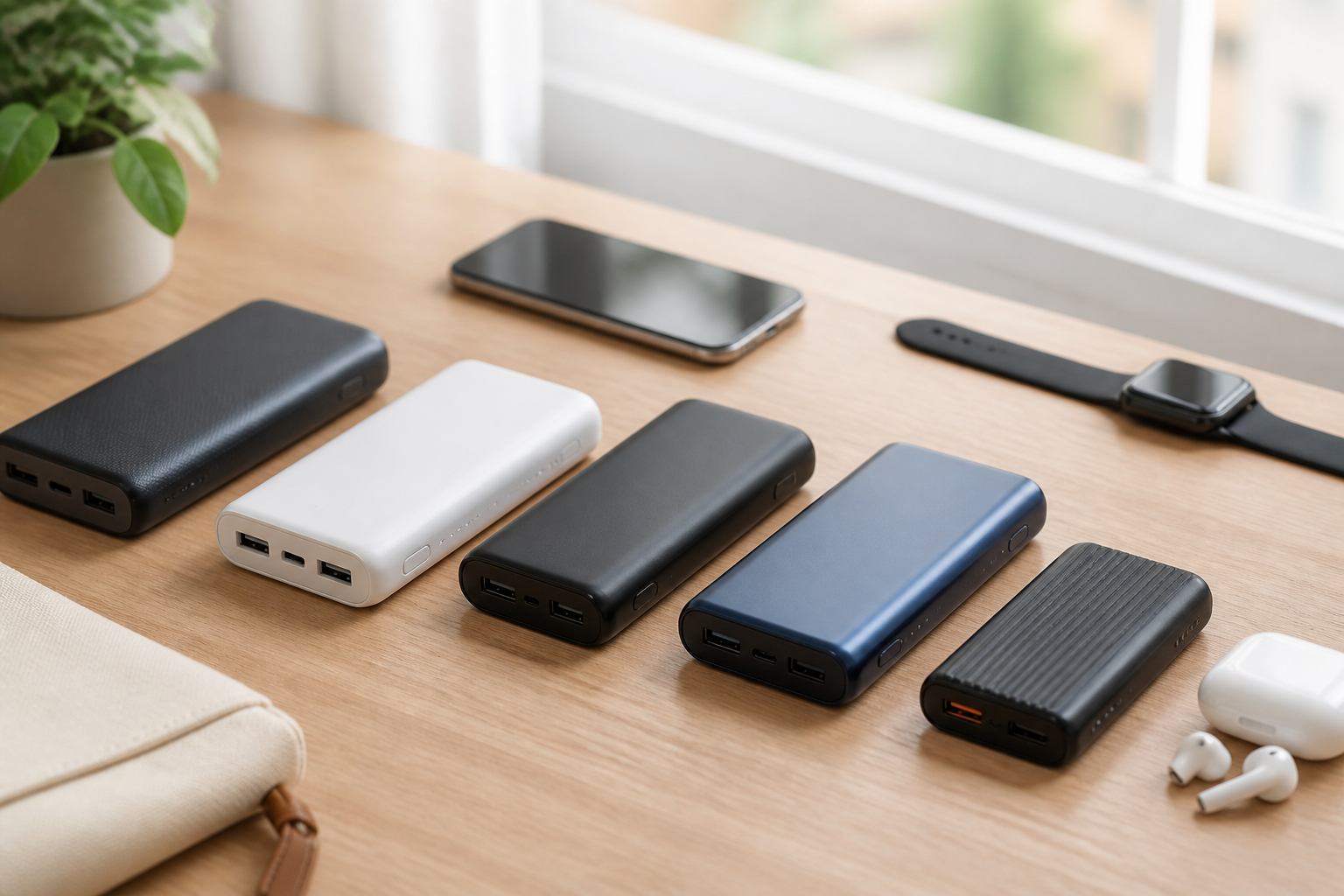
Choosing the right power bank for your smartphone is not just about buying the biggest battery you can find. The best option depends on how you use your phone, how often you travel, whether you need fast charging, and how much weight you are willing to carry every day. A good power bank should fit your routine instead of adding extra hassle.
If you have ever bought a charger that felt too bulky, charged too slowly, or did not hold enough power for a full day away from an outlet, you already know why this choice matters. The goal is to find a power bank that is practical, safe, and compatible with your phone and accessories.
Start with your real charging needs
The first step is to think about how you actually use your smartphone. Someone who only needs a little backup during commutes has very different needs from someone who travels, streams video all day, or uses the phone for work navigation and hotspot duties.
Ask yourself a few simple questions before shopping:
- Do you need enough power for one full recharge or several?
- Will you carry the power bank every day or only on trips?
- Do you want to charge one phone or multiple devices?
- Is fast charging important, or is overnight charging enough?
Once you understand your usage pattern, the other specifications become easier to evaluate.
Choose the right capacity
Capacity is one of the most important factors when buying a power bank. It is usually measured in milliampere-hours, or mAh. In simple terms, a higher number generally means more stored energy, but it also usually means a larger and heavier device.
Common capacity ranges
A compact power bank around 5,000 mAh is often a good choice if you want something light and pocket-friendly. It is useful for topping up a smartphone in emergencies or getting through part of a day when you cannot reach a wall charger.
A 10,000 mAh power bank is one of the most practical all-around options for most smartphone users. It usually offers a good balance between portability and usable energy. Many people find this size ideal for daily carry or short trips.
A 20,000 mAh power bank is better for longer travel, heavy phone use, or charging more than one device. It is less convenient to carry than smaller models, but it can provide more peace of mind when outlets are unavailable.
Very large models above that range can be useful for tablets or extended travel, but they are often unnecessary for basic smartphone backup. Bigger is not always better if you rarely use the extra capacity.
Understand usable capacity
It is important to remember that a power bank’s rated capacity is not the same as the exact amount your phone will receive. Some energy is lost during conversion and charging. That means a 10,000 mAh power bank will not usually deliver 10,000 mAh directly to your phone battery.
Because of this, it is smart to buy a little more capacity than the minimum you think you need. If you want one full phone charge and some backup, a 10,000 mAh model may be more realistic than a 5,000 mAh model.
Check charging speed and output
A power bank can have plenty of capacity but still feel frustratingly slow if the output is weak. Output affects how quickly it can charge your smartphone, and this matters a lot if you need a quick top-up before leaving home.
Look for the output rating on the power bank’s ports. Many modern smartphones support faster charging when paired with a compatible power bank and cable. If the output is too low, your phone may charge, but not at an ideal speed.
Why fast charging support matters
If your phone supports fast charging, choosing a power bank that also supports that standard can save a lot of time. This is especially helpful when you are on the move and only have a short window to charge.
However, fast charging only works well when the power bank, cable, and phone all support compatible charging standards. A high-output power bank is useful, but it should still match your device’s needs.
Do not ignore input speed
Input speed is how fast the power bank itself can be recharged. This is easy to overlook, but it matters if you want the power bank ready quickly for the next trip. A large capacity model with slow input can take a long time to refill, which becomes inconvenient if you use it often.
Make sure it matches your smartphone
Compatibility is essential. Your smartphone may use USB-C, Lightning, or another charging standard depending on the brand and model. The power bank should have the right port and support the charging method your phone expects.
For most modern smartphones, USB-C is the most flexible choice because it is common, efficient, and often supports faster charging. Some power banks include multiple output ports, which can be useful if you also carry earbuds, a smartwatch, or another device.
If your phone supports wireless charging, you may also see wireless power banks. These can be convenient, but they are often slower and less efficient than wired charging. They can be a good option for convenience, but they are not always the best choice if speed and efficiency matter most.
Consider portability and weight
Many buyers focus on capacity first and then regret choosing a power bank that is too heavy for daily use. Portability matters because a power bank only helps if you actually carry it with you.
Smaller power banks are easier to slip into a pocket, purse, or small bag. Larger models may be fine for a backpack, suitcase, or work bag, but they can feel cumbersome if you want something lightweight for everyday carry.
A useful way to decide is to think about where the power bank will live most of the time. If it stays in a travel bag, a larger model may be acceptable. If it needs to fit in a jacket pocket, smaller is often better.
Look at the number and type of ports
The ports on a power bank affect how flexible it is. A model with one output port may be enough for a single phone user. If you often charge more than one device, multiple ports can be helpful.
Also pay attention to port type. USB-C is increasingly important because it can often work as both input and output. Some older models may still rely on micro-USB for recharging, which is less convenient for many users today.
Here are a few practical considerations:
- One port may be enough for simple phone backup.
- Two or more ports can help if you charge a phone and accessories.
- USB-C input and output can make the power bank more future-friendly.
- Multiple port types can reduce the need to carry extra adapters.
Think about safety features
Safety should never be an afterthought. A power bank is a battery device, so you want one that includes sensible protections against common issues such as overheating, overcharging, and short circuits.
Reliable safety features help reduce the chance of damage to your phone or the power bank itself. They also make the device more comfortable to use for everyday charging, overnight top-ups, or travel.
When comparing options, check whether the product description mentions basic protection features in clear terms. Avoid vague listings that give little detail about safety or build quality.
Pay attention to build quality and design
A power bank should feel solid enough to survive life in a bag or pocket. The outer shell, buttons, and port area should seem durable and well put together. Cheaply made devices may wear out faster or feel unreliable over time.
Design also affects convenience. A clear battery indicator is useful because it helps you know when to recharge the power bank. Some models use simple LED lights, while others use percentage displays. Either can work well as long as the information is easy to read.
Physical size, grip, and cable storage can also matter. A slim shape may be better for daily carry, while a sturdier build may suit travel more than minimalism.
Understand what the battery indicator really tells you
A battery indicator is helpful, but it is not always perfectly precise. A four-light system, for example, gives a general idea of charge level, while a percentage display may offer more detail. Either way, the indicator is meant to guide you rather than provide laboratory-level accuracy.
The key is to use it as a planning tool. If you know the power bank is nearly empty, recharge it before leaving home. That simple habit prevents surprises when you need it most.
Do not overlook cable quality
Even a good power bank can perform poorly if you use a low-quality cable. The cable can influence charging speed, reliability, and convenience. Some power banks include a cable, while others do not, so check before buying.
If your smartphone supports fast charging, the cable should also be suitable for that standard. Using the wrong cable may limit performance even if the power bank itself is capable of faster output.
It is often worth keeping a dedicated cable in your bag with the power bank so you always have the right setup when you need it.
Choose a capacity that fits your travel habits
Travel changes the equation. For short daily outings, a compact charger may be enough. For flights, road trips, or long workdays, a higher-capacity model is often more practical.
If you travel frequently, consider a power bank that balances capacity with airline-friendly size and weight. Rules can vary by airline and region, so it is wise to check current travel guidelines before flying with larger battery packs.
For commuters, a slim model that can rescue a low phone battery during the day may be the best fit. For vacations or business trips, a larger power bank can reduce anxiety about finding outlets.
Common mistakes to avoid
Many shoppers make the same avoidable mistakes when buying a power bank. Learning these ahead of time can save money and frustration.
- Buying based on capacity alone and ignoring charging speed.
- Choosing a model that is too heavy to carry regularly.
- Overlooking compatibility with the smartphone’s charging port.
- Forgetting to check whether a cable is included.
- Ignoring input speed and ending up with a slow-to-recharge power bank.
- Assuming every fast-charging label will work with every phone.
- Picking an oversized model when a smaller one would be more practical.
A thoughtful purchase is usually better than a bigger one. The goal is not to buy the most impressive-looking battery, but the one that genuinely fits your routine.
How to compare options before buying
When comparing power banks, it helps to reduce the decision to a few practical questions. This keeps you from getting distracted by marketing language that sounds impressive but does not necessarily help in real use.
- How many full smartphone charges do I need?
- Will I carry this every day or only occasionally?
- Does it support my phone’s charging standard?
- Is it fast enough for my schedule?
- Is it small enough to carry comfortably?
- Does it have the ports I actually need?
If a model answers these questions well, it is probably a stronger fit than one with flashy but unnecessary extras.
When a wireless power bank makes sense
Wireless power banks can be useful if you value convenience over maximum speed. They can be especially handy when you want to keep things simple and avoid carrying a cable for short top-ups.
That said, wireless charging usually involves more energy loss than wired charging, and it may also charge more slowly. For people who depend on their phone throughout the day, a wired power bank is often the more practical everyday choice.
Wireless models make the most sense when ease of use is your top priority and you are comfortable with a slower or less efficient charge.
FAQ: Choosing the right power bank for a smartphone
What capacity is best for most smartphone users?
For many people, 10,000 mAh is a good balance of size, portability, and useful backup power. It is often enough for a solid emergency charge or more, without becoming too bulky for daily use.
Is a higher mAh always better?
Not necessarily. Higher capacity can mean more charging potential, but it also often means more size and weight. The best power bank is the one that fits how you actually carry and use it.
Can any power bank fast charge my phone?
No. Fast charging depends on compatibility between the power bank, cable, and smartphone. If one part does not support the right charging method, the overall speed may be lower.
Should I choose wired or wireless charging?
Wired charging is usually faster and more efficient. Wireless charging is more convenient in some situations, but it may not be the best choice if you want maximum speed or battery efficiency.
How many ports do I need?
If you only charge one smartphone, a single port may be enough. If you also charge earbuds, a smartwatch, or another phone, extra ports can make the power bank much more useful.
How do I know if a power bank is portable enough?
Check the size, weight, and shape before buying. If you plan to carry it daily, look for something slim and easy to store. If it will stay in a travel bag, you can prioritize capacity more freely.
Conclusion
Choosing the right power bank for your smartphone comes down to balancing capacity, charging speed, portability, compatibility, and safety. The best model is not always the largest or the cheapest. It is the one that matches your routine and gives you reliable backup power without unnecessary bulk.
For most buyers, a mid-capacity power bank with USB-C support, sensible safety features, and a size that is easy to carry will be the most practical option. If you travel often or use your phone heavily, you may want more capacity. If you only need occasional backup, a compact model may be perfect.
By focusing on real-world use instead of marketing language, you can choose a power bank that feels genuinely useful every time your phone battery runs low.