Introduction
A smartphone screen protector can seem like a small purchase, but the right choice can make a real difference in how your phone looks, feels, and handles everyday wear. With so many options available, it is easy to focus only on price or assume that all protectors do the same job. In reality, screen protectors vary in material, durability, clarity, touch response, edge coverage, and compatibility with cases and fingerprint sensors.
This guide explains how to choose the right screen protector for your smartphone based on your needs, not just the packaging. Whether you want basic scratch protection, a smoother glass-like feel, added privacy, or a protector that works well with a curved display, understanding the main differences can help you make a better buying decision.
The best screen protector is not always the thickest or the most expensive. It is the one that fits your phone properly, supports the way you use your device, and offers the balance of protection and usability you actually want.
Start with Your Priorities
Before comparing products, it helps to decide what matters most to you. Different users have different needs, and the best protector for one person may be inconvenient for another.
Protection level
If your main concern is preventing scratches from keys, coins, dust, or daily friction, a basic protector may be enough. If you tend to drop your phone often, you may want a more durable option that offers better impact resistance, though no screen protector can guarantee complete protection against every type of damage.
Touch feel and clarity
Some people want a protector that feels as close as possible to the bare screen. Others are willing to trade a little clarity or smoothness for added privacy, matte texture, or reduced glare. Think about how often you use your phone for gaming, typing, video viewing, or outdoor use.
Budget and replacement frequency
A screen protector is usually a replaceable accessory, so it is worth considering how often you may need to swap it out. If you are comfortable replacing protectors more frequently, you may prefer a lower-cost option. If you want something that lasts longer and stays visually clean, a more durable material may be worth considering.
Understand the Main Screen Protector Types
The most important buying decision is usually the material. The common types differ enough that the right one depends on how you use your phone.
Tempered glass
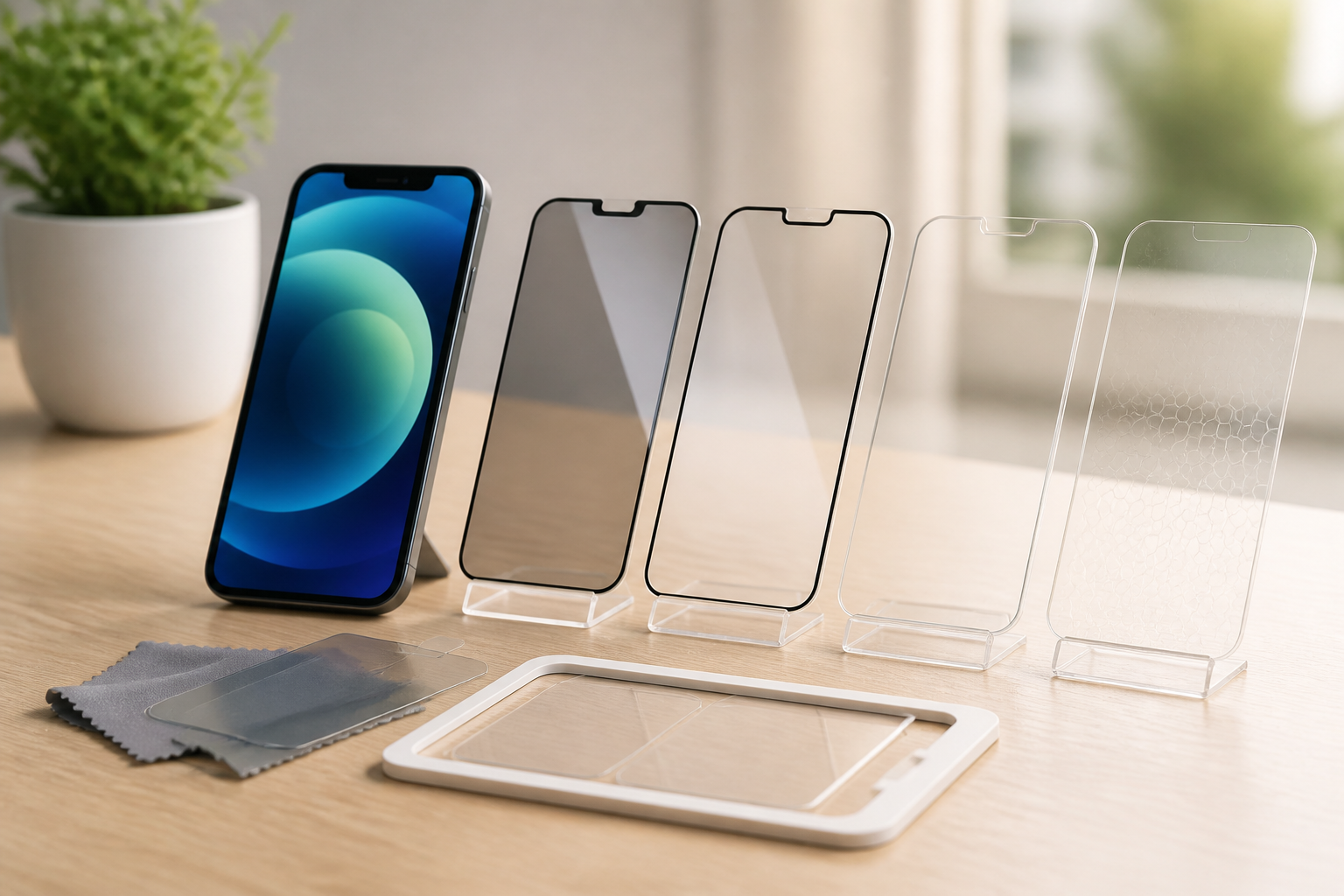
Tempered glass is one of the most popular choices because it often provides a smooth, glass-like feel and strong scratch resistance. It can be a good fit for users who want a familiar touch experience and clear display visibility. Tempered glass protectors are often thicker than film alternatives, which can make them feel sturdier and easier to apply, but they may also be more noticeable on the screen.
Tempered glass can be a strong option for everyday users who want a simple balance of clarity, touch comfort, and protection. However, compatibility with curved screens, fingerprint sensors, and certain cases should be checked carefully before buying.
Plastic film
Plastic film protectors, often made from PET or TPU, are typically thinner and less noticeable than tempered glass. They may be a good choice for people who want light protection without adding much bulk. Film protectors can be useful for reducing minor scratches and maintaining a very slim profile.
Film can also work well on some curved displays where rigid glass protectors may not fit as cleanly. The trade-off is that the feel may be less premium than glass, and the level of protection is usually more basic. Some film protectors also show marks or micro-scratches more easily over time.
Hybrid and specialty options
Some protectors are designed to combine qualities of glass and film, or to provide a specific feature such as anti-glare, anti-reflective, privacy filtering, or extra flexibility for curved screens. These can be helpful if you have a specific use case, but it is especially important to verify compatibility and understand what trade-offs the special feature introduces.
Check Compatibility with Your Smartphone
Compatibility is one of the most common buying mistakes. A screen protector may be marketed as suitable for a phone model, but details still matter.
Exact model fit
Phone screens can vary by size, shape, camera cutout, and sensor placement even across similar-looking models. Always confirm the protector is made for your exact phone model. A protector for one version of a phone may not align correctly with another version from the same brand.
Case compatibility
If you use a protective case, make sure the screen protector is designed to work with it. Some protectors extend too close to the edges and may lift when paired with a case. A case-friendly design usually leaves a little space around the perimeter so the case can sit properly without pushing up the protector.
Curved displays
Phones with curved edges can be more difficult to cover. Some protectors are made to cover only the flatter center area, while others use flexible materials or special adhesive methods to improve edge coverage. If your phone has a curved screen, pay special attention to whether the protector covers the entire active display and whether it is known to stay in place securely.
Sensor and camera cutouts
Some phones use in-display fingerprint readers or have front-facing cameras positioned within the screen area. A poorly matched protector can interfere with these features. Read the product details carefully to confirm that cutouts, sensor support, and touch sensitivity are suitable for your device.
Consider Touch Sensitivity and Screen Responsiveness
A screen protector should not make your phone harder to use. If the protector interferes with typing, scrolling, swiping, or unlocking the phone, it may become frustrating quickly.
Fingerprints and touch ID support
If your smartphone uses an in-display fingerprint sensor, not every protector will work equally well. Some thicker glass options may affect recognition if they are not designed for that sensor type. Look for protectors specifically described as compatible with in-display fingerprint systems, and follow installation instructions carefully.
Gaming and fast typing
People who play mobile games or type quickly may prefer protectors that preserve a smooth, responsive feel. Tempered glass often provides a more natural glide for fingers, while some matte or film protectors create a slightly different touch experience. If responsiveness matters to you, consider how you use your phone most often.
Tap accuracy
A protector that is poorly installed, too thick for the device, or not aligned correctly may affect tap accuracy at the edges and corners. This is another reason why model-specific fit matters. Even a high-quality protector can feel unsatisfactory if it is not properly matched to the screen.
Think About Clarity, Glare, and Finish
Your screen protector should not turn a bright, sharp display into something dim or distracting. Finish and coating affect how the screen looks in daily use.
Clear or high-transparency finish
Clear protectors are generally the best choice if you want to preserve color accuracy and display sharpness. These are often preferred for streaming, photo viewing, and everyday use because they keep the phone looking close to its original state.
Matte or anti-glare finish
Matte protectors can reduce reflections and may be more comfortable in bright sunlight or under strong indoor lighting. They can also give the screen a different texture that some users prefer for writing or gaming. The trade-off is that matte finishes may slightly soften the display image or alter the way colors appear.
Privacy filters
Privacy screen protectors can limit side-angle viewing so that people nearby cannot easily read what is on your screen. These are useful for commuting, public spaces, or work-related privacy. However, privacy filters may reduce brightness or narrow the viewing angle, so they are not ideal for everyone.
Look at Durability and Scratch Resistance
Screen protectors are mainly designed to sacrifice themselves before the phone screen does, but their durability still varies.
Everyday scratch protection
For most people, the biggest value of a screen protector is preventing minor scratches from keys, dust, bag debris, and repeated contact. Even when a phone is handled carefully, fine scratches can appear over time. A good protector can help reduce that kind of wear.
Drop-related considerations
Some protectors are advertised with enhanced impact resistance. While that can be helpful, it is important to view such claims carefully. A screen protector may reduce the chance of direct contact on a fall, but it should not be treated as a complete solution against impact damage. Phone cases and careful handling still matter.
Resistance to visible wear
Different materials age differently. Glass protectors may stay visually clean for longer if they resist micro-scratches well, while some films may show marks sooner but can still function well as a lightweight protective layer. Consider how long you want the protector to maintain a clear look before replacement.
Pay Attention to Installation and Fit
Even a good protector can disappoint if it is difficult to install. Ease of installation is a practical factor that buyers sometimes overlook.
Dust control and alignment
Look for products that include alignment tools or installation frames if you want a simpler setup. These features can help reduce the chance of uneven placement, trapped dust, or edge misalignment. A precise installation matters because bubbles and dust can reduce both appearance and usability.
Adhesive quality
Some protectors use full-surface adhesion, while others have adhesive only around the edges or in specific areas. Full adhesion usually feels more secure and can improve touch consistency. Poor adhesive design may lead to lifting, rainbow effects, or reduced clarity in certain areas.
Repositioning and replacement
If you are not confident about installation, choose a protector that is known for easier alignment and less stressful application. Some materials are more forgiving during installation than others. A protector that can be applied cleanly on the first attempt may save time and frustration.
Choose Features Based on How You Use Your Phone
Extra features can be useful, but they are only worthwhile if they match your habits.
For outdoor use
If you often use your phone outside, glare reduction may be helpful. A clearer protector with good anti-reflective qualities or a matte finish may make the display easier to see in bright conditions.
For privacy-conscious users
If you read emails, messages, or documents in public, a privacy protector may be a practical choice. Just remember that privacy filtering usually comes with a brightness or viewing-angle trade-off.
For people who want a near-bare-screen feel
Users who are sensitive to touch response or prefer the original feel of the device often lean toward thin tempered glass with a smooth coating. This type may provide an experience closest to the original screen while still adding a protective layer.
For phones with curved edges
If your phone has a curved display, flexibility and edge coverage may matter more than a rigid glass feel. In that case, look for products specifically made to match the screen shape and avoid protectors that leave the edges exposed unless that is acceptable to you.
Common Buying Mistakes to Avoid
It is easy to buy the wrong protector if you focus only on a few visible features. These are some of the most common mistakes.
- Buying for the wrong model: A protector may look similar to another phone’s version but still fail to fit correctly.
- Ignoring case compatibility: A protector that reaches too close to the edge can lift when used with a case.
- Overlooking fingerprint sensor support: Some protectors can interfere with in-display sensors if they are not designed properly.
- Choosing features you do not need: Privacy or matte finishes are useful for some users, but unnecessary for others.
- Expecting a screen protector to replace a case: Screen protectors and cases serve different purposes and work best together.
- Skipping installation prep: Dust and misalignment are common reasons a protector looks bad or performs poorly.
Who Different Screen Protectors May Suit
Different protectors suit different buyers. Thinking in terms of use case can simplify the decision.
Tempered glass may suit
People who want a smooth, premium-feeling surface and clear display visibility often prefer tempered glass. It can also be a practical choice for general everyday use.
Film protectors may suit
Users who want a slimmer profile, need flexible coverage for curved screens, or only want basic scratch protection may prefer film.
Privacy protectors may suit
Commuters, office workers, and anyone who frequently uses their phone in public may find privacy filtering useful.
Matte protectors may suit
People who use their phone outdoors or dislike strong reflections may appreciate a matte or anti-glare finish.
Practical Tips Before You Buy
A few simple checks can help you avoid disappointment after purchase.
- Read the compatibility details carefully: Confirm the exact phone model, sensor support, and case fit.
- Decide on your finish first: Clear, matte, and privacy protectors feel very different in daily use.
- Check what comes in the box: Alignment tools, cleaning wipes, and dust removal stickers can make installation easier.
- Consider your replacement habits: If you tend to replace accessories often, you may not need the most premium option.
- Match the protector to your routine: Outdoor use, gaming, public commuting, and video watching may each call for a different feature set.
Frequently Asked Questions
Do screen protectors affect display quality?
They can, depending on the material and finish. Clear tempered glass usually preserves display quality well, while matte and privacy options may slightly change brightness, clarity, or color appearance.
Is tempered glass always better than film?
Not always. Tempered glass often offers a more premium feel and stronger scratch resistance, but film may be better for curved screens, thinner profiles, or users who want a lighter, less noticeable layer.
Can a screen protector prevent all screen damage?
No protector can guarantee complete protection from every drop or impact. A screen protector can help reduce scratches and may help limit direct screen contact in some situations, but it should be used as part of a broader protection approach.
How do I know if a protector works with my fingerprint sensor?
Check the product description for explicit fingerprint sensor compatibility. If your phone uses an in-display fingerprint reader, this detail is especially important.
Should I buy a protector with installation tools?
If you are worried about alignment or dust, yes, installation tools can be helpful. They do not guarantee a perfect result, but they often make the process easier and more consistent.
Conclusion
Choosing the right screen protector for your smartphone starts with understanding how you use your device and what kind of protection you really need. Tempered glass, film, matte, and privacy options all serve different purposes, and the best choice depends on your priorities for clarity, feel, durability, and compatibility.
Before buying, check your exact phone model, confirm case compatibility, and think carefully about features such as fingerprint sensor support, edge coverage, and finish. A well-chosen screen protector should feel natural to use, fit your phone properly, and provide the kind of everyday protection that matches your routine. By focusing on practical compatibility and real use cases, you can pick a protector that feels like a smart upgrade instead of a compromise.