Introduction
A well-organized study desk can make everyday studying feel calmer, faster, and more manageable. When your workspace is cluttered, it becomes harder to find notes, keep track of supplies, and focus on the task in front of you. On the other hand, a desk that is arranged with care can support better concentration, reduce time spent searching for things, and create a more pleasant place to work.
Keeping a study desk organized is not about making it look perfect all the time. It is about creating a setup that fits your habits, the amount of space you have, and the kinds of materials you use most often. Some people need room for textbooks, notebooks, and a laptop. Others may want a simple surface for writing and a few compact organizers for pens, chargers, and sticky notes. The best approach is one that makes daily use easier, not one that looks good only in photos.
This guide explains how to keep your study desk organized using practical storage ideas, useful product features to look for, and simple routines that help prevent clutter from building up again. Whether you are setting up a desk for school, college, exam preparation, or home study, the goal is the same: create a space that is functional, comfortable, and easy to maintain.
Start With a Clear Desk Setup Plan
Before buying organizers or rearranging supplies, it helps to decide how you actually use your desk. A desk organization plan does not need to be complicated. It only needs to answer a few basic questions: what do you use every day, what do you use occasionally, and what should stay off the desk entirely?
If you spend most of your time writing by hand, you may need more open surface space and easy access to notebooks, pencils, and paper. If you study on a laptop, cable management and device storage may matter more. If you switch between subjects often, you may want a system for separating books, files, and assignments so they do not pile up in one area.
Separate daily essentials from occasional items
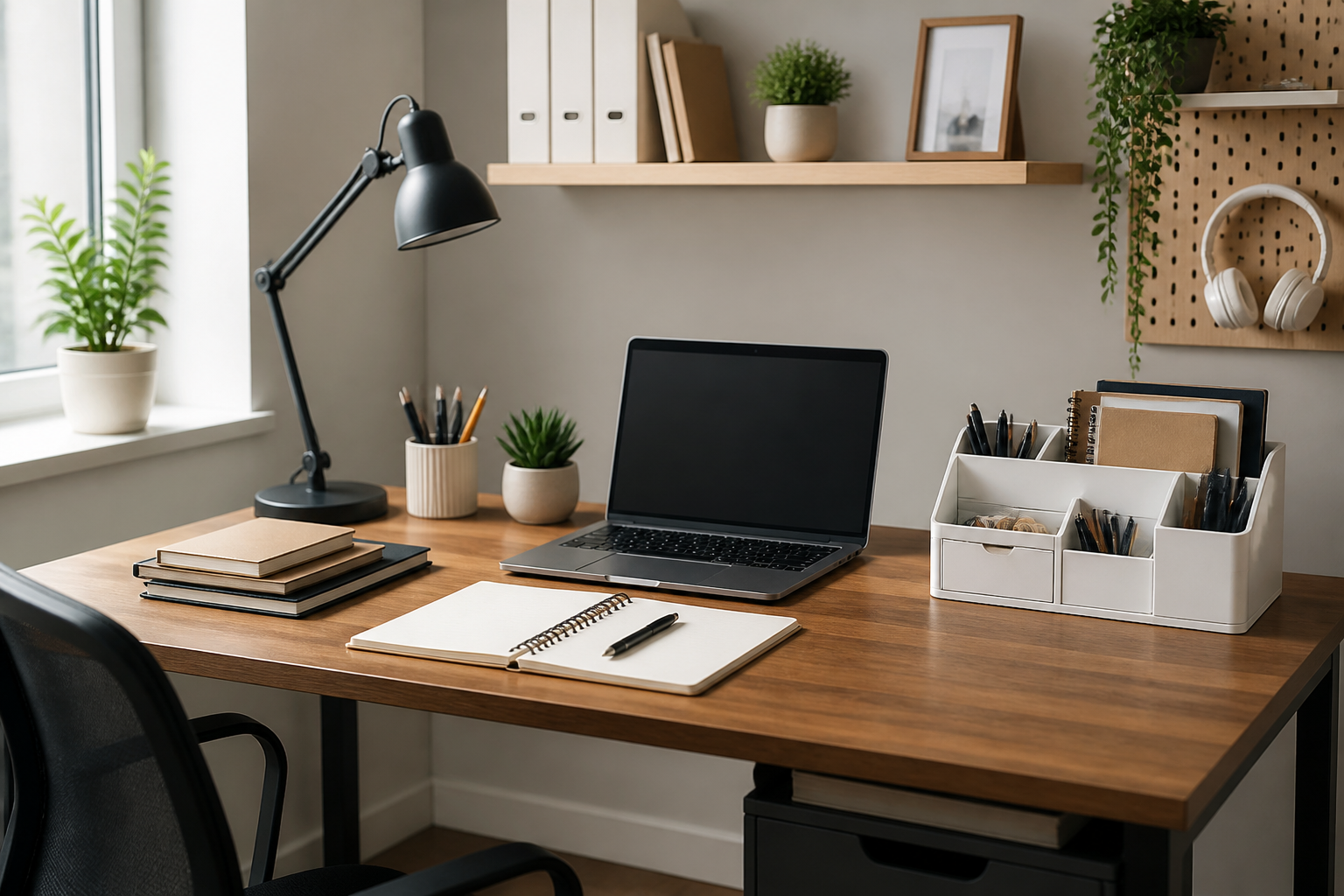
One of the easiest ways to keep a study desk organized is to keep only the essentials within arm’s reach. Daily items might include a pen holder, a notebook, a lamp, a water bottle, and a laptop or tablet. Less frequently used items, such as extra paper, archived notes, spare chargers, and subject-specific books, can be stored in drawers, bins, shelves, or nearby cabinets.
This separation matters because clutter often grows when everything is treated as equally important. If a desk surface is reserved for active study materials, it is easier to keep it clear and ready for use.
Choose a desk organization style that fits your habits
Different study styles call for different setups. A minimal style may work well for people who prefer a clean surface and only a few visible items. A categorized style may suit students who need separate spaces for stationery, documents, and electronics. A mobile style may be better for shared rooms, where portable organizers can be moved out of the way when study time is over.
There is no single correct system. The best organization style is the one you can maintain without extra effort.
Use Storage Tools That Match Your Needs
Choosing the right storage tools can make a major difference in how easy your study desk is to maintain. Instead of buying many organizers at once, start with a few useful pieces that solve specific problems. The goal is to reduce surface clutter while keeping the items you use most often easy to reach.
Desk trays and document holders
Paper is one of the fastest ways a desk becomes messy. Assignments, handouts, notebooks, and loose sheets can quickly spread across the surface if they do not have a home. Desk trays and document holders help keep papers grouped by purpose. You might use one tray for current work, one for completed work, and one for papers that need filing later.
When choosing a document organizer, look for enough space to hold your common paper sizes without bending or crowding them. Multi-tier trays can be useful if you often handle several subjects at once. If your desk is small, a vertical holder may save more space than a wide tray.
Pen cups and small desktop containers
Pens, highlighters, scissors, rulers, erasers, and sticky tabs are easy to lose if they are kept in random drawers or left loose on the desk. A pen cup or small divided container keeps writing tools grouped together. If you use many small items, compartments can help you separate them by type.
When shopping for these organizers, think about size, weight, and stability. A lightweight holder may slide around if it is too full, while a sturdier container may stay in place better during daily use. Simpler designs often work well because they are easier to clean and do not add visual clutter.
Drawer organizers and desk dividers
If your desk has drawers, internal organizers can be especially helpful. Without dividers, small items tend to collect in one corner and become difficult to sort through. Drawer inserts can create sections for stationery, notes, cables, and study accessories. This is useful when you want the desktop itself to stay clear.
Adjustable dividers are often a good choice because they can be adapted as your supplies change. A student’s needs may change throughout the school year, so flexible storage tends to be more practical than fixed compartments.
Bookends and vertical storage
Textbooks and notebooks can take up a lot of space if they are stacked flat. Bookends or vertical shelf storage can help keep them upright and accessible. This is especially useful for students who regularly switch between subjects and want to prevent books from spreading across the desk.
If you use bookends, make sure they are sturdy enough for the size and weight of your books. Lightweight bookends can tip if the load is uneven. For a small desk, vertical storage may free up more room than horizontal stacking.
Cable organizers and charging solutions
Electronics can quickly create visual clutter, especially if chargers, headphones, and device cables are left tangled on the surface. Cable clips, ties, sleeves, or small cable boxes can help reduce mess and make cords easier to identify. If you frequently charge a phone, tablet, and laptop at the same desk, a designated charging spot can keep devices from spreading across the workspace.
When comparing cable organizers, consider how often you unplug devices. Some solutions are best for cables that stay in one place, while others are better for cords that need to be moved regularly.
Design the Desk Surface for Easy Daily Use
An organized study desk works best when the surface itself is arranged with intention. Even good storage tools will not help much if the desk top becomes a catch-all for everything you own. The more clearly each item has a place, the easier it becomes to reset the desk after every study session.
Keep the center area open
The center of the desk should usually remain the most open area. This is where you write, read, and work on assignments, so it helps to keep it free from permanent clutter. Large items placed in the middle can make the desk feel crowded and reduce usable space.
If you need reference materials nearby, place them to one side rather than in the center. A small lamp, monitor stand, or laptop stand can also help define the main working area while leaving room for notebooks and writing space.
Use zones for different tasks
Desk zones can make organization feel more natural. For example, one side of the desk can hold school supplies, another can hold electronics, and a small area can be reserved for active papers. If you use the desk for both studying and creative work, separate zones can help prevent tools from mixing together.
Zones work especially well in shared rooms or small study areas because they create order without requiring large storage furniture. Even a simple division between “writing,” “reading,” and “charging” can improve how the desk functions.
Limit decorative items if they distract you
Decorations can make a study space feel personal, but too many decorative items can get in the way. If objects take up valuable workspace or become dust collectors, they may make it harder to keep the desk tidy. A few thoughtful items are usually easier to maintain than a crowded display.
If you like a more personalized setup, choose items that are both attractive and useful, such as a desk lamp, a calendar, or a small organizer that matches your room’s style.
Build Simple Habits That Prevent Clutter
Organization is easier to maintain when it becomes part of your routine. Even the best storage system will eventually fail if items are left out repeatedly. Small habits can stop clutter before it gets out of hand.
Reset the desk at the end of each study session
One of the most effective habits is a quick reset at the end of each study session. Put pens back in their holder, stack papers in the correct tray, close books, and return charging cables to their place. This does not need to take long, but it makes a big difference over time.
A desk that starts clean is easier to use the next day. It also helps you begin studying faster because you do not need to sort through leftover items first.
Sort papers once, not repeatedly
Loose papers often move from one pile to another without ever being filed properly. To avoid this, make a habit of sorting paper right away. Decide whether a sheet should be filed, recycled, completed, or kept on the active work tray.
If you are not ready to fully organize papers immediately, at least place them in a temporary category. A holding tray is better than letting documents spread across the desk.
Use a weekly cleanup routine
A short weekly cleanup helps prevent small messes from becoming major problems. During this routine, clear trash, return supplies to storage, review papers, and remove items that no longer belong on the desk. This is also a good time to check whether your organizers still match your current workload.
For example, if one tray is always overflowing, you may need another file holder. If a drawer is rarely used, you may be storing too many unnecessary items.
Choose Products With Practical Features
When shopping for desk organization products, focus on features that improve usability rather than appearance alone. A well-designed organizer should be easy to use, stable, and suited to the space you actually have.
Look for the right size and footprint
Desk organizers should fit the available space without overwhelming it. Large containers may be useful, but only if they do not block writing space or crowd your main work area. Before buying, measure your desk or compare the organizer’s footprint to the area where it will sit.
For smaller desks, vertical storage and stackable pieces may be more practical than wide storage trays. For larger desks, multiple categories of storage can be separated more comfortably.
Prioritize easy access
The best organizers are the ones you actually use. If a storage box is too deep, too hidden, or too inconvenient, items may end up living on the desk instead. Choose products that make retrieval simple. Open containers, clear labels, and easy-to-reach compartments can improve day-to-day use.
Access matters especially for study supplies that are used repeatedly, such as pens, flashcards, and chargers.
Consider cleanability and durability
Study desks collect dust, paper scraps, pencil shavings, and minor spills over time. Storage items that are easy to wipe down can save effort later. Smooth surfaces and simple shapes are often easier to maintain than complex designs with many tight corners.
Durability is important too, especially if you plan to move organizers around or use them daily. Materials should hold up to regular handling without wobbling, cracking, or bending too easily.
Think about flexibility
Students often change schedules, subjects, and supply needs throughout the year. Flexible organizers, modular storage, and adjustable dividers can adapt as your workflow changes. This may be more practical than buying rigid systems that only work for one specific arrangement.
Flexible products are especially useful if your desk is shared, seasonal, or likely to change with new courses and devices.
Common Mistakes to Avoid
People often try to organize a study desk by buying too many containers or by rearranging everything at once. While that can feel productive, it does not always lead to a system that lasts. Avoiding a few common mistakes can make your setup far more effective.
- Buying storage before sorting items: It is easier to choose organizers after you know what needs to be stored.
- Using too many containers: Too many small boxes can create more complexity instead of less.
- Keeping everything on the desk: The surface should hold only active study items, not long-term storage.
- Ignoring vertical space: Shelves, risers, and wall-adjacent storage can free up valuable desk room.
- Forgetting maintenance: Even a good system needs short weekly resets to stay useful.
Who This Kind of Desk Organization May Suit
Desk organization strategies are useful for many types of students and home learners, but different setups suit different needs. A simple, compact system may work best for people with small desks or shared spaces. A more layered system may be helpful for students who use many subjects, documents, or electronics.
This approach may suit:
- School students who need a reliable place for stationery, homework, and class materials.
- College and university students who manage multiple subjects, printed notes, and device charging.
- Exam candidates who want a distraction-free setup with easy access to essential materials.
- Remote learners who need a desk that supports both digital and paper-based study.
- Shared-room users who need portable or compact organizers that are easy to keep tidy.
Practical Tips to Keep the Desk Organized Long Term
Once your desk is arranged, the challenge is keeping it that way. Long-term organization usually comes from small decisions repeated often. The following habits can make your setup easier to maintain.
- Give every item a home: If you know where something belongs, it is more likely to be put away.
- Keep duplicates limited: Extra pens and cables can accumulate quickly, so store only what you use regularly.
- Label if needed: Labels can be helpful for drawers, document folders, and storage bins.
- Review supplies monthly: Remove dried-up pens, old papers, and items you no longer need.
- Match storage to habits: If a system is inconvenient, change it instead of forcing yourself to follow it.
It can also help to think of organization as a support for studying rather than a separate task. When supplies are easy to find and put away, you spend less energy on cleanup and more on the work itself.
Frequently Asked Questions
How can I keep a study desk organized if I have very little space?
Focus on vertical storage, compact containers, and keeping only daily essentials on the surface. Small desks benefit from a minimal setup with a limited number of categories.
What should always stay on a study desk?
Only the items you use frequently during study sessions should remain on the desk. This often includes a lamp, writing tools, a notebook, and current study materials. Everything else can usually be stored nearby.
How do I stop papers from piling up?
Use a document tray or folder system and sort papers as soon as possible. If you are not ready to file them, place them in a temporary holding area rather than leaving them loose on the desk.
Is it better to use drawers or open organizers?
Both can be useful. Drawers are helpful for hidden storage, while open organizers make items easier to reach. Many study setups use a mix of both.
How often should I clean and reorganize my desk?
A quick reset after each study session and a slightly more thorough weekly cleanup is often enough for many people. If your workload changes, you may need to adjust the routine.
Conclusion
Knowing how to keep your study desk organized is less about achieving a perfect look and more about building a system that supports your daily study habits. Start by identifying the items you use most often, then choose storage tools that fit your space and workflow. Keep the desktop surface focused on active tasks, use clear zones for different materials, and make it a habit to reset the desk regularly.
The most effective study desk organization is simple, realistic, and easy to maintain. When everything has a place and the setup matches how you actually work, studying becomes smoother and less distracting. With a few smart choices and a short routine, your desk can stay organized enough to help you focus on what matters most.