Introduction
If your kitchen feels busy every time you cook, the problem is often not the number of tools you own, but how accessible they are. Frequently used kitchen tools such as spatulas, tongs, measuring spoons, peelers, whisks, can openers, and ladles should be easy to find, easy to reach, and easy to put back. When these items are scattered across drawers, overcrowded counters, and random containers, even simple meal prep can feel more frustrating than it should.
Organizing the kitchen tools you use most often is less about creating a picture-perfect display and more about building a practical system that saves time and reduces clutter. The best setup depends on how you cook, how much storage you have, and whether you prefer drawers, countertop containers, wall storage, or cabinet solutions. A good organization method should help you work faster, keep tools in better shape, and make cleanup simpler after cooking.
This guide explains how to organize frequently used kitchen tools in a way that is useful for real kitchens. It covers what to keep close at hand, which storage options are worth considering, how to choose the right organizers, and common mistakes to avoid. Whether you are setting up a new kitchen or improving an existing one, a thoughtful system can make everyday cooking feel much smoother.
Start by sorting tools by how often you actually use them
The first step in organizing kitchen tools is not choosing a container; it is deciding which tools deserve the most convenient space. A drawer near the stove or a countertop crock should be reserved for the items you reach for repeatedly. Tools used only a few times a month can live deeper in a cabinet or a secondary drawer.
Group tools into three simple categories
A practical way to sort kitchen tools is to divide them into daily, weekly, and occasional use. Daily-use items might include a spatula, wooden spoon, tongs, measuring spoons, a whisk, and a peeler. Weekly-use items might include a garlic press, citrus juicer, kitchen scissors, or grater. Occasional-use tools could include specialty gadgets and extra serving tools that do not need prime storage.
This approach helps prevent overcrowding. If everything is treated as equally important, the most useful tools get buried. By identifying your true daily essentials, you can design storage around real habits rather than theoretical convenience.
Keep duplicates only if they solve a real problem
Many kitchens contain multiple versions of the same tool, such as several spatulas or whisks. Duplicates are not automatically a problem, but they should earn their space. If you cook often and use different tools for hot pans, baking, and serving, a few duplicates may be reasonable. If duplicates are cluttering the drawer and making it harder to find the right item, it may be time to reduce the collection.
A leaner tool set is usually easier to organize. It also makes it simpler to assign a specific home to each item, which is one of the best ways to maintain order over time.
Choose storage based on how you cook
There is no single best storage method for kitchen tools. The right choice depends on your workflow, counter space, drawer depth, and cooking style. A good organizer should support how you move through the kitchen, not force you to adapt to a rigid system.
Drawer storage for a clean, contained setup
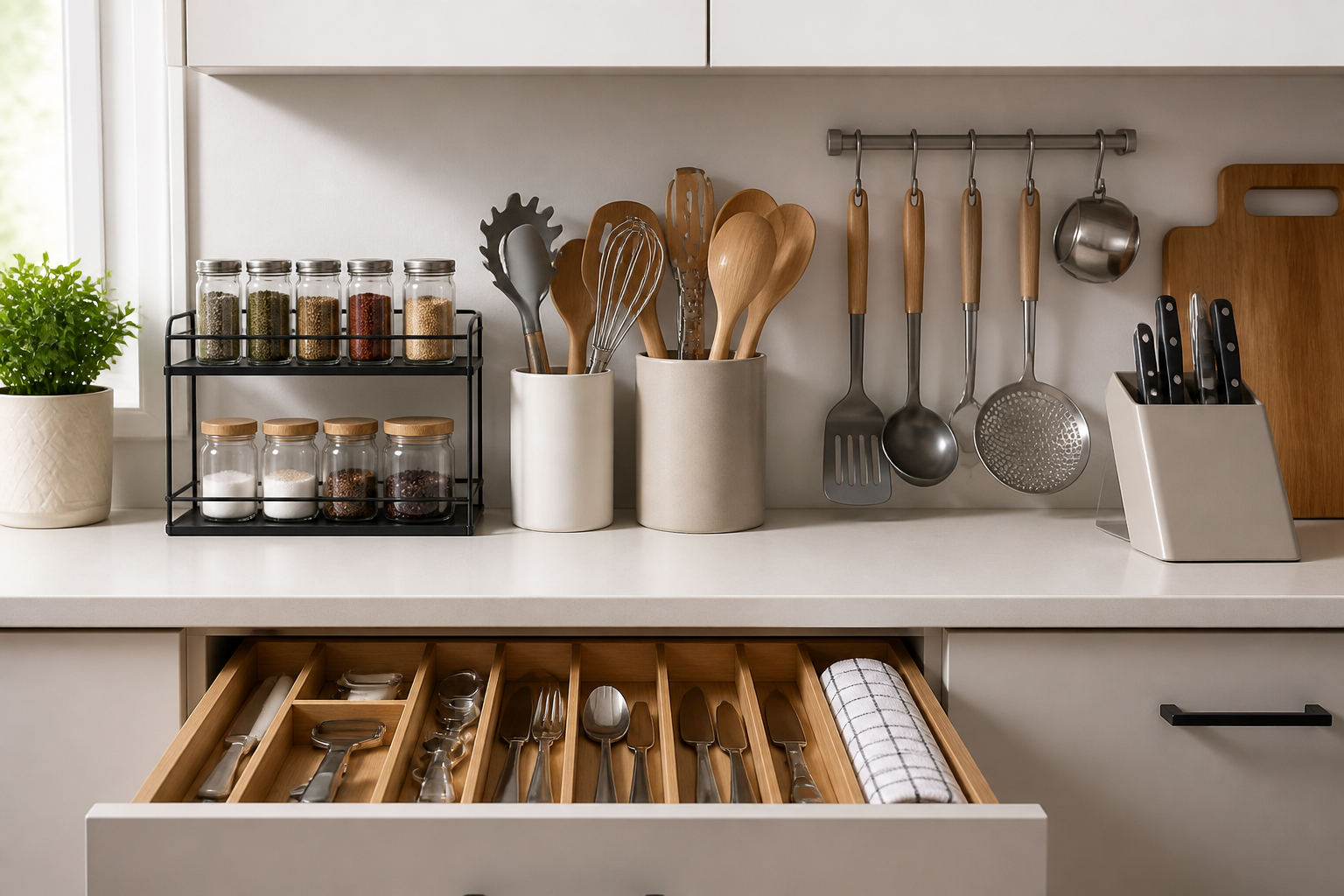
Drawer storage is often the best option for people who want a tidy look and easy access without adding visual clutter. Drawer dividers, trays, and adjustable inserts can keep utensils separated so that a spatula does not tangle with measuring spoons or scissors.
This method works especially well for kitchens with limited counter space. It is also helpful if you want to keep tools away from dust and cooking splatter. The main challenge is drawer depth and size. A shallow or crowded drawer can become messy quickly, so it is important to measure the space before choosing inserts.
Countertop containers for high-frequency tools
A countertop crock or utensil holder is useful for the tools you use many times during a cooking session. Items such as spatulas, wooden spoons, ladles, and tongs are common candidates. Keeping them upright near the stove can make cooking more efficient because you are not constantly opening drawers while food is on the heat.
For this method to work well, limit the container to the most frequently used tools. Overfilling it creates the opposite effect and turns a helpful station into a cluttered cup of mixed utensils. Choose a sturdy container with enough weight to stay stable when tools are added or removed.
Wall or rail storage for small kitchens
When counter and drawer space is limited, wall storage can be a smart alternative. Rails, hooks, and peg-style systems can hold certain tools in a visible, easy-to-grab location. This method can work well for lightweight tools and items with hanging loops.
Wall storage is most useful when organized by task. For example, cooking tools can stay near the stove, while prep tools can be placed near the main work surface. The advantage is quick access; the tradeoff is that the area must stay neat because the storage is visible.
Cabinet organizers for overflow items
Cabinets are often best for tools that are useful but not needed every minute. Tiered shelves, bins, and small baskets can help separate categories such as baking tools, prep tools, and serving utensils. Cabinet storage is also useful for backup tools that you want nearby but not in the main work zone.
Even in cabinets, organization matters. If everything is tossed into a single bin, the search time can be just as frustrating as a cluttered drawer. Use containers that allow you to see and reach items without unpacking the entire shelf.
Important features to look for in kitchen tool organizers
If you are buying organizers rather than improvising with containers you already own, a few practical features can make a big difference. The best organizer is not necessarily the most attractive one; it is the one that supports everyday use and stays functional over time.
Size and fit
Measure the space before you buy anything. Drawer organizers should fit the width, depth, and height of the drawer without wasting room or leaving tools jammed at awkward angles. Countertop containers should fit where you naturally cook, not where they merely look good. If an organizer is too large, it can cause new clutter instead of reducing it.
Dividers and compartments
Compartments help prevent tools from shifting into one another. Adjustable dividers are especially useful because they can adapt to changing tool collections. A fixed tray may work well if your utensil set is stable, but flexible compartments are often better for households where tools come and go over time.
Ease of cleaning
Kitchen tools collect dust, crumbs, and cooking residue, especially when stored near the stove. Choose organizers that are easy to wipe down or remove for cleaning. Smooth surfaces are generally simpler to maintain than deeply textured or overly decorative finishes. If an organizer is difficult to clean, it is more likely to become neglected.
Stability
Stability matters for countertop holders, drawer inserts, and rail-mounted systems. A tipping utensil crock or a sliding tray can create frustration every day. Look for organizers that stay in place when tools are removed and returned quickly during cooking.
Visibility and access
The best storage makes it easy to see what you have without rummaging. This is one reason clear bins, open trays, and divided drawers can work well. At the same time, visibility should not come at the cost of clutter. The goal is controlled access, not exposure to every tool at once.
How to organize tools by task
Organizing by task can be more practical than organizing by size or shape. When tools are grouped by what you use them for, cooking becomes more intuitive because the right tools are stored near the right activity.
Cooking tools near the stove
Heat-resistant tools and everyday stirring utensils are best stored close to the stove. This might include spatulas, tongs, wooden spoons, ladles, and slotted spoons. A countertop holder or a nearby drawer can keep these tools within arm’s reach while cooking.
Prep tools near the main work area
Tools used for prep, such as peelers, measuring spoons, whisks, kitchen shears, and small graters, are often better stored near the area where you chop, mix, and measure. Keeping them together saves time when recipe steps happen in sequence.
Baking tools in a separate zone
If you bake often, it can help to create a dedicated baking section for tools such as measuring cups, spatulas, dough scrapers, pastry brushes, and whisks. Even if baking is occasional, keeping these items together means you do not have to search through general utensil storage when you need them.
Serving tools stored slightly away from daily prep items
Serving spoons, tongs, and specialty servers may be used often enough to deserve organized storage, but they do not always need to sit in the most active cooking zone. A nearby drawer or cabinet can work well, especially if your countertop space is limited.
Common organizing mistakes to avoid
Even a well-intentioned kitchen organization project can become frustrating if the system is too complicated or not suited to real habits. Avoiding a few common mistakes can make your setup easier to keep up with.
Storing too many items in the prime location
The easiest storage spot should be reserved for truly frequent tools. If you place everything in the same drawer or holder, you will lose the benefit of quick access. Prime storage should feel selective, not unlimited.
Using containers that are too deep or too broad
Deep containers can hide smaller tools at the bottom, while overly broad containers can let items spread out and mix together. Choose proportions that match the tools you are storing. A smaller, better-fitted organizer often works better than a large one with extra space.
Mixing categories without a plan
When prep tools, cooking tools, and baking tools are all mixed together, the system can become difficult to maintain. Category-based organization makes it easier to put items back where they belong. It also helps other household members understand the setup.
Ignoring maintenance
Any organizing system needs occasional upkeep. Tools move, habits change, and new items enter the kitchen. A quick reset every few weeks can keep the system useful. Without maintenance, even the best organizer can slowly become cluttered again.
Practical tips for maintaining an organized tool setup
A smart organization system should be easy to maintain on busy days. If it takes too much effort to keep tools in order, the system is probably too complicated. These practical habits can help preserve the setup you create.
- Return tools to their home immediately after use. This simple habit prevents small messes from spreading across the kitchen.
- Keep only the tools you genuinely use. If an item has not been used in months, consider moving it out of the prime storage area.
- Use labels when helpful. Labels can be useful in shared kitchens or inside drawers where categories are not obvious at a glance.
- Match storage to your dominant hand and workflow. Place the most-used items where they feel most natural to reach during cooking.
- Reassess seasonally. Cooking habits often change with routines, holidays, and meal plans.
These habits help the system stay functional after the initial organizing effort fades. The goal is not perfection; it is making the kitchen easier to use every day.
Who benefits most from different organizing styles
Different kitchens need different solutions, and the most effective storage style depends on the user. Thinking about your own cooking habits can help you choose a setup that feels natural rather than forced.
Busy home cooks
People who cook often usually benefit from fast-access storage near the stove and prep area. A countertop crock, drawer divider, or a combination of both can reduce unnecessary movement during meal preparation.
Small-space kitchens
In compact kitchens, the best solution often uses vertical or hidden storage. Wall rails, compact drawer inserts, and slim cabinet bins can keep tools accessible without taking over the limited workspace.
Families and shared kitchens
When multiple people cook in the same kitchen, consistency matters. Clear categories, labeled zones, and simple storage rules can make it easier for everyone to put things back correctly.
Frequent bakers
Bakers may want a dedicated baking section rather than mixing baking tools into general utensils. This reduces search time and keeps specialized tools grouped together for faster prep.
Frequently asked questions
What kitchen tools should be kept most accessible?
The tools you use every day or several times during a cooking session should be the easiest to reach. Common examples include spatulas, tongs, wooden spoons, measuring spoons, whisks, ladles, and peelers.
Is it better to store utensils in a drawer or on the counter?
Both can work well. Drawers offer a cleaner look and can reduce visual clutter, while countertop containers provide very fast access. The best choice depends on how much space you have and how often you use the tools.
How many utensils should go in a countertop holder?
Only enough to stay useful and easy to reach. If the holder feels crowded or tools are difficult to remove, it is holding too many items. Reserve it for the most frequently used utensils.
Should all kitchen tools be organized together?
Not necessarily. It is often more practical to organize them by task or frequency. Cooking tools, prep tools, baking tools, and serving tools may each deserve their own storage zone.
How often should I reorganize kitchen tools?
There is no fixed schedule, but a quick review every few months is helpful. Reorganize sooner if your cooking habits change or if a storage area has become crowded again.
Conclusion
Organizing frequently used kitchen tools is one of the most practical ways to make cooking easier. When the items you reach for most often have a clear home, meal prep feels smoother, cleanup is simpler, and your kitchen becomes more efficient overall. The best system is the one that matches your habits, your space, and the way you actually cook.
Start by identifying the tools you use most often, then choose storage that fits your workflow. Drawer dividers, countertop holders, wall storage, and cabinet bins each have a place depending on the kitchen and the cook. Focus on accessibility, stability, easy cleaning, and thoughtful grouping. Avoid overcrowding prime storage areas, and keep only the tools that truly earn their space.
With a simple, consistent system, your most-used kitchen tools can stay easy to find and easy to use. That small improvement can make a noticeable difference every time you cook.