Introduction
Not everyone has a spare room for dumbbell racks, cardio machines, or large storage bins full of workout gear. Many people need fitness accessories that can fit beside a bed, under a sofa, inside a closet, or in a small suitcase. The good news is that a compact workout setup can still be practical, versatile, and effective when the right accessories are chosen.
This guide focuses on useful fitness accessories that do not take much space. It is designed for people living in apartments, shared homes, dorm rooms, or small houses, as well as anyone who wants portable equipment for travel or occasional workouts at the office. The goal is not to build the biggest home gym possible. The goal is to choose small, flexible tools that support regular movement without creating clutter.
When shopping for compact fitness accessories, it helps to think about three things: storage, versatility, and ease of use. A small item is only useful if it can actually replace or support a workout you will do consistently. That is why the best space-saving accessories are usually simple, durable, and easy to store.
Why space-saving fitness accessories matter
Compact fitness gear is appealing for more than just small spaces. It often fits better into busy lifestyles because it can be set up quickly and put away just as fast. That makes it easier to keep a routine going when time, space, or motivation is limited.
Space-saving accessories may also help reduce friction. If your workout gear is stored in one drawer or one basket, you are more likely to use it than if it is buried behind bulky equipment. For many people, the best fitness setup is not the most advanced one. It is the one that is easiest to access and hardest to ignore.
Another advantage is flexibility. Many small accessories can support strength training, mobility work, warm-ups, and recovery. Instead of buying a separate piece of equipment for each purpose, you can choose a few compact items that cover multiple types of training.
Useful fitness accessories that do not take much space
Resistance bands
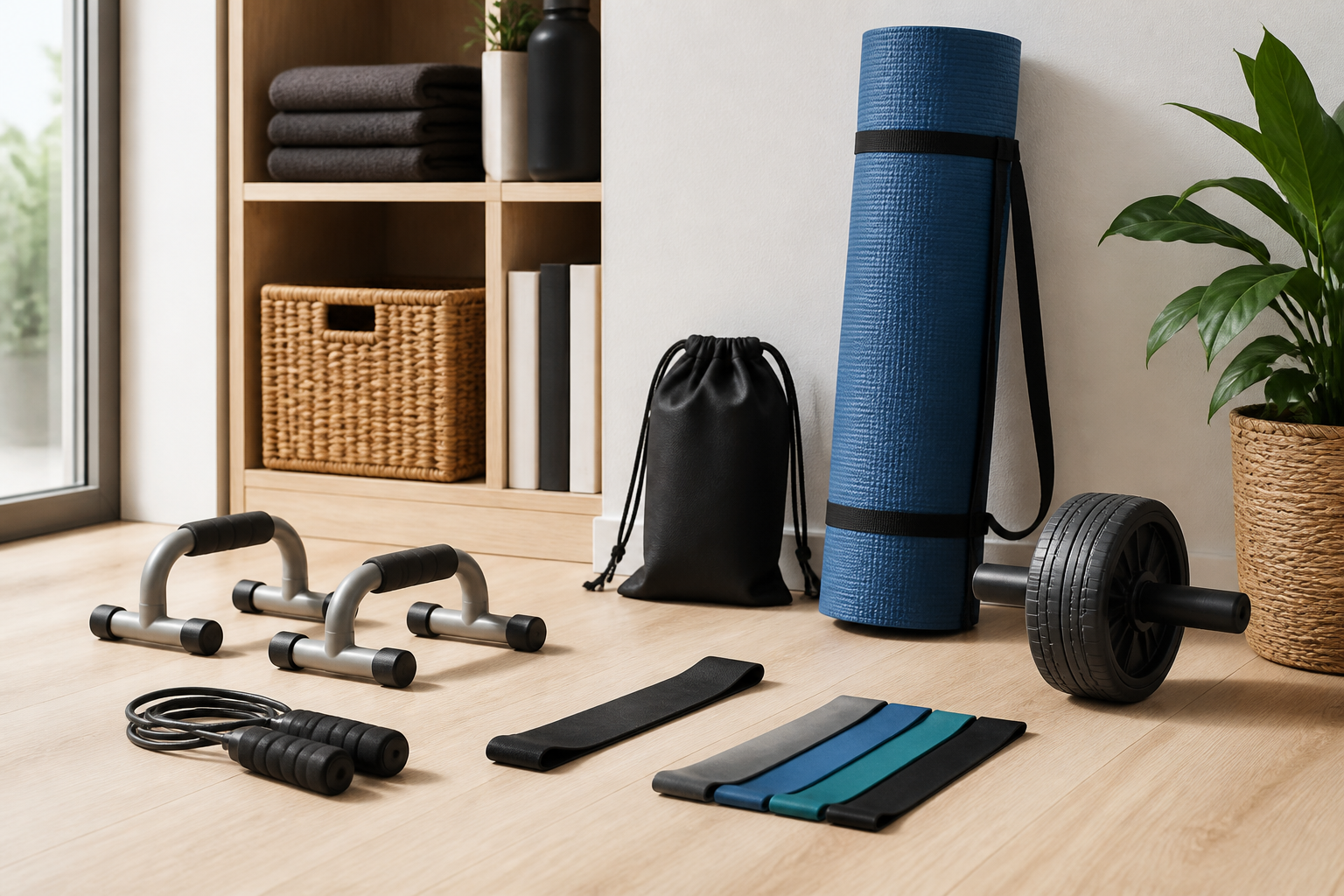
Resistance bands are one of the most space-efficient fitness accessories available. They are lightweight, easy to fold, and simple to store in a drawer or pouch. Depending on the style, they can be used for lower-body exercises, upper-body movements, warm-ups, stretching, and assisted mobility work.
There are several common types. Loop bands are often used for glute and leg work. Tube bands with handles may suit people who want a more traditional “gym-like” feel. Long flat bands can be useful for stretching and assisted exercises. Before buying, look for the resistance level, material quality, and whether the band length fits your intended exercises.
Resistance bands may suit beginners, travelers, and anyone with limited floor space. They are also useful for people who want a low-cost way to add variety without buying large equipment. A common buying mistake is choosing only very light bands or only very heavy ones. A small set with different resistance levels is usually more practical than a single band that becomes either too easy or too difficult.
Adjustable dumbbells
If you want strength training without a full rack of weights, adjustable dumbbells can be a smart space-saving option. Instead of storing many individual pairs, you keep one compact system with multiple weight settings. This can save a significant amount of room while still giving you room to progress over time.
When comparing adjustable dumbbells, pay attention to the adjustment method, total weight range, and how securely the weight stays in place during use. Comfort also matters. Handles should feel stable enough for pressing, rowing, and carrying movements. Some models change weight quickly, while others take longer to adjust. The best choice depends on whether you value speed, simplicity, or a wider weight range.
Adjustable dumbbells may suit home exercisers who want a more complete strength routine but do not want separate pairs cluttering a room. A mistake to avoid is buying a system that looks compact but feels awkward to adjust. If the setup process is inconvenient, you may end up using it less often.
Foldable workout mat
A workout mat is not always tiny, but a foldable mat can be much easier to store than a traditional rolled mat. It can slide into a closet, stand upright in a narrow corner, or tuck into a storage bin. For people doing floor work, stretching, yoga, or bodyweight exercises, a mat can make a small area feel more usable and comfortable.
When shopping, consider thickness, texture, and whether the mat stays in place during movement. A thicker mat may feel more comfortable for floor exercises, but it may also take up a bit more storage space. A thinner mat is easier to pack but may provide less cushioning. Look for a balance that fits your workout style and storage needs.
Foldable mats may suit people who train in living rooms, bedrooms, or multipurpose spaces. They are also useful for anyone who wants to create a workout area that disappears quickly after use. A common mistake is choosing a mat based only on appearance or portability without considering grip and comfort.
Jump rope
A jump rope is one of the smallest fitness tools you can buy, yet it can support cardio workouts, coordination practice, and warm-ups. It stores easily in a drawer, gym bag, or suitcase, which makes it ideal for limited spaces. If you have enough clearance for overhead movement, it can be a very practical way to add intensity without bulky equipment.
Important features include rope length adjustability, handle comfort, and the type of rope material. Some ropes are better for speed work, while others are designed more for general fitness. If you are a beginner, a slightly heavier rope can sometimes feel easier to control than a very fast one.
Jump ropes may suit people who want a simple cardio option with minimal storage needs. They are also good for travel. One thing to keep in mind is that they require enough ceiling height and floor clearance. If your space is tight, you may need to measure before buying. Also, if impact is a concern, look for lower-impact cardio alternatives instead of assuming a rope is the only compact option.
Suspension trainer
A suspension trainer uses straps and body weight to support a wide range of exercises. It takes up very little storage space, especially compared with larger strength equipment, but it can open the door to a surprisingly broad workout routine. Many people appreciate that it can be attached to a secure door anchor or other suitable support, depending on the product design.
This type of accessory may be suitable for users who want to train strength, stability, and core control without heavy equipment. It can be especially useful in a home setting where floor space is limited. Before buying, check the attachment method, weight limits, strap adjustability, and whether the handles feel comfortable for longer sessions.
A common buying mistake is overlooking installation needs. A compact item is only useful if you have a safe and appropriate place to use it. Make sure you understand how the system anchors and what surfaces or door types it is designed for.
Massage ball or trigger point ball
Recovery tools can also be small and useful. A massage ball or trigger point ball takes almost no room but can help with self-massage, mobility work, and general muscle relaxation after exercise. It can be stored in a drawer, bag, or even a desk organizer.
When choosing one, consider firmness, size, and surface texture. A firmer ball may feel more focused, while a softer ball may feel more forgiving. Smaller balls can target specific areas more precisely, while slightly larger ones may feel more comfortable on broader muscle groups.
This kind of accessory may suit people who sit for long periods, do repetitive movement, or want a simple recovery tool to pair with other compact fitness gear. It is not a replacement for medical care or professional treatment, but it can be a practical addition to a small home setup.
Foam roller
A foam roller is larger than some other compact accessories, but it is still relatively space-friendly compared with machines or benches. It can often be stored vertically in a corner, under a bed, or in a closet. For many home exercisers, it is a useful recovery item that supports stretching and muscle relief routines.
Foam rollers come in different lengths, densities, and surface patterns. A short roller is easier to store, while a longer one may feel more versatile for larger body areas. Beginners often prefer a medium density option, since extremely firm rollers can feel uncomfortable. If possible, think about where you will use it and how easy it will be to store after each session.
A mistake to avoid is buying a large, aggressive roller when you mainly want a simple recovery tool. The most useful option is usually the one you will actually use regularly.
Mini exercise step or compact platform
A small step platform or compact aerobic step can support bodyweight exercises, step-ups, light cardio work, and some strength movements. It is not as minimal as a resistance band, but it can still be relatively space-conscious if chosen carefully. Some versions are designed to stack, fold, or fit under furniture.
Look for a stable base, non-slip surface, and a size that fits your available floor area. Stability is especially important because a step that moves or wobbles can make exercise less comfortable. Compact platforms may suit people who want a slightly more structured workout surface without buying larger cardio equipment.
Be sure to think about storage height as well as footprint. A platform that is short but wide may still be awkward in a small room, while a narrower design may fit better into tight storage areas.
Yoga block
Yoga blocks are small, inexpensive-looking accessories that can offer real value for mobility, stretching, and floor-based training. They can make stretches more accessible, support alignment, and help users hold positions with better control. Since they are lightweight and stackable, they are easy to store almost anywhere.
When choosing a block, consider material, firmness, and size. Foam blocks are usually light and comfortable to use. Cork blocks may feel denser and more stable. If you only have room for one, choose a style that suits the kind of floor work or flexibility training you do most often.
Yoga blocks may suit beginners, mobility-focused users, and anyone who wants inexpensive support without clutter. A common mistake is assuming they are only for yoga. They can also be helpful for stretching, warm-ups, and certain strength exercises.
Mini loop bands
Mini loop bands are a smaller category of resistance band that can be especially useful for glute activation, hip exercises, and lower-body warm-ups. They are very easy to pack and store, making them one of the best accessories for people who need ultra-compact gear.
Because these bands are small, quality matters. Look for a material that feels durable and resistance levels that suit your current ability. Some sets include multiple levels so you can progress gradually. If the band rolls, pinches, or feels too loose, it may not be pleasant to use.
Mini loop bands are often a good fit for people who want quick lower-body sessions without setting up larger equipment. They are also useful as a supplement to walking, running, or general home workouts.
How to choose compact fitness accessories
Think about your actual training goals
The best space-saving fitness gear depends on what you want to do. A person focused on strength training may get the most value from adjustable dumbbells and resistance bands. Someone who wants cardio may prefer a jump rope. If recovery is the priority, massage tools or a foam roller may make more sense.
Try not to buy accessories just because they are small. Each item should serve a role in your routine. A compact accessory is useful only if it fills a real need.
Check storage and portability
Before buying, think about where the item will live when not in use. Can it fit in a drawer, closet, basket, or under-bed box? Will you need to carry it to another location? Portability matters especially for people who travel, commute, or share space with others.
Some accessories fold or pack flat. Others are small but awkwardly shaped. The most storage-friendly choice is usually the one that can be put away in seconds without rearranging the room.
Look for versatility
In a small space, versatile items usually offer better value than single-purpose tools. Resistance bands can support strength and mobility. A suspension trainer can work several muscle groups. A yoga block can assist with stretching and stability. The broader the range of uses, the more likely the item is to earn its place.
Prioritize durability and comfort
Compact does not have to mean flimsy. Check the materials, stitching, grip, and overall feel. Handles should be comfortable. Surfaces should be stable. Items that contact the body should feel usable for more than a few minutes at a time. If an accessory is hard to hold, hard to clean, or unpleasant to use, it may not last in your routine.
Common buying mistakes to avoid
- Buying gear that is small but does not match your workout style
- Choosing the cheapest option without checking build quality
- Ignoring storage shape and only considering size on paper
- Overlooking setup requirements for straps, anchors, or platforms
- Buying too many accessories at once instead of starting with a few useful basics
- Picking advanced equipment before you have a regular routine
A simple setup is often better than an impressive one. Many people start with one or two compact items and expand only after they know what they will actually use. That approach helps reduce clutter and unnecessary spending.
Tips for building a small-space fitness routine
Small-space fitness works best when the equipment is easy to access and easy to put away. Store your gear where you can see it. Keep related items together. For example, bands, a mat, and a massage ball can live in one basket or bin. That makes it easier to begin a workout without searching for supplies.
It also helps to choose accessories that support more than one type of session. A resistance band can be used for warm-up, strength, and mobility work. A jump rope can be part of a quick cardio circuit. A mat can support stretching and floor exercises. The more flexible your items are, the more useful they become in a limited space.
If you share your home, quieter accessories may be especially helpful. Bands, yoga blocks, and mobility tools usually create less noise than large cardio equipment. That can make it easier to stay consistent without disturbing others.
Frequently Asked Questions
What is the most useful fitness accessory for a small space?
Resistance bands are often one of the most practical choices because they are compact, affordable-looking, and versatile. They can support strength, warm-ups, and mobility work without taking much room.
Can I get a good workout with only small fitness accessories?
Yes, many people can build a useful routine with compact gear such as bands, a jump rope, a mat, and adjustable dumbbells. The key is choosing items that match your goals and using them consistently.
Are foldable fitness accessories worth it?
They can be, especially if storage is tight. Foldable or compact items are helpful when they are easy to set up and do not sacrifice too much comfort or stability.
What should I avoid when buying space-saving fitness gear?
Avoid buying equipment that looks clever but is difficult to use or store. Also avoid pieces that do not match the kind of exercise you plan to do. In a small space, practicality matters more than novelty.
How many accessories do I really need?
For many people, a small starter set is enough. One item for strength, one for cardio or movement, and one for recovery can cover a lot of ground. It is usually better to begin with a few reliable tools than to fill a small room with unused equipment.
Conclusion
Useful fitness accessories that do not take much space can make exercise feel more manageable, especially in apartments, shared homes, and busy routines. The best choices are usually the ones that are compact, versatile, easy to store, and suitable for the kind of training you actually want to do.
Resistance bands, adjustable dumbbells, foldable mats, jump ropes, suspension trainers, yoga blocks, massage balls, foam rollers, mini loop bands, and compact steps all have a place in small-space fitness planning. You do not need a large room to build a practical routine. You only need a few well-chosen tools and a realistic plan for using them.
When comparing options, focus on storage, durability, comfort, and versatility. That approach makes it easier to choose accessories that stay useful over time instead of adding clutter. For many shoppers, the smartest fitness purchase is not the biggest one. It is the one that fits both the space and the routine.