Introduction
Small kitchens can be charming, efficient, and surprisingly practical, but they also leave little room for clutter, oversized tools, or accessories that only solve one problem. When every drawer, shelf, and countertop inch matters, the best kitchen accessories are the ones that help you save space, simplify daily cooking, and make cleanup easier without adding visual or physical bulk.
Choosing useful kitchen accessories for small spaces is not just about buying smaller versions of standard tools. It is about looking for items that serve more than one purpose, fit into tight storage areas, stack neatly, and support the way you actually cook. The right accessories can make a compact kitchen feel more open, reduce the need for duplicate gadgets, and help you stay organized with less effort.
This guide focuses on practical, space-conscious kitchen accessories that suit apartments, studio kitchens, tiny homes, shared kitchens, and any home where storage is limited. It also explains what to look for before buying, common mistakes to avoid, and how to choose items that will genuinely earn their place in a small kitchen.
What makes a kitchen accessory useful in a small space?
In a large kitchen, an accessory can be convenient even if it takes up a lot of room. In a small kitchen, convenience and footprint need to be balanced more carefully. A useful item should either replace another tool, improve storage, or speed up a task enough to justify the space it occupies.
When evaluating accessories for compact kitchens, focus on these qualities:
- Compact size: The item should fit comfortably in your drawers, cabinets, or countertop zones without crowding other essentials.
- Multi-function use: Tools that handle more than one task reduce duplication and save storage space.
- Stackability or nesting: Accessories that can be stacked, nested, collapsed, or folded are often easier to store.
- Easy cleaning: Simpler designs are usually quicker to wash and less likely to become clutter magnets.
- Durability: A small kitchen has little room for rarely used gadgets, so the accessories you buy should be able to handle regular use.
In many cases, the best choice is not the smallest product available, but the one that is easiest to store and use regularly. A slightly larger item that replaces two or three others can be more space-efficient overall.
Useful kitchen accessories for small spaces
1. Collapsible measuring cups and measuring spoons
Measuring tools are essential for baking, portioning, and recipe prep, but traditional sets can take up more room than expected. Collapsible or nesting measuring cups and spoons are a practical choice for small kitchens because they reduce drawer clutter and often stack together neatly.
Look for sets with clearly marked measurements and sturdy construction so they do not flex too much during use. If you cook often, choose a set that feels stable in the hand and is easy to read quickly. These tools are especially helpful for people who bake occasionally but do not want multiple bulky sets occupying valuable storage space.
2. Stackable food storage containers
Food storage containers are among the most useful accessories in any kitchen, and in a small space, stackable designs are especially valuable. They help organize leftovers, dry ingredients, meal prep portions, and snacks while keeping shelves more orderly.
When buying containers, look for rectangular or square shapes because they typically use shelf space more efficiently than round ones. Airtight lids are useful for keeping ingredients contained and reducing spills, but the lid design should still be easy to open and close. Matching sets often store better than mixed containers with different lid styles.
Consider whether the containers nest inside one another when empty. This can make a big difference in a cabinet with limited depth or height. Transparent containers also make it easier to see what you have without opening every lid.
3. Over-the-sink drying rack
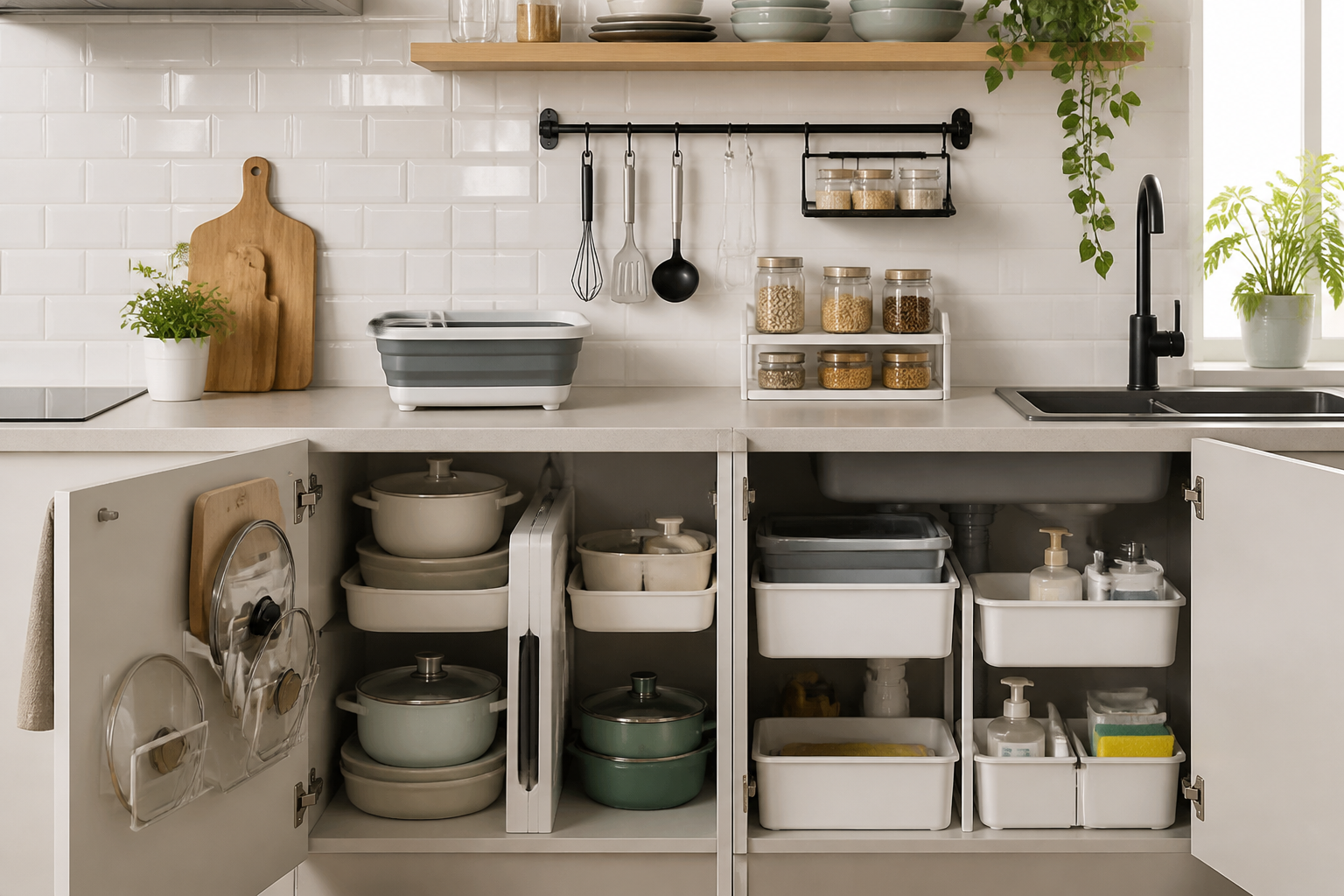
Countertop drying racks can consume valuable prep space, which is why over-the-sink drying racks are such a smart option for compact kitchens. They allow dishes, utensils, and produce to dry above the sink instead of spreading across the counter.
Before buying, measure your sink width carefully and check the rack’s load capacity and stability. Some designs roll up or fold away when not in use, making them especially useful for kitchens that need the sink area to remain flexible. This kind of accessory works well for people who hand-wash dishes but want to avoid keeping a permanent drying rack on the counter.
4. Wall-mounted or under-cabinet utensil storage
When drawer space is limited, moving utensils off the counter and out of crowded drawers can be a major improvement. Wall-mounted rails, hooks, magnetic strips, and under-cabinet organizers can store utensils, mugs, or frequently used tools without using shelf space.
These accessories are especially helpful for items you reach for daily, such as spatulas, ladles, measuring spoons, and oven mitts. The key is to keep the setup orderly and not overload it. A few well-chosen hanging tools can be more helpful than a crowded wall full of accessories that are difficult to access.
If you live in a rental, look for options that can be installed with minimal damage or removed later. Adhesive systems can work well for light items, but always check the weight limit and the type of surface required.
5. Nested mixing bowls
Mixing bowls are kitchen basics, but full-size sets can be awkward to store. Nested bowls solve that problem by fitting one inside another, which saves cabinet space and keeps the set together. Many nesting sets also include lids, which makes them useful for prep, serving, and storing leftovers.
For small spaces, choose a set with a practical range of sizes rather than too many bowls you will never use. A few well-sized bowls are usually more helpful than a large set with overlapping functions. Materials matter too: lightweight stainless steel, tempered glass, and durable plastic each have different advantages depending on your cooking style and storage needs.
6. Compact cutting board options
A cutting board is an everyday essential, but large boards can be awkward in a small kitchen. Compact cutting boards, thin boards that slide into narrow gaps, or boards with hanging holes can be more manageable. Some kitchens benefit from a slim board set that can be stored vertically beside a tray divider or inside a cabinet door organizer.
If you cook frequently, consider whether one larger board or two smaller boards is more practical for your routine. A compact board may be easier to store, but it should still be large enough to handle the foods you prepare most often. A board that is too small can become frustrating and less safe to use comfortably because ingredients are more likely to spill over the edges.
7. Compact spice storage
Spices can quickly create clutter because they come in different shapes and sizes. A compact spice rack, drawer insert, magnetic spice container set, or slim tiered organizer can keep seasonings visible and easy to reach without taking over cabinet space.
Choose a storage system that matches how you cook. If you use spices daily, a countertop or wall-mounted solution may be practical. If you prefer a cleaner look, a drawer-based organizer can keep everything tucked away. The best spice storage is one that helps you see what you have before buying duplicates.
Labeling also matters. In a small kitchen, better labeling reduces time spent searching and makes it easier to maintain order over time.
8. Slim trash and recycling solutions
A bulky trash bin can consume a surprising amount of floor space, especially in a narrow kitchen. Slim trash cans, under-sink bins, and dual-purpose waste solutions can make waste management more efficient without interrupting movement around the room.
When choosing a bin, look for a shape that fits the layout of your kitchen rather than forcing itself into the available space. A narrow bin can tuck beside a cabinet or under a counter more easily than a wide one. If you separate recycling, look for a design that allows sorting without requiring multiple large bins.
9. Drawer organizers and dividers
Small kitchens often have fewer drawers, which means those drawers need to work harder. Adjustable dividers, utensil trays, and drawer organizers help create order so tools do not become tangled together.
These are especially useful for keeping small items from getting lost, such as peelers, thermometers, bottle openers, and measuring spoons. Before buying, measure your drawer depth and width, since some organizers are designed for standard drawers while others work better in shallower spaces.
A good drawer system can make the whole kitchen feel more manageable because you spend less time searching and more time cooking.
10. Foldable or nesting colanders
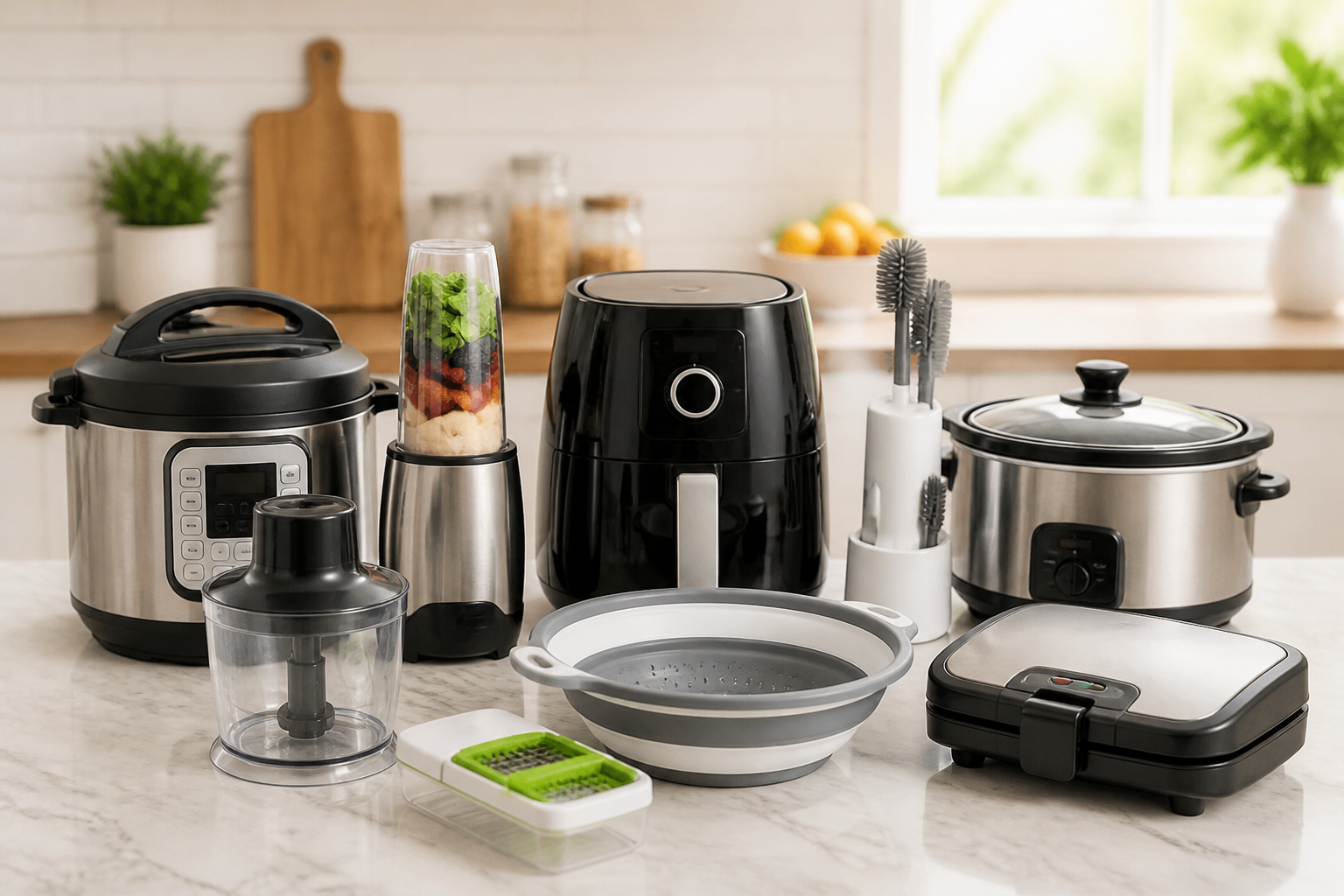
Colanders are essential for draining pasta, rinsing produce, and washing ingredients, but traditional versions can be bulky. Foldable silicone colanders and nesting sets are ideal for small kitchens because they store more easily and often fit in shallow cabinets or tight drawer spaces.
Check that the base is stable and the handles feel secure. If you plan to use the colander often, durability and shape retention matter as much as storage convenience. A good foldable colander should collapse for storage but still feel dependable when filled.
11. Magnetic or vertical knife storage
Knife blocks can take up counter space that a small kitchen may not have to spare. A magnetic knife strip or vertical knife organizer can free up the countertop while keeping knives more accessible. This also reduces the need to dig through crowded drawers for frequently used blades.
When selecting knife storage, make sure the setup is appropriate for your kitchen layout and easy to clean. The goal is to store knives safely and neatly without adding clutter. If a wall-mounted strip is not practical, a compact in-drawer knife tray may be a better fit.
12. Multi-purpose prep bowls and serving containers
Prep bowls that also serve as condiment bowls, snack dishes, or storage containers can reduce the number of items you need. In a small kitchen, this kind of versatility is valuable because it lowers the total amount of equipment you must store.
Look for bowls that nest well, are easy to wash, and have lids if you want to use them for storage. Choosing items that can move from prep to serving to leftovers helps streamline both cooking and cleanup.
How to choose the right accessories for your kitchen layout
The best accessories for small spaces depend on how your kitchen is arranged. A tool that works well in one kitchen may be inconvenient in another if the cabinet depth, wall space, or sink placement is different. Before buying, think about where each accessory will live when not in use and how often you will access it.
Ask yourself the following questions:
- Will this item replace another tool, or will it simply add more clutter?
- Where will I store it, and is that location realistic for daily use?
- Does it fold, stack, nest, or hang in a way that saves space?
- Is it useful enough to justify its footprint?
- Will it match the way I cook, clean, and organize?
For example, someone who cooks simple meals might benefit more from a few high-quality prep tools and stackable storage containers than from specialized gadgets. Someone who bakes regularly might prioritize measuring tools, mixing bowls, and cooling accessories that store compactly. Matching the accessory to your habits is more important than following a generic “must-have” list.
Practical buying considerations
Measure before you buy
One of the most common mistakes in a small kitchen is assuming an accessory will fit. Measure drawer interiors, cabinet shelves, sink width, and counter clearance before making a purchase. Even a well-designed product can become frustrating if it does not fit the space available.
Prefer multi-use over novelty
Novelty gadgets may seem clever, but they are not always the best use of limited storage. In compact kitchens, the most valuable accessories are usually those that handle a real task well and can serve more than one purpose.
Choose simple cleaning routines
Accessories with too many corners, removable parts, or complicated mechanisms may be harder to maintain. In a small kitchen, items that are easy to clean are more likely to stay in use and less likely to become clutter.
Think about visual clutter too
Small kitchens can feel even smaller when crowded with mismatched tools. Coordinated colors, clear containers, and tidy storage systems can make the space feel calmer. While appearance is not the main priority, a more organized look often supports better habits.
Common mistakes to avoid
One common mistake is buying too many single-purpose gadgets. Garlic presses, avocado slicers, egg separators, and other niche tools may be appealing, but they often take up more room than they are worth in a compact kitchen unless you use them constantly.
Another mistake is choosing storage solutions without checking compatibility. A drawer organizer that looks perfect online may not fit your actual drawer dimensions, and a hanging rail may interfere with cabinet doors or backsplash details. Always confirm measurements first.
It is also easy to overlook cleanup. Accessories that are difficult to wash or dry can create friction in a small kitchen, where every item should ideally earn its place through convenience and reliability.
Tips for keeping a small kitchen organized
Even the best accessories only help if the system stays manageable. A few simple habits can make a compact kitchen work much better.
- Group similar items together: Keep prep tools, baking tools, and serving tools in separate zones when possible.
- Use vertical space: Shelves, hooks, and stackable containers help you use height instead of only width.
- Keep the counter clear: Reserve countertop space for the items you use most often.
- Review duplicates regularly: If you have several tools that do the same job, keep the one you use most.
- Choose accessories that are easy to put back: If storage is simple, the kitchen is more likely to stay tidy.
Small kitchens often become more functional when the storage system is easy enough to maintain daily. The best accessories support that habit rather than making organization feel like a separate chore.
Frequently asked questions
What kitchen accessories are most useful in a small apartment?
Some of the most useful options include stackable food containers, collapsible measuring tools, drawer organizers, compact cutting boards, nested bowls, and over-the-sink drying racks. These items help with daily cooking while saving space.
Should I buy multi-purpose tools or separate tools?
In a small kitchen, multi-purpose tools are often the better choice if they perform well and are easy to store. However, if a multi-purpose item is awkward to use or replaces a tool you rely on often, separate tools may be more practical.
How do I avoid clutter when buying kitchen accessories?
Start with the biggest storage problems in your kitchen, such as crowded drawers, limited counter space, or disorganized cabinets. Buy accessories that solve one of those problems directly rather than collecting gadgets you may not use regularly.
Are wall-mounted accessories worth it?
They can be very useful if you have usable wall space and want to free up drawers or counters. Just make sure they fit your layout, are easy to clean, and do not create a crowded or cluttered look.
What should I prioritize first in a small kitchen?
Prioritize accessories that improve storage and daily workflow, such as drawer organizers, stackable containers, and compact prep tools. These usually have the most immediate impact on usability.
Conclusion
Useful kitchen accessories for small spaces should do more than look clever. They should save room, reduce clutter, and make everyday cooking feel smoother. In a compact kitchen, the best choices are often the simplest: stackable containers, nested bowls, foldable tools, compact organizers, and storage solutions that use vertical or hidden space well.
Before buying, measure carefully, think about how often you will use each item, and focus on accessories that match your actual routines. A small kitchen can be highly functional when every accessory has a clear purpose and a practical place to live. With the right buying decisions, even a limited space can feel organized, efficient, and easier to enjoy.