Introduction
Meal preparation can feel slow for many reasons: ingredients need washing, peeling, chopping, measuring, mixing, and storing, and all of that happens before the stove even turns on. The right kitchen tools do not replace cooking skills, but they can remove friction from the process and make everyday meals easier to plan, assemble, and finish. For busy households, students, new cooks, and anyone trying to spend less time in the kitchen, a few well-chosen tools can make a real difference.
This guide focuses on useful kitchen tools for faster meal preparation. It is not about buying every gadget available. Instead, it helps you identify the tools that most directly reduce prep time, improve consistency, and support a smoother cooking routine. The best choices depend on what you cook, how often you cook, how much space you have, and whether you prefer manual tools or electric ones. With that in mind, the sections below explain the most practical categories, what to look for, and how to choose tools that fit your habits.
Why the right prep tools matter
Fast meal preparation is not just about speed for its own sake. It is about making cooking more manageable so that home meals feel realistic on busy days. When basic prep steps become easier, you may be more likely to cook at home, use fresh ingredients efficiently, and keep your kitchen workflow organized.
Useful prep tools can help in several ways:
- They reduce repetitive labor, such as chopping or stirring.
- They improve consistency, which can make cooking more predictable.
- They help you prepare ingredients in advance and store them safely for later use.
- They can make cleanup simpler by cutting down on extra dishes and spills.
That said, not every kitchen needs a drawer full of specialty items. The most practical tools are usually the ones you reach for often and that work well across multiple recipes. A good buying strategy is to focus on versatility, durability, comfort, and ease of cleaning.
Essential kitchen tools that save time
Chef’s knife
A sharp chef’s knife is one of the most important tools for faster meal preparation. It handles a wide range of jobs, including slicing vegetables, chopping herbs, cutting fruit, and trimming meat. A good knife allows for cleaner cuts with less effort, which can speed up prep and improve control.
When buying a chef’s knife, pay attention to balance, handle comfort, and blade length. Many home cooks prefer an 8-inch knife because it offers a useful mix of control and cutting surface. If a knife feels awkward or too heavy, you may use it less often, which defeats the purpose. A knife that is comfortable in your hand is often more valuable than a more expensive model with features you do not need.
Cutting board
A sturdy cutting board supports efficient prep by giving you a stable work surface. Larger boards can reduce the need to stop and move ingredients around, which helps keep the flow going. Many cooks like to keep more than one board on hand for different tasks, such as produce and raw proteins, although the best setup depends on your cooking style and cleaning routine.
Look for a board that stays in place, has enough room for your most common ingredients, and is easy to clean. A board that is too small can slow you down because you keep running out of space. A board that is too large for your counter, however, may feel cumbersome in a smaller kitchen.
Food processor
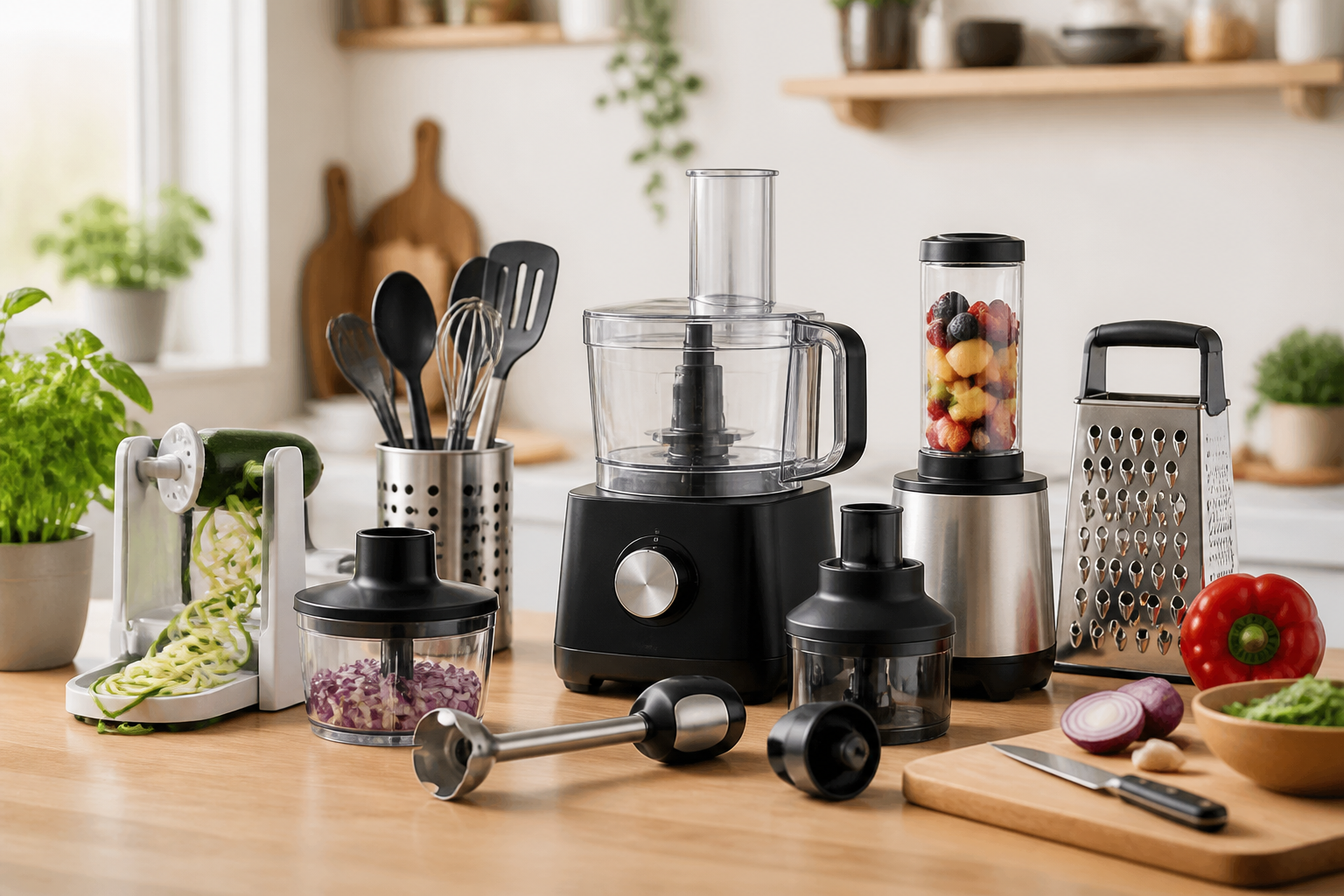
A food processor is one of the strongest time-saving tools for repetitive prep tasks. It can chop vegetables, shred cheese, mix doughs, puree sauces, and blend dips depending on the model and attachments. For people who cook large batches, meal prep for the week, or often make recipes with many chopped ingredients, a food processor can save substantial effort.
Before buying one, consider bowl size, ease of assembly, storage footprint, and how easy the parts are to clean. A machine that is complicated to assemble may not feel faster in practice. If you only cook for one or two people, a smaller model may be more practical than a large one.
Box grater and microplane
Grating cheese, zesting citrus, and finely shaving garlic or spices can take longer than expected when done with the wrong tool. A box grater is useful for bulk grating, while a microplane is ideal for fine work such as citrus zest or hard cheese. These tools are simple, affordable, and very helpful in kitchens where flavor-building ingredients are used often.
When choosing one, consider handle comfort, stability, and how easy it is to clean. A good grater should feel safe and steady during use, since slowing down to manage awkward handling can reduce its value.
Vegetable peeler
A sharp, comfortable peeler can make peeling carrots, potatoes, cucumbers, and other produce much faster. It may seem like a minor tool, but a poor peeler can create frustration and waste time. If you prepare a lot of root vegetables or fruit, a well-made peeler is worth having.
There are different handle shapes and blade styles, so it helps to choose one that feels natural in your hand. A peeler that glides smoothly often saves more time than one with more complicated features.
Kitchen shears
Kitchen shears are surprisingly useful for fast prep because they can cut herbs, trim fat, open packaging, portion pizza, and handle light cutting jobs without needing a cutting board. For some tasks, shears are quicker than a knife and easier to clean up after use.
Buyers should look for sturdy construction, a comfortable grip, and easy disassembly if cleaning is important to them. If you cook frequently, kitchen shears can become one of the most convenient tools in the room.
Tools that help with measuring, mixing, and portioning
Measuring cups and spoons
Accurate measuring tools help speed up cooking by reducing guesswork. They are especially useful when following recipes closely, baking, or preparing sauces and dressings. Good measuring cups and spoons should be easy to read, fit into jars and small containers, and stack neatly for storage.
For faster prep, choose a set that is durable and simple to grab. If your measuring tools are hard to organize or labels wear off quickly, you may waste time searching through drawers.
Mixing bowls
A set of mixing bowls supports faster meal preparation by keeping ingredients organized while you work. Bowls are useful for holding prepped vegetables, combining sauces, tossing salads, mixing batters, and marinating ingredients. Having the right sizes on hand means you can work in stages without creating clutter.
When buying bowls, think about nesting design, material, and ease of cleaning. Lightweight bowls are convenient for everyday use, while heavier bowls may stay put better during mixing. Clear bowls can help you see contents at a glance, which may be useful during prep-heavy cooking.
Kitchen scale
A kitchen scale can improve speed and reduce cleanup when you cook from recipes that use weight measurements. Instead of filling and leveling multiple cups, you can often measure ingredients directly into one bowl. This can be especially helpful for baking, meal prep, and portioning proteins or grains.
Look for a scale with a clear display, easy tare function, and a size that fits your counter and storage space. If you often prepare the same meals, a scale can make repeat cooking more efficient and consistent.
Prep bowls and containers
Small prep bowls and containers help organize ingredients before cooking begins. This approach, sometimes called mise en place, can make cooking feel faster because everything is ready when you need it. Prepped ingredients also reduce the chance of missing steps or losing track of small items like spices or chopped herbs.
Choose containers that nest well, are easy to label if needed, and can move between prep and storage without much hassle. If you meal prep regularly, this category can be just as valuable as the cutting tools themselves.
Electric tools that can speed up repetitive work
Immersion blender
An immersion blender is a practical time-saver for soups, sauces, and smoothies because it lets you blend directly in the pot or cup. That means fewer dishes and less transferring hot liquids. It is also convenient for small batches when a full-size blender feels excessive.
When comparing models, check motor power, attachment options, and how easy the blender is to clean. A comfortable handle matters because you will often hold the tool for several minutes at a time.
Stand mixer
A stand mixer can save time in kitchens that frequently make doughs, batters, whipped mixtures, or other recipes that benefit from extended mixing. It does not replace all manual work, but it reduces the amount of hands-on attention required for certain tasks. For avid bakers or households that prepare large batches, it may be a worthwhile investment.
Consider bowl capacity, available attachments, storage space, and how often you will actually use it. A stand mixer is most helpful when the recipes in your routine align with its strengths.
Electric hand mixer
A hand mixer is a compact alternative to a stand mixer and can speed up common tasks such as whipping cream, mixing cake batter, or blending fillings. It usually takes up less space and is easier to store, making it a practical choice for smaller kitchens.
If you want faster mixing without committing to a larger appliance, a hand mixer may be the better fit. Look for comfortable weight, multiple speed settings, and beaters that are easy to remove and wash.
Storage and organization tools that support speed
Ingredient bins and pantry containers
Fast meal prep often starts before cooking begins. If ingredients are easy to find, you can start sooner and avoid interrupting your workflow. Clear pantry containers, ingredient bins, and labeled storage can help keep dry goods visible and accessible.
Choose storage that matches the foods you buy most often. Stackable, uniform containers can save space and reduce clutter, but only if they suit your pantry shelves and cabinet height. The goal is not to create a perfectly styled pantry; it is to make ingredients easy to access quickly.
Meal prep containers
Meal prep containers help you portion cooked food, store chopped produce, and organize leftovers. They are useful for people who batch cook or prepare lunches in advance. Good containers should seal well, stack efficiently, and be easy to clean.
If you prepare meals for the week, a consistent container system can reduce the time spent searching for lids and re-packing leftovers. That small improvement adds up over time.
Drawer organizers
Cutting tools, measuring tools, and small accessories are only fast to use if you can find them quickly. Drawer organizers help keep common tools in predictable places, which reduces clutter and saves time during busy cooking sessions.
Before buying organizers, measure your drawers and think about which tools you use most often. An organizer that looks good but does not fit your actual tools may create more frustration than benefit.
How to choose the right tools for your kitchen
Start with your cooking habits
The best kitchen tools depend on what you cook most often. If you make soups, a blender or immersion blender may be more useful than specialty slicing tools. If you chop a lot of vegetables, a chef’s knife, cutting board, and peeler may matter most. If you bake regularly, measuring tools and a mixer may be the biggest time-savers.
It helps to think about the steps that slow you down. Do you spend the most time chopping, mixing, cleaning, or organizing? Buy tools that target your bottlenecks first.
Think about comfort and ease of use
A tool only saves time if you enjoy using it enough to keep it out and ready. Comfort matters, especially for knives, peelers, shears, and mixers. Handles, weight, grip, and stability all affect whether a tool feels efficient in real use.
If possible, look for tools with simple operation and straightforward cleaning. Easy maintenance often matters more than extra features.
Consider storage space
Large tools can slow you down if they are difficult to store or retrieve. Before buying, consider where the item will live in your kitchen. Countertop appliances should earn their space by being used regularly. Smaller tools should fit neatly in drawers or shelves you can reach without effort.
In smaller kitchens especially, compact and multi-purpose tools are often the best choice.
Common buying mistakes to avoid
- Buying too many specialized gadgets that only solve one narrow problem.
- Choosing tools based on trends instead of actual cooking habits.
- Ignoring storage space and countertop size.
- Prioritizing appearance over comfort and ease of cleaning.
- Buying large appliances for tasks that happen only occasionally.
- Forgetting that sharp, well-maintained basic tools often outperform cheaper alternatives that dull quickly.
A useful rule is to buy one tool at a time and let it prove its value in your routine before adding another. That approach helps you build a kitchen setup that is practical instead of crowded.
Practical tips for faster meal preparation
- Keep frequently used tools in the same place so you can grab them without thinking.
- Prep ingredients before heating the pan to avoid rushing during cooking.
- Use bowls or containers to group ingredients by recipe or meal.
- Clean as you go when possible so that end-of-meal cleanup does not feel overwhelming.
- Maintain sharp blades and clean tools so they continue to work efficiently.
- Choose multi-purpose tools where possible to reduce clutter and decision fatigue.
Small workflow changes can be as important as the tools themselves. A well-organized space with a few dependable essentials often performs better than a crowded kitchen full of rarely used gadgets.
Frequently Asked Questions
What kitchen tool saves the most time overall?
There is no single answer for every home, but a sharp chef’s knife and a sturdy cutting board usually make a major difference because they affect many common prep tasks. For some cooks, a food processor or immersion blender may save even more time if they frequently handle chopped vegetables, sauces, or purees.
Do I need expensive tools to prepare meals faster?
Not necessarily. Many efficient kitchen tools are simple and reasonably priced. What matters most is whether the tool fits your cooking style, feels comfortable to use, and is easy to clean and store.
Should I buy electric or manual tools?
Manual tools are often better for small kitchens, quick tasks, and simple routines. Electric tools can be more helpful if you cook in larger batches or do repetitive prep work often. The right choice depends on how much time the task takes and how frequently you do it.
How many kitchen prep tools do I really need?
Most people need fewer tools than they think. A practical starter set might include a chef’s knife, cutting board, peeler, kitchen shears, measuring tools, mixing bowls, and one or two storage solutions. Add specialty items only when they clearly match your cooking habits.
Conclusion
Useful kitchen tools for faster meal preparation are the ones that remove the most common barriers to cooking. A sharp knife, reliable cutting board, good measuring tools, simple storage solutions, and a few time-saving appliances can make prep more efficient without making your kitchen feel crowded. The smartest purchases are not always the most advanced ones; they are the tools that fit your routine, your space, and the foods you actually cook.
If you want to speed up meal preparation, start with the tasks that slow you down most. Build around those needs with versatile, comfortable, easy-to-maintain tools. Over time, a thoughtful setup can make cooking feel smoother, quicker, and far more manageable.